Claude (MCP Server)

Park Graph runs a hosted Model Context Protocol (MCP) server at https://parkgraph.com/api/mcp. It works in Claude (web, desktop, mobile, Claude Code) and any MCP client. There is nothing to install: point Claude or any MCP client at the URL. No key is needed. 9 tools, over Streamable HTTP (JSON-RPC 2.0).

Server v2.4.0 · Recommended Claude model: claude-sonnet-4-5-20250929 · Last updated November 8, 2026

Listed in the Claude directory: Park Graph in Claude.

Every payment completes on parkgraph.com with the driver present; no tool charges money on its own.

Quick Start

Connect in one step

Add https://parkgraph.com/api/mcp as a remote MCP server. No install, no key.

Add the server to your client's MCP config (Claude Desktop, Cursor, Windsurf, VS Code and others use this shape). In Claude, you can instead add a custom connector with the URL.

MCP client configjson
{
  "mcpServers": {
    "parkgraph": {
      "url": "https://parkgraph.com/api/mcp"
    }
  }
}

/mcp is an alias of /api/mcp; both answer the same way.

Add Park Graph to your assistant

The 7 public tools need no sign-in or API key; my_sessions and my_vehicles ask the driver to sign in. ChatGPT uses its own Park Graph server; every other client uses https://parkgraph.com/api/mcp.

ChatGPT

  1. Open chatgpt.com/plugins, select the plus button, then Add custom MCP server.
  2. Name it Park Graph and enter the server URL: https://parkgraph.com/api/mcp/chatgpt
  3. Leave authentication off, tick “I understand and want to continue”, then create the plugin.
  4. In a chat, type @ and pick Park Graph.

On Business, Enterprise and Edu workspaces, an admin or owner adds it first.
Claude

  1. Open claude.ai/customize/connectors, select + Add, then Add custom connector.
  2. Name it Park Graph, enter the URL https://parkgraph.com/api/mcp and select Continue.
  3. Choose Sign in now for authentication and Register automatically for the OAuth client, select Add, then Connect and sign in to Park Graph.
  4. In a chat, open + (lower left) → Connectors and turn Park Graph on.
Claude Codebash
claude mcp add --transport http parkgraph https://parkgraph.com/api/mcp

To use my_sessions and my_vehicles, run claude mcp login parkgraph in your shell and sign in to Park Graph in your browser.

On Team and Enterprise, an owner adds it under Organization settings → Connectors, then members select Connect.

Gemini

  1. In Gemini CLI, run the command below.
  2. In Antigravity CLI, add Park Graph to ~/.gemini/config/mcp_config.json instead.
  3. Run /mcp to check that Park Graph is connected.
Gemini CLIbash
gemini mcp add --transport http --scope user parkgraph https://parkgraph.com/api/mcp
~/.gemini/config/mcp_config.jsonjson
{
  "mcpServers": {
    "parkgraph": {
      "serverUrl": "https://parkgraph.com/api/mcp"
    }
  }
}

Grok

  1. Open grok.com/connectors and select New Connector, then Custom.
  2. Enter the MCP server URL: https://parkgraph.com/api/mcp
  3. Then ask Grok to find parking.

On Business and Enterprise, an admin adds it first.

Copilot

  1. In Copilot Studio, open your agent, go to Tools and select Add a tool → Model Context Protocol.
  2. Name it Park Graph, enter the server URL https://parkgraph.com/api/mcp and choose no authentication.
  3. Select Add, review the tools, then Save.

GitHub Copilot in VS Code uses the VS Code steps.

Cursor

  1. Add Park Graph to ~/.cursor/mcp.json (every project) or .cursor/mcp.json (one project).
  2. Save the file and restart Cursor.
~/.cursor/mcp.jsonjson
{
  "mcpServers": {
    "parkgraph": {
      "url": "https://parkgraph.com/api/mcp"
    }
  }
}

VS Code

  1. Open the Command Palette and run MCP: Add Server.
  2. Choose HTTP, enter https://parkgraph.com/api/mcp and name it parkgraph.
  3. Choose Global, then trust the server when VS Code asks.

Store kit

The 60-second walkthrough, recorded in MCP Inspector against the live server with no key.

  • No key: connect to https://parkgraph.com/api/mcp and ask. No account, sign-in or API key for seven of the nine tools.
  • Test near downtown Redmond, WA (47.674, -122.122), where 16300 Redmond Way is. Don't pay on its pay page: it is a real customer's lot.
  • The sample phone code Q7M4RX with plate 4FD returns SESSION_NOT_FOUND.

What is MCP?

The Model Context Protocol is Anthropic's open standard for connecting AI models to external data sources and tools. Claude Desktop users can add Park Graph as an MCP server to search, book, and manage parking directly from their conversations.

Programmatic Usage

curl https://parkgraph.com/api/v1/lots/search \
  -G -d "lat=39.6403" -d "lng=-106.3742" -d "radius_km=5"

Authentication

Every tool works without a key. No client config on this page needs one.

Drivers check their own session with what's on the receipt: get_session and extend_session take the 6-character phone code from the driver's receipt or pass (phone_code) and the last 3 characters of the plate (plate_last3). extend_session answers with the price and a pay link to the driver's session page, and the time is added once the driver pays there.

Sign-in is optional, and only for my_sessions and my_vehicles: they are for a driver signed in to Park Graph (OAuth 2.1 with PKCE). Called without sign-in they return a SIGN_IN_REQUIRED error with the sign-in page, parkgraph.com/account; in a client connected with sign-in, they work once the driver signs in.

Available Tools

search_lotsWorks without a key; more with one

Finds parking near where the driver is going: place is a U.S. address, venue, landmark or city ("Coors Field, Denver"), or send lat and lng. Nearest first, with spaces left and the current price. vehicle narrows the list to lots that take a car, truck, tractor-trailer or RV, with truck rates where a lot sets them. No API key needed. Results include bookable Park Graph lots (lots; each id is the lot_id that get_lot, the quote tool and reserve take) plus public directory lots (unlisted_lots, with a page_url; not bookable). The top-level summary is a one-line, plain-language answer. An empty lots list means no bookable Park Graph lot near there. Every payment completes on parkgraph.com with the driver present; no tool charges money on its own.

get_lotNo key needed

Everything a driver needs about one lot: address, map point, spaces, features, hours, prices and spaces left right now. Takes the lot_id from search_lots. No API key needed. Every payment completes on parkgraph.com with the driver present; no tool charges money on its own.

quoteNo key needed

What parking at a lot costs for a number of hours, at the lot's current price (daily max applied). No API key needed. booking.mode in the result is the next step: reserve (the reserve tool holds a space) or pay_at_qr_page (booking.pay_url is the lot's pay page, where the driver pays and parks). Every payment completes on parkgraph.com with the driver present; no tool charges money on its own.

reserveWorks without a key; more with one

Holds space at a lot for the driver for a few minutes and returns booking_url, the lot's pay page on parkgraph.com (opened on duration_hours when it is sent). No API key needed. A hold takes a real space until it expires or the driver pays. Lots that take payment at their QR page place no hold: the result is status pay_at_qr_page with a pay_url, the lot's pay page. Every payment completes on parkgraph.com with the driver present; no tool charges money on its own.

get_sessionWorks without a key; more with one

Looks up the driver's parking: lot, status, start and end times, rate, amount so far and extensions, with a link to the driver's session page. No API key needed. Requires phone_code (the 6-character code on the driver's receipt or pass) and plate_last3 (the last 3 characters of the plate), or session_id with session_code. Any mismatch returns the same answer, SESSION_NOT_FOUND. Every payment completes on parkgraph.com with the driver present; no tool charges money on its own.

extend_sessionWorks without a key; more with one

Adds time to the driver's active hourly parking, once the driver pays for it. No API key needed. Requires phone_code (the 6-character code on the driver's receipt or pass), plate_last3 (the last 3 characters of the plate) and extend_hours (0.5 to 8, in half-hour steps); session_id with session_code works in place of the two codes. Returns the price, the new end time once paid and a pay_url to the driver's session page, where the driver pays. Nothing is charged and the end time doesn't move until the driver pays there. Any mismatch returns the same answer, SESSION_NOT_FOUND. Every payment completes on parkgraph.com with the driver present; no tool charges money on its own.

search_eventsWorks without a key; more with one

Finds dated events (games, concerts, shows) at the venues in Park Graph's event network, each with its parking: q is the question in plain words ("Knicks game Friday", "Taylor Swift MetLife Nov 14"), with optional date or from and to, venue, and lat and lng. Dates in q (today, tomorrow, Friday, this weekend, Nov 14, 2026-11-14) are read in the venue's time zone. Each event lists bookable Park Graph lots within a mile (lots; each lot_id works with get_lot, the quote tool and reserve; event_price where the lot set one), lots nearby that take parking requests (request_lots, each with a request_url, where a driver leaves an email; not bookable) and the event's page (event_url). partner adds a partner key to every link. No API key needed. The top-level summary is a one-line, plain-language answer; an empty events list means no upcoming event matched. Every payment completes on parkgraph.com with the driver present; no tool charges money on its own.

my_sessionsDriver sign-in required

The signed-in driver's own parking: recent sessions (newest first), spaces held through this connector, and monthly passes, each with a link to its page on parkgraph.com. Requires driver sign-in to Park Graph through this connector; without sign-in the call returns SIGN_IN_REQUIRED with the sign-in page. Sessions are matched by the driver's verified sign-in email (the email on their receipts). get_session checks one session without sign-in, by phone code. Every payment completes on parkgraph.com with the driver present; no tool charges money on its own.

my_vehiclesDriver sign-in required

The signed-in driver's saved vehicles (up to 5 plates, each with an optional label) and plates from their past parking that aren't saved yet. action list (the default) only reads; save adds a plate or sets its label, rename changes a label, remove deletes a saved plate. Saving or removing the same plate twice changes nothing. A saved plate works as reserve's plate. Requires driver sign-in to Park Graph through this connector; without sign-in the call returns SIGN_IN_REQUIRED with the sign-in page. Every payment completes on parkgraph.com with the driver present; no tool charges money on its own.

Every tool returns JSON, as structuredContent and as a text block.

Example prompts

Three things to ask for each tool. The assistant picks the tool; you just ask.

search_lots

  • “Find parking near Union Station in Denver.”
  • “Is there a lot with spaces left within a kilometer of Lionshead Village in Vail?”
  • “Show me the three closest parking lots to the Eagle County airport.”

get_lot

  • “What are the hours at the first lot you found?”
  • “Does that lot have EV charging, and how many spaces are left right now?”
  • “What's the full address of that lot?”

quote

  • “How much is 3 hours at that lot?”
  • “What would a full day cost there?”
  • “Compare 2 hours at the two closest lots.”

reserve

  • “Hold a space there for 2 hours. My plate is ABC123.”
  • “Book 4 hours at the closest lot and send me the link to pay.”
  • “Hold 2 spaces at that lot for tonight.”

get_session

  • “Check my parking. My receipt code is 4F7K2Q and my plate ends in 4XZ.”
  • “When does my parking end? Code 4F7K2Q, plate ending 4XZ.”
  • “How much has my parking session cost so far?”

extend_session

  • “Add an hour to my parking. Code 4F7K2Q, plate ending 4XZ.”
  • “Extend my session by 30 minutes and send me the pay link.”
  • “How much would 2 more hours cost on my current session?”

search_events

  • “Find parking for the Knicks game at Madison Square Garden on Friday.”
  • “Is there a lot I can book near MetLife Stadium for Sunday's game?”
  • “What's on at Prudential Center this weekend, and where can I park?”

my_sessions

  • “Where did I park last week?”
  • “Am I parked anywhere right now, and when does it end?”
  • “Show me my monthly passes and when they renew.”

my_vehicles

  • “Which plates do I have saved?”
  • “Save my plate ABC123 as Work truck.”
  • “Hold a space at the closest lot for my work truck.”

Resources

parkgraph://docs/overview

Platform overview, API capabilities, and integration documentation

Lots on the Starter plan

Lots on the free Starter plan are listed and quotable, but they don't take agent bookings. For those lots, reserve returns the lot's QR pay page instead of a hold, and quote says so up front. Hand the link to the driver.

reserve result for a Starter lotjson
{
  "status": "pay_at_qr_page",
  "lot_id": "5c2f7d1e-8a43-4b9e-b0d6-3e71a9c4f2b8",
  "pay_url": "https://parkgraph.com/p/AB12CD",
  "message": "This lot takes payment at its QR page. Send the driver there to park."
}

Calling the server directly

The endpoint takes JSON-RPC 2.0 over POST and answers with JSON. The server is stateless, so there is no session header to keep.

curl -X POST https://parkgraph.com/api/mcp \
  -H "Content-Type: application/json" \
  -H "Accept: application/json, text/event-stream" \
  -d '{"jsonrpc":"2.0","id":1,"method":"initialize","params":{"protocolVersion":"2025-06-18","capabilities":{},"clientInfo":{"name":"curl","version":"1"}}}'

Tool Schema

search_lots schemajson
{
  "name": "search_lots",
  "description": "Finds parking near where the driver is going: place is a U.S. address, venue, landmark or city (\"Coors Field, Denver\"), or send lat and lng. Nearest first, with spaces left and the current price. vehicle narrows the list to lots that take a car, truck, tractor-trailer or RV, with truck rates where a lot sets them. No API key needed. Results include bookable Park Graph lots (lots; each id is the lot_id that get_lot, the quote tool and reserve take) plus public directory lots (unlisted_lots, with a page_url; not bookable). The top-level summary is a one-line, plain-language answer. An empty lots list means no bookable Park Graph lot near there. Every payment completes on parkgraph.com with the driver present; no tool charges money on its own.",
  "inputSchema": {
    "type": "object",
    "properties": {
      "place": {
        "type": "string",
        "minLength": 2,
        "maxLength": 200,
        "description": "Where the driver is going: a U.S. address, venue, landmark or city (\"Coors Field, Denver\", \"JFK Terminal 4\"). Sent in place of lat and lng."
      },
      "lat": {
        "type": "number",
        "minimum": -90,
        "maximum": 90,
        "description": "Latitude of the driver's destination, sent with lng"
      },
      "lng": {
        "type": "number",
        "minimum": -180,
        "maximum": 180,
        "description": "Longitude of the driver's destination, sent with lat"
      },
      "latitude": {
        "type": "number",
        "minimum": -90,
        "maximum": 90,
        "description": "Same as lat"
      },
      "longitude": {
        "type": "number",
        "minimum": -180,
        "maximum": 180,
        "description": "Same as lng"
      },
      "radius_km": {
        "type": "number",
        "minimum": 0.1,
        "maximum": 100,
        "default": 5,
        "description": "Search radius around that point, in km"
      },
      "limit": {
        "type": "integer",
        "minimum": 1,
        "maximum": 50,
        "default": 10,
        "description": "Maximum number of lots returned"
      },
      "vehicle": {
        "type": "string",
        "enum": [
          "car",
          "truck",
          "tractor_trailer",
          "rv"
        ],
        "description": "Only lots that take this vehicle. truck covers box trucks, trailers and tractor-trailers; rv means lots with oversized spaces."
      }
    },
    "additionalProperties": false
  }
}

Example Conversation

Claude
User:Find parking near the stadium for 3 hours
Claude:I found two lots within 1 km. The closest is $4/hr, so 3 hours comes to $12. Want me to reserve it?
User:Yes, please.
Claude:This lot takes payment at its own page, so here's the link to park and pay: parkgraph.com/p/…

Try It

search_lots answers from Park Graph's lot search. Run the same search here, with no key:

Try itThe lot search behind search_lots

Limitations

  • Requires Claude Desktop or an MCP-compatible client
  • JSON responses only: every answer comes back on its own POST. A GET asking for an event stream gets an idle stream that sends no notifications and closes after 4 minutes
  • 60 tool calls a minute per caller: each MCP session (the Mcp-Session-Id that initialize returns), signed-in driver, ChatGPT conversation or API key. A client that sends none of these is counted by its IP. AI platforms that route many users through shared addresses (Claude, ChatGPT) get a higher shared limit. One address can send up to 600 tool calls a minute in all, as much as a whole AI platform. A 429 asks you to wait at most 60 seconds (Retry-After).
  • Real-time availability may vary by lot refresh interval
  • Starter-plan lots return a QR pay link instead of a hold

Support, privacy and terms

Questions or problems with the MCP server: email support@parkgraph.com.

Read the Privacy Policy and the Developer and AI Agent Terms. Using the server accepts the Developer and AI Agent Terms for you and for every person you act for.

Security model

The Park Graph MCP server sits behind the same security perimeter as the dashboard and the public website. The notes below summarise the controls that apply to every MCP server request; a deeper write-up lives in the developer changelog.

No tool on the hosted MCP server needs an API key. The key notes below are for the REST API.

  • Authentication

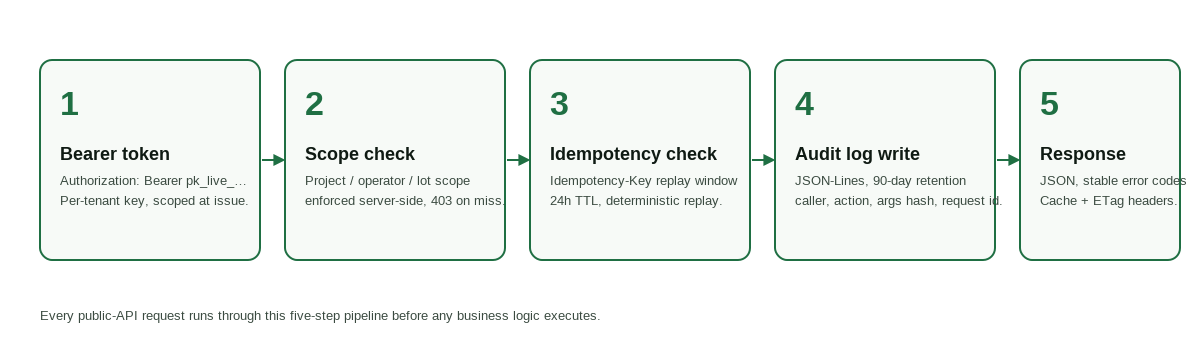
    Every authenticated request carries an API key in the Authorization header (`Bearer pk_live_…`). Keys are issued per project from /dashboard/api-keys. Rotation is an HTTP DELETE + re-create in the dashboard; old keys are revoked immediately. Live and sandbox keys use the `pk_live_` and `pk_test_` prefixes so they cannot be confused in code review.

  • Transport security

    TLS 1.3 with HSTS preloaded on every host (parkgraph.com, *.parkgraph.com). Plaintext requests are rejected at the edge with HTTP 426. Certificates are issued through the public Let's Encrypt CA and pinned in the CT logs.

  • Payment handling

    Card data is tokenised inside Stripe Elements on the driver's device — Park Graph never observes raw PANs and is therefore SAQ-A scope. Sessions reference Stripe PaymentIntents by id only; webhooks are signed by Stripe using HMAC-SHA256 and verified server-side before any state change.

  • Data retention

    Driver email addresses and license plates are retained for the lifetime of the operator's relationship with Park Graph (or 30 days after a verified delete request, whichever comes first). Search-only requests with no booking outcome are anonymised after 24 hours. Aggregated occupancy data has no personal identifiers and is retained indefinitely.

  • Audit trail

    Every write — session create, end, extend, refund, rate change, agent registration — appends an immutable row to the audit_log table with actor type, actor id, and the diff. The log is exposed to operators through the dashboard activity feed and via a per-lot CSV export. Deletes are tombstoned, not hard-removed.

Rate limits

A request that sends an API key is counted by its key; a request without one, by its IP. Limits count fixed one-minute windows, and the daily quota counts the UTC day. Every response carries X-RateLimit-Limit, X-RateLimit-Remaining, and X-RateLimit-Reset headers; 429 responses additionally carry Retry-After. Retry-After is never more than 60 seconds, and the error message says how long to wait. Bursts above the per-minute budget should be backed off with jitter — the official SDK does this automatically.

The hosted MCP server, which needs no key, allows 60 tool calls a minute per caller: each MCP session (Mcp-Session-Id), signed-in driver, ChatGPT conversation or API key. One address can send up to 600 a minute in all, so assistants that share addresses don't slow each other's users down. The table below is for the REST API.

ScopeBudgetWindow
Lot search without a key (`/lots/search`)60 requestsper IP per minute
Other public reads without a key (lot detail, availability, GeoJSON, QR)100 requestsper IP per minute, each endpoint
Other public reads sent with an API key100 requestsper API key per minute, each endpoint
Requests with an API key (Starter and Pro)60 requestsper API key per minute
Requests with an API key (Enterprise)120 requestsper API key per minute
Daily quota for every API key10,000 requestsper API key per UTC day
Sandbox endpoints (`pk_test_…` keys)30 requestsper key per minute

Need a higher ceiling? Email developers@parkgraph.com with your projected throughput and we will lift the burst budget on a per-key basis.

Error codes

Every error response uses the same envelope: { "error": { "code": "…", "message": "…", "request_id": "req_…" } }. The HTTP status indicates the broad class; the code field disambiguates within a class. Surface the request_id to your support team — we can look up the full server-side trace by id alone.

CodeHTTP statusMeaning
BAD_REQUEST400Required parameter missing or out of range. Response body lists the offending field.
UNAUTHORIZED401Missing or malformed Authorization header. Send `Authorization: Bearer pk_live_…`.
FORBIDDEN403API key is valid but the plan does not include this scope (e.g. agent or intelligence endpoints on Starter).
NOT_FOUND404Lot, session, or webhook id does not exist or has been deleted.
CONFLICT409Idempotent retry of a non-terminal session, or attempt to end an already-completed session.
RATE_LIMITED429A rate limit was reached (per API key, or per IP without one). Inspect `Retry-After` and back off.
PAYLOAD_TOO_LARGE413Webhook delivery body or batch upload exceeds 1 MB.
INTERNAL500Unexpected server error. Park Graph automatically opens an incident and retries idempotent writes.
BAD_GATEWAY502Upstream payment processor returned an error. Safe to retry with the same idempotency key.

AI-agent use cases

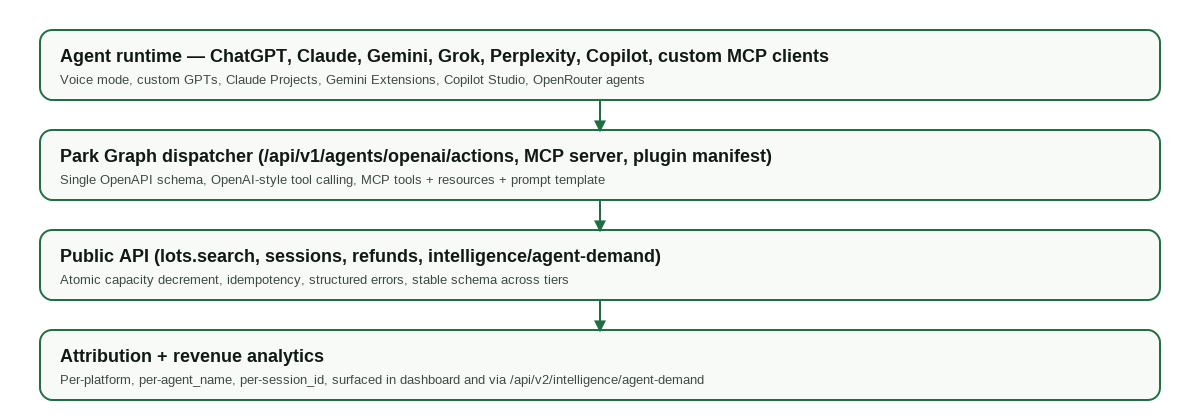
Park Graph is built for agentic distribution: every commercial endpoint (search, availability, rates, sessions, refunds) is callable by an LLM through MCP, OpenAI Actions, Gemini function declarations, xAI function calling, Perplexity Agent API, or Microsoft Copilot plugins. The grid below maps the most common agent-driven workflows on top of the MCP server.

On the hosted MCP server, which needs no key, an assistant can search lots, read rates, quote a stay and hold a space, and the driver pays on parkgraph.com. Starting sessions and refunds through the REST API take an operator's API key.

Conversational booking

An end user asks ChatGPT, Claude, Gemini, Grok, or Perplexity to find parking near a destination. The model calls /lots/search, summarises 3-5 lots with prices and walking distance, then on confirmation calls /sessions to start a session and returns the QR-coded receipt URL.

Travel-app companion

A flight-booking or hotel-booking assistant pre-fetches arrival-airport parking for the trip dates and displays inline lot suggestions inside its itinerary view. The same surface backs in-app booking and a fallback web checkout.

Voice-first ordering

Realtime voice assistants (e.g. gpt-realtime, Gemini Live, Grok Voice) confirm a lot, plate, and duration verbally, then call /sessions and read back the session code. Drivers never touch a screen until they walk away from the car.

Fleet dispatcher

An autonomous-vehicle fleet (rideshare, delivery, robotaxi) holds AV-fleet allocations with /av-fleet/dispatch, then commits the spot at handoff. See /developers/av-fleet for the AV-specific contract.

Procurement / expense agent

An accounts-payable agent reconciles staff parking against company-card statements by querying /sessions/search by plate, then files reimbursements through the agent's own ledger.

City planning analytics

A research agent queries /api/v2/intelligence/market-rate and /api/v2/intelligence/agent-demand for an address corridor, then drafts a report on rate elasticity and AI-agent traffic.

Architecture

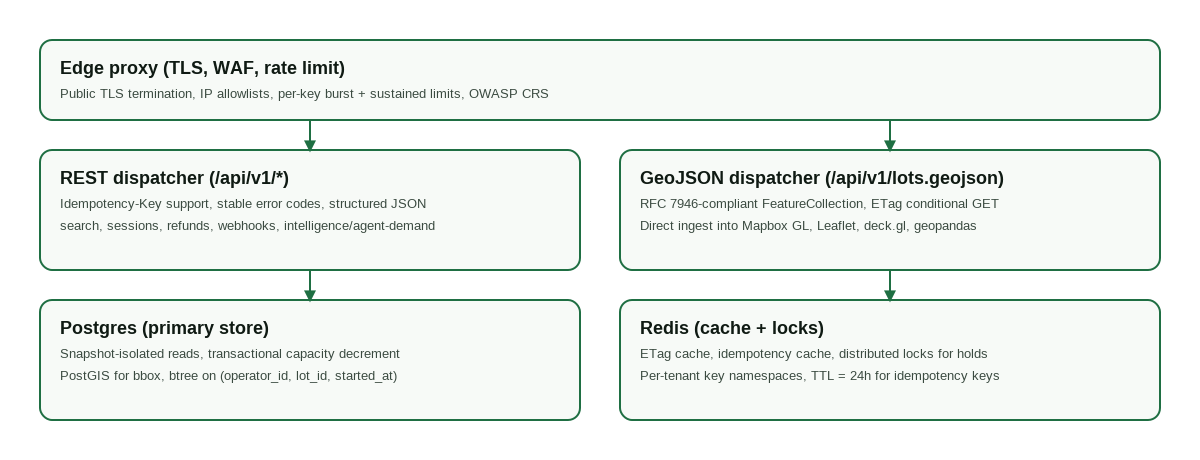
Every Park Graph request — whether it arrives from the MCP server, the dashboard, the QR-driven mobile checkout, or an agent — runs through the same Next.js Edge front door, hits the same Postgres-backed core, and shares the same audit log and webhook fan-out. There is no divergent code path between "agent traffic" and "human traffic": anything an agent can do, a human can do, and vice versa.

Park Graph MCP server request architecture: edge proxy, REST and GeoJSON dispatchers, Postgres primary store, Redis cache and locks
MCP server request architecture — edge proxy, REST + GeoJSON dispatchers, Postgres primary store, Redis cache and distributed locks. Identical perimeter for human, agent, and webhook traffic.
Park Graph MCP server authentication and rate-limit pipeline — bearer token, scope check, idempotency, audit log, response
Five-step MCP server request pipeline that runs before any business logic — bearer auth, scope check, idempotency replay window, audit log write, structured response.
Park Graph AI agent integration stack: agent runtimes, dispatcher, public API, attribution analytics
The AI integration stack that sits on top of the public API — agent runtimes (ChatGPT, Claude, Gemini, Grok, Perplexity, Copilot, custom MCP), dispatcher, public API, and attribution analytics.
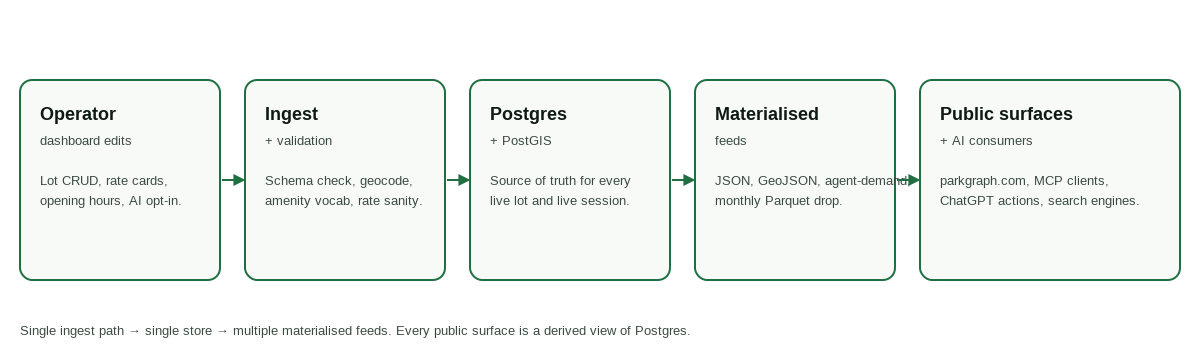
Park Graph data pipeline: operator dashboard edits flow through ingest validation into Postgres and out to materialised feeds and public surfaces
The data pipeline behind every Park Graph public surface — single ingest path, single source of truth in Postgres, multiple materialised feeds for AI consumers, search engines, and the public site.

Sandbox & getting help

Every operator gets a sandbox key prefixed with pk_test_. Sandbox traffic uses Stripe test mode, synthetic lots, and never charges a real card. Spin one up at /developers/sandbox, then point your client at https://parkgraph.com/api/v1 exactly as you would in production.

For integration help, reach the developer team at developers@parkgraph.com or open an issue on the public GitHub org. Status and incident history live at /developers/changelog; subscribe to the JSON feed for machine-readable updates.

MCP Server for Parking — Claude & AI Agents | Park Graph