Compare
How Park Graph stacks up
Honest, side-by-side comparisons against every major parking platform — pricing, features, AI integrations, and more.
Marketplace
Management Software
Data & Navigation
Valet Software
Management Service
How to compare parking platforms
Parking software is not a single product category — it is a stack of decisions about hardware, payments, pricing, data ownership, and increasingly, AI discoverability. Two platforms can both call themselves "parking management software" and yet differ so fundamentally that comparing them on a feature checklist alone is misleading. The comparisons linked above go line by line, but the framework below is the lens we use to evaluate every alternative, including ourselves.
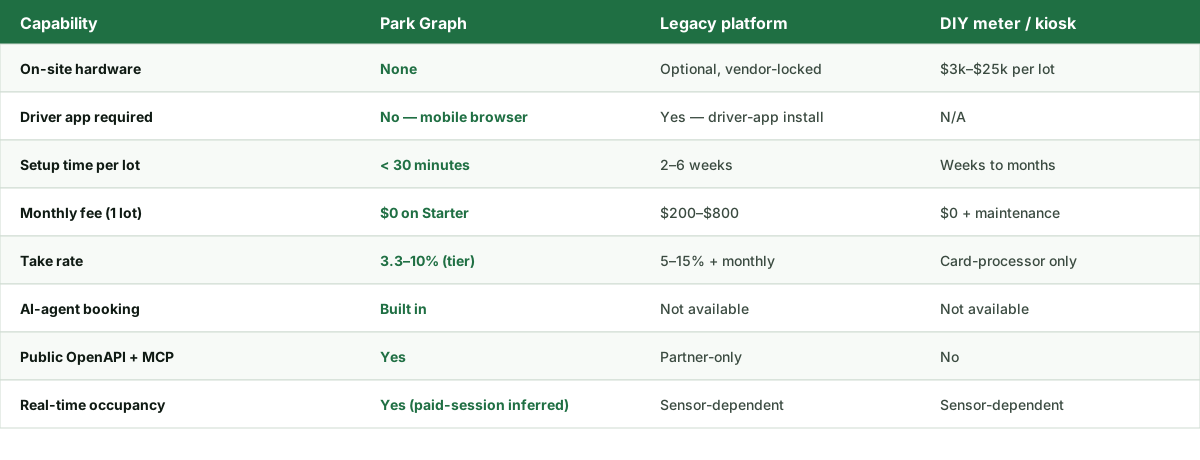
The single biggest fork is hardware versus hardware-free. Gate-and-kiosk platforms like SKIDATA and Flowbird require barrier arms, pay stations, sensors, and the cabling and maintenance contracts that come with them. That hardware sets a floor on both the upfront cost and the installation timeline — typically weeks to months and tens of thousands of dollars per lot. Park Graph is hardware-free: a printed QR code is the only physical artifact, so a lot can go live in minutes and a damaged sign is a five-dollar reprint rather than a service call.
Pricing model and payout handling
The second dimension is the pricing model. Many incumbents stack a fixed monthly platform fee on top of a percentage take rate, and some add per-space or per-device charges that scale with the size of the lot rather than the revenue it produces. When you compare platforms, normalize everything to the effective percentage of gross collections the operator keeps after every fee. A low headline take rate paired with a high monthly minimum can be worse for a small lot than a slightly higher take rate with no fixed fee at all.
Closely related is payout handling. Some platforms hold funds and remit on their own schedule, which affects operator cash flow and reconciliation. Park Graph processes payments through Stripe Connect, so funds settle directly to the operator's connected Stripe account on Stripe's standard payout schedule, and every session row reconciles to a payment record. When you evaluate an alternative, ask who holds the money, how quickly it lands, and whether each transaction can be tied back to a session without manual spreadsheet work.
Driver experience is the third axis. App-first platforms such as ParkMobile and SpotHero require drivers to download an app and create an account before they can pay, which introduces an adoption ceiling and a steady stream of abandoned payments. A browser-based QR flow asks the driver only to scan and pay, with no install and no account. The difference shows up directly in payment completion rates and in the volume of driver support requests an operator has to field.
AI-agent discoverability and data ownership
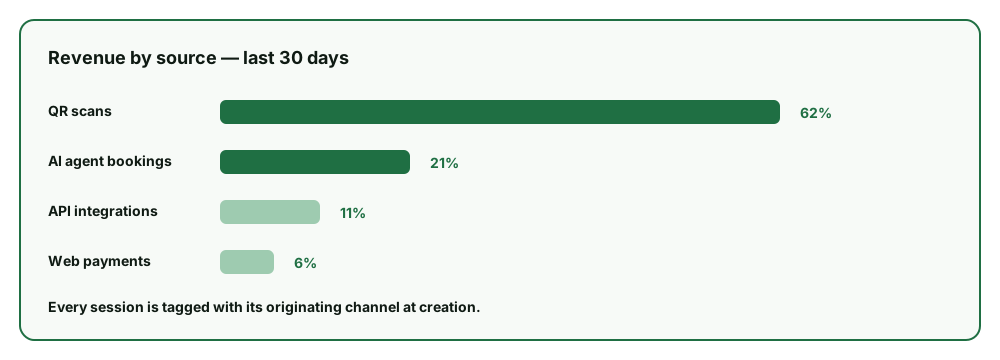
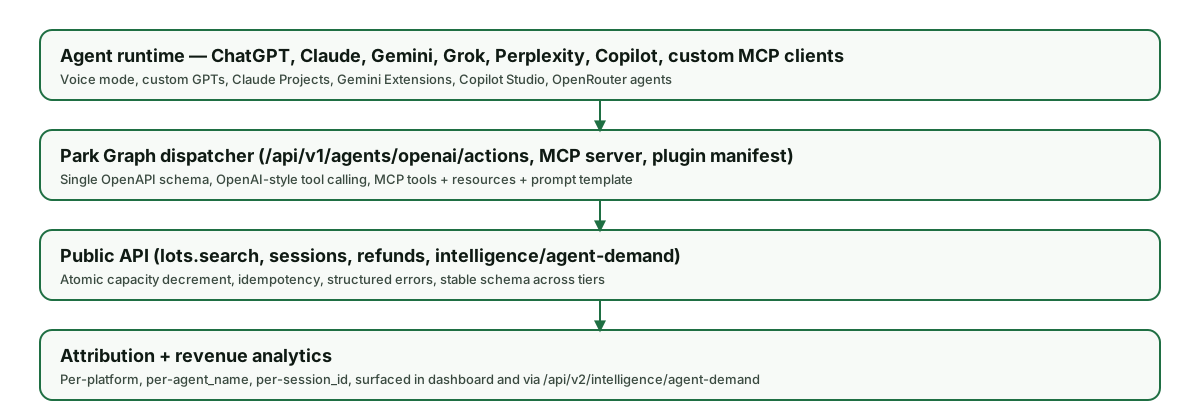
The newest — and most overlooked — dimension is AI-agent discoverability. Drivers increasingly ask ChatGPT, Perplexity, Gemini, Grok, and Microsoft Copilot to find and book parking for them. A platform that exposes lot inventory, rates, and availability through a public API, an MCP server, and ChatGPT Actions lets those agents surface and reserve an operator's spaces; a platform that locks its data behind certified-partner agreements does not. This is built into every Park Graph plan and absent from most legacy platforms, so it is worth checking explicitly rather than assuming parity.
Finally, weigh data ownership and portability. Many incumbents gate revenue and occupancy data behind quarterly reports and partner integrations, which makes it hard to analyze performance or migrate later. The right question is whether you can pull your full operational history — sessions, refunds, payouts — through an API or a standard export at any time. Run each comparison below against these five axes (hardware, pricing, driver experience, AI discoverability, and data ownership) and the right platform for your lots becomes clear quickly.
Ready to modernize your parking?
Get started in minutes. No hardware required. Generate your first QR code for free.