AI agent bookings
Every AI agent can find your lot
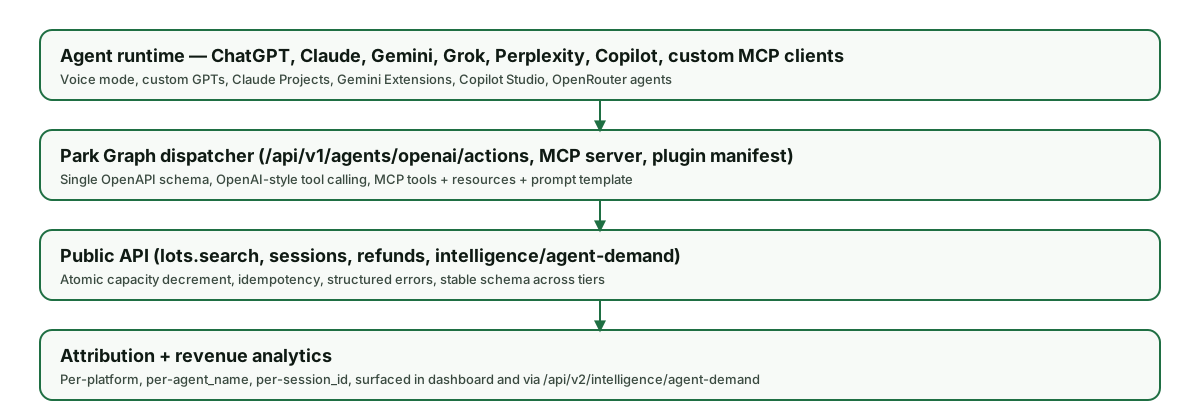
Park Graph is the protocol layer between every parking lot and every AI agent on the planet. When someone tells Claude, ChatGPT, Gemini, or any AI assistant to “find me parking,” your lot shows up. Every AI-booked session is tracked and attributed in your dashboard. No configuration is required — once your lot is live, it is automatically discoverable by every supported AI platform through Park Graph's multi-protocol integration layer.
See how AI agents interact with Park Graph
Real text reservations, end-to-end
Drivers describe what they need. Park Graph parses, finds, and holds — atomically.
Need parking near Eagle airport tonight 8pm-midnight, EV.
Found 3 EV-friendly lots near Eagle County Regional: 1. **Eagle Airport Surface E** — $9/hr, 12 EV chargers, 7 spots open 2. **Gypsum Park & Ride** — $5/hr, 4 chargers, 18 spots, 2-min shuttle 3. **Vail Valley Lot B** — $12/hr, 8 chargers, 5 spots open Want me to hold the cheapest one for you?
Yes, hold Gypsum for me.
Held space at **Gypsum Park & Ride** (8:00 PM – 12:00 AM, $20.00 total). Hold expires in 3 minutes — confirm with one tap when you're ready. Hold ID: **PKG-H7Y3**.
Supported AI platforms
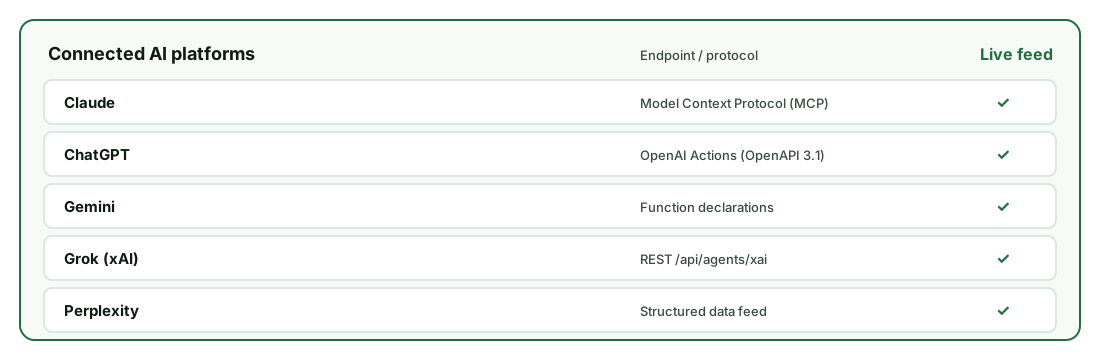
Claude (MCP Protocol)
Park Graph implements the Model Context Protocol (MCP) specification, giving Claude native access to search, check availability, get rates, and start sessions. When a Claude user asks about parking, Claude can query Park Graph directly through its tool system. The MCP integration supports real-time availability checks, spatial proximity searches within configurable radius, and detailed lot metadata including features, accessibility, and EV charger availability.
ChatGPT (OpenAI Actions)
The Park Graph OpenAI Action spec is available at /api/agents/openai/actions. ChatGPT can use it to search for parking near any location, check real-time availability, compare rates, and provide drivers with direct booking links. The action schema follows OpenAPI 3.1 format and is automatically validated by OpenAI's GPT builder system. Custom GPTs built on the Park Graph action can be tailored for specific use cases like airport parking, event parking, or fleet management.
Gemini (Function Declarations)
Park Graph exposes a Gemini-compatible function declaration endpoint at /api/agents/gemini. Google's AI can call these functions to find parking, check capacity, and generate booking URLs for users. The function declarations include parameter descriptions, type constraints, and example values that help Gemini understand exactly how to call each endpoint for the most relevant results.
Grok (xAI)
The xAI integration at /api/agents/xai allows Grok to search and recommend Park Graph lots. Grok users asking about parking near venues, airports, or events get accurate, real-time results. The integration supports the same full set of search parameters as other platforms, ensuring consistent results regardless of which AI agent the driver uses.
Perplexity
Park Graph's Perplexity integration provides structured parking data for search queries. When Perplexity answers questions about parking options, it can pull real-time availability and pricing from Park Graph. The integration returns formatted results with links, pricing tables, and availability indicators that Perplexity can present directly to users in its answer format.
REST API + SDK
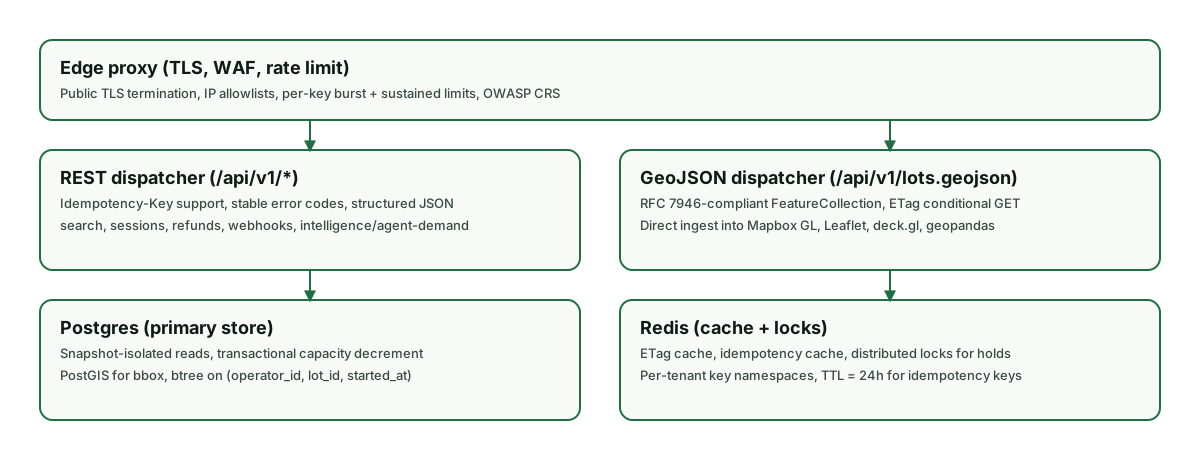
For custom integrations, the Park Graph REST API provides full access to lot search, availability, rates, and session management. API keys are managed through the dashboard with configurable scopes and rate limits. The SDK is available for JavaScript/TypeScript with generated type-safe clients. Rate limits default to 60 requests per minute on Pro and 120 on Enterprise, with burst support for high-traffic scenarios.
Agent bookings use the same payment infrastructure as QR payments. See how the complete payment flow works.
See QR paymentsHow agent bookings generate revenue
Every AI agent booking follows the same payment flow as a QR scan. The agent provides the driver with a booking link. When the driver clicks through and confirms payment, a session starts with full Stripe authorization and manual capture. The link is unique, pre-filled with the lot and duration the AI recommended, so the driver confirms with a single tap rather than filling out forms.
Agent bookings are attributed in your dashboard under the “Agent” source category, with the specific platform (Claude, ChatGPT, Gemini, etc.) tracked as metadata. This lets you see exactly how much revenue each AI platform is driving to your lots. The attribution is automatic and requires no setup or tagging on your part — Park Graph tracks the originating agent through the booking URL parameters.
AI agent bookings open a discovery surface that walk-up QR alone cannot reach. Drivers who never see your lot in person can still find it through Claude, ChatGPT, Gemini, Grok, or Perplexity. As AI assistants become the default way people search for local services, lots that are not accessible to AI agents will lose discovery share to those that are.
Agent bookings can include an optional per-booking surcharge (configurable in your pricing rules) to account for the premium nature of pre-booked, guaranteed spaces. This is separate from the platform transaction fee and flows entirely to the lot owner. A typical surcharge of $1-$3 per booking adds meaningful revenue without deterring bookings, since drivers value the convenience of guaranteed availability.

The agent-first future of parking
The parking industry is at an inflection point. Consumer apps like SpotHero built a marketplace. Hardware companies like SKIDATA built gates. But the next wave is not consumer or hardware — it is infrastructure. Infrastructure that makes every parking space accessible to every software system on earth.
In the agent-first future, people do not open a parking app. They tell their AI assistant they need parking, and the assistant handles everything: finding options, comparing prices, booking a space, processing payment, and providing navigation. The parking lot that is not accessible to these agents simply does not exist in this new workflow. It becomes invisible to the fastest-growing customer acquisition channel in history.
Park Graph is building the protocol layer for this future. By connecting to every major AI platform today, your lot is positioned for the massive shift in how people discover and book parking. Early adopters will have years of occupancy data, pricing optimization, and agent relationship history that late entrants cannot replicate. Data network effects compound over time — the more sessions you run through Park Graph, the better your pricing optimization and demand forecasting become.
Autonomous vehicle fleets will need parking APIs for their vehicles. Navigation apps will need real-time availability feeds. Smart city platforms will need standardized parking data. Park Graph is the infrastructure layer that connects all of these systems. By adopting Park Graph today, you are not just solving today's payment collection problem — you are building the digital foundation for how your parking assets will operate for the next decade.
Track agent-driven bookings, revenue by platform, and conversion rates in your real-time dashboard.
View the dashboardNavigation and mapping integration
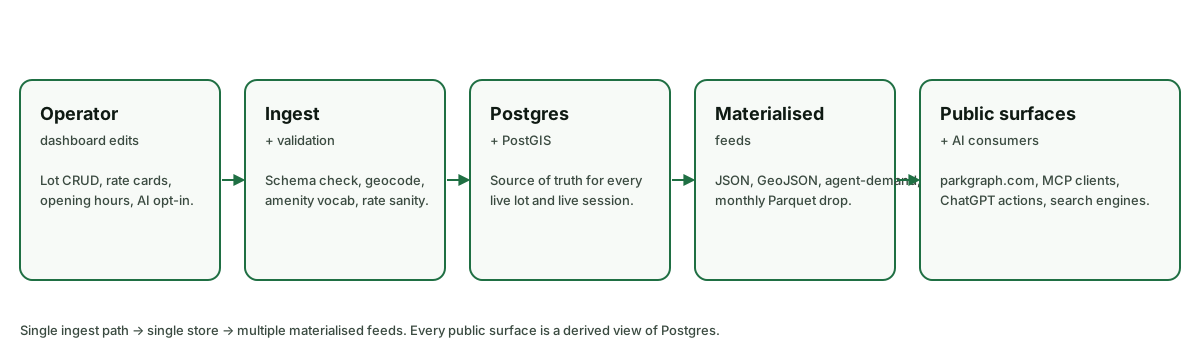
Beyond AI agents, Park Graph integrates with navigation and mapping platforms. Your lots can appear in Google Maps, Apple Maps, and Waze through standard data feeds. When a driver searches for parking in any navigation app, your lot shows up with real-time availability and pricing. The driver taps the listing to start navigation and arrives at your lot ready to scan and pay.
Park Graph exposes a GeoJSON endpoint at /api/v1/lots.geojson that provides spatial data for all listed lots. This endpoint is consumed by mapping platforms, fleet management systems, and smart city dashboards. Each lot's GeoJSON feature includes coordinates, capacity, current occupancy, rates, features (EV charging, handicap, valet), and a direct booking URL.
For operators in transit-heavy areas, Park Graph supports GTFS-flex integration for transit agencies. This allows transit planning apps to suggest your lot as a park-and-ride option, connecting your parking spaces to the broader public transportation network. Commuters searching for the best combination of driving and transit see your lot as a recommended stopping point.
Privacy, security, and data control
Every AI agent integration is secured with API key authentication and rate limiting. You control exactly what data each agent can access. Public availability and pricing data is shared by default. Sensitive data like revenue, driver information, and session history is never exposed to external agents.
Each integration can be individually enabled or disabled from your dashboard. If you want your lots visible to ChatGPT but not to Grok, you can configure that with a single toggle. Rate limits prevent any single agent from overwhelming your infrastructure. Enterprise plans include dedicated rate limits and priority response times for high-traffic agent integrations.
All agent interactions are logged and auditable. You can see exactly which agents queried your lots, how many bookings each agent generated, and what revenue came through each channel. This attribution data helps you understand where your customers are coming from and which AI platforms drive the most value for your business.
Make your lots visible to every AI agent
AI agent integrations are included on Pro and Enterprise plans. Get started with QR payments on the free Starter plan.