AI-powered parking management
Park Graph uses artificial intelligence across every layer of parking operations: dynamic pricing that maximizes revenue, AI agents that book spaces, chat assistants that handle driver support, and analytics that predict demand before it happens.
AI agents book your spaces
When someone tells Claude, ChatGPT, Gemini, or any AI assistant to find parking, Park Graph lots appear. Every major AI platform can search, check availability, get rates, and generate booking links through native integrations.
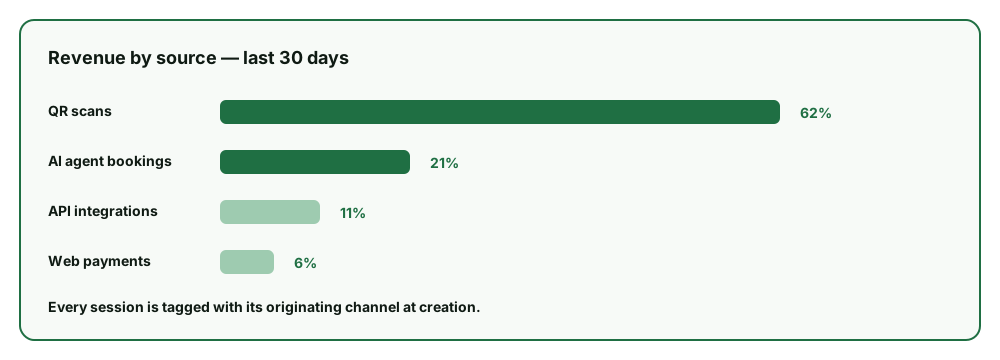
AI-booked sessions are tracked separately in your dashboard. See which platforms drive the most revenue, which lots are most popular with AI users, and how agent bookings compare to QR scans in terms of duration and spend.
Real text reservations, end-to-end
Drivers describe what they need. Park Graph parses, finds, and holds — atomically.
Need parking near Eagle airport tonight 8pm-midnight, EV.
Found 3 EV-friendly lots near Eagle County Regional: 1. **Eagle Airport Surface E** — $9/hr, 12 EV chargers, 7 spots open 2. **Gypsum Park & Ride** — $5/hr, 4 chargers, 18 spots, 2-min shuttle 3. **Vail Valley Lot B** — $12/hr, 8 chargers, 5 spots open Want me to hold the cheapest one for you?
Yes, hold Gypsum for me.
Held space at **Gypsum Park & Ride** (8:00 PM – 12:00 AM, $20.00 total). Hold expires in 3 minutes — confirm with one tap when you're ready. Hold ID: **PKG-H7Y3**.

Total Revenue
$12,847
Sessions
342
Occupancy
73%
Avg Rate
$8.40
Revenue by source
Intelligent pricing and analytics
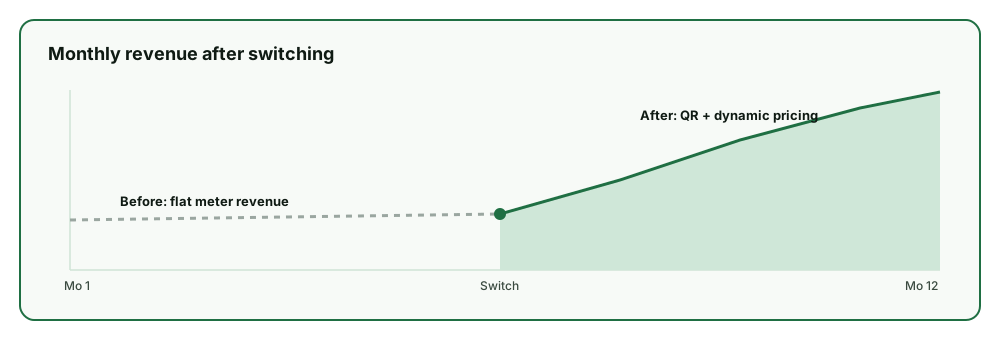
Dynamic pricing rules adjust rates automatically based on occupancy, time of day, day of week, and nearby events. The system monitors occupancy in real-time and applies surge multipliers when demand spikes.
Analytics dashboards show revenue trends, occupancy patterns, session duration distributions, and source attribution. Identify your most profitable hours, optimize rates for underperforming time slots, and track the impact of every pricing change.
Where AI sits in the parking stack
AI parking management is not a single feature bolted onto a payment system — it is a layer that touches pricing, bookings, driver support, and forecasting at the same time. Park Graph runs every lot on the same software foundation regardless of plan, then turns AI capabilities on top of the data those lots already generate. Because occupancy is derived from real paid sessions rather than sensors, the pricing engine and the forecasting models work from the same ground truth the operator sees in the dashboard.
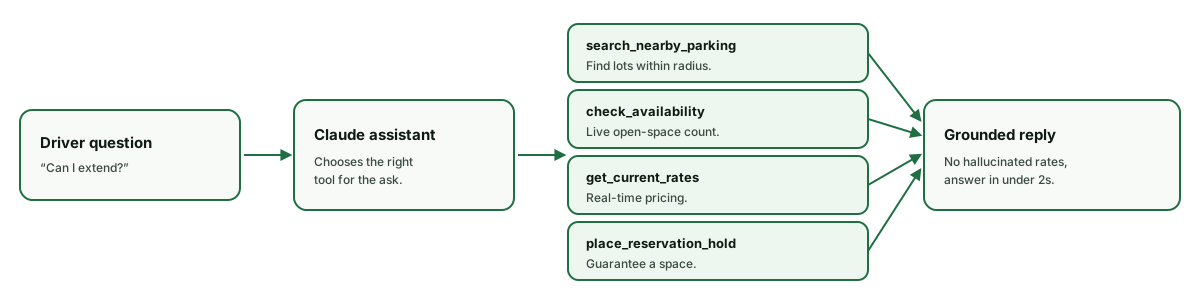
The most visible layer is AI-agent booking. Park Graph publishes a public API, an MCP server, and direct integrations with ChatGPT, Perplexity, Gemini, Grok, and Microsoft Copilot. When an operator opts in, those assistants can search inventory, check live rates, hold a space, and pay on a driver's behalf — without the operator building anything custom. The same protocol layer that exposes a lot to a human in a browser exposes it to an autonomous agent.
The second layer is autonomous pricing. Operators configure rules — time-of-day bands, day-of-week multipliers, occupancy thresholds, and event surge windows — and the system applies them continuously without manual intervention. Every rule change is versioned and reversible, and each triggered rule logs the conditions that fired it, so the automation stays auditable rather than opaque.
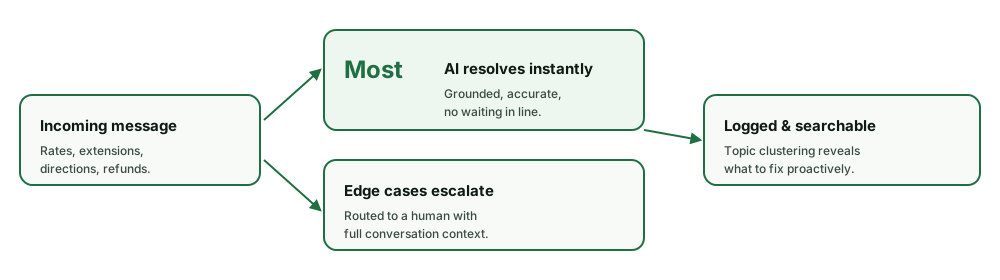
The third layer is AI-assisted driver support. Text-based assistants answer the most common driver questions — rates, extensions, directions, and lot policies — grounded in each lot's real configuration, and escalate anything they cannot resolve to a human. The result is round-the-clock coverage without a round-the-clock support desk, and a measurable reduction in the ticket volume an operator has to staff for.
Escalation, oversight, and operator control
Automation without oversight is a liability, so Park Graph keeps the operator in control of every AI-driven action. Pricing rules have guardrails — floor and ceiling rates — so the engine never prices a lot outside the bounds an operator sets. Support escalations route to a human whenever the assistant is uncertain or the driver explicitly asks for one, and every AI-handled conversation is logged for review. Operators can pause any automated behaviour from the dashboard at any time.
This matters most for the operators who adopt AI parking management first: multi-lot owners and municipal departments who cannot manually adjust rates across dozens of zones, and high-variability venues — stadiums, airports, hospitals — where demand swings faster than a human can respond. For these operators the value of AI is not novelty; it is the ability to run more lots, more responsively, without proportionally growing headcount.
Park Graph deliberately scopes its claims to what the platform does today. AI booking is live across the integrations listed in the product, autonomous pricing and AI support are configurable per lot, and forecasting improves as a lot accumulates session history. For line-by-line feature parity against specific platforms, see the comparison hub; for the underlying booking mechanics, see AI agent booking.
AI-powered targets
0
AI agent platforms (live in agents/models.ts)
0%
Queries resolved by AI (target)
0/7
Automated operations
0%
Labor cost reduction (target)
Projected targets reflect 2026+ planning and internal pilot modeling — not live customer outcomes.
Let AI manage your parking
AI features are available on Pro and Enterprise plans.