Money page
The smart parking system that costs nothing to install
Traditional smart parking systems require sensors, gates, cameras, and months of installation. Park Graph delivers the same intelligence — real-time occupancy, dynamic pricing, analytics — through a single QR code. No hardware, no wiring, no construction.
What makes a parking system smart?
A smart parking system does four things: it knows how many spaces are available in real-time, it adjusts pricing based on demand, it connects to external platforms so drivers can find and book spaces, and it provides operators with actionable data to optimize revenue.
Most smart parking vendors require $50,000-$500,000 in hardware — ultrasonic sensors for each space, ALPR cameras at entrances, central processing units, network cabling, and months of installation. The ROI takes 3-5 years to materialize, if it ever does.
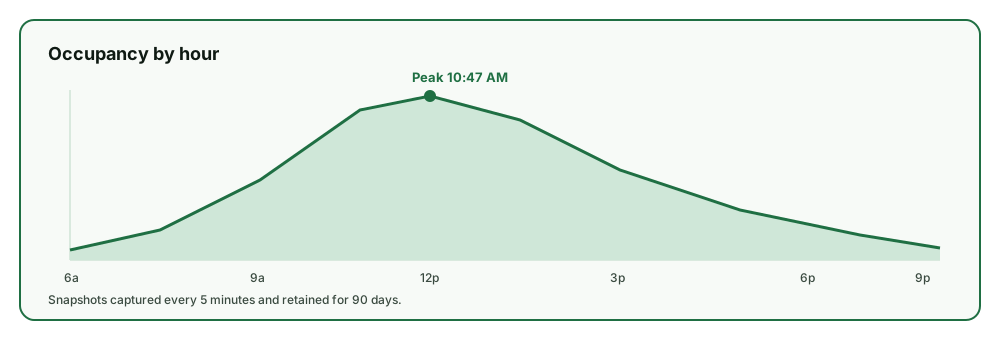
Park Graph achieves the same outcome with software. When drivers pay through QR codes, the system knows exactly how many sessions are active, which spaces are occupied, and what the current demand looks like. This session-based occupancy data is as accurate as sensor data, at a fraction of the cost.
Dynamic pricing adjusts rates based on configurable rules: time of day, day of week, occupancy levels, and nearby events. When occupancy crosses your threshold (default 85%), surge pricing kicks in automatically. When a major event is detected within your impact radius, event surge multipliers apply.
Set up in 3 steps
Get started in 3 steps
From sign-up to first payment in under 10 minutes.
Try it now
Try it now
Generate a QR code for your lot. No account required.
QR preview
Smart parking by the numbers
$0
Hardware cost
0 min
Setup time
0
AI agent platforms (live)
0%
Revenue lift (target)
Projected targets reflect 2026+ planning and internal pilot modeling — not live customer outcomes.
Who this is for and how the workflow runs
A smart parking system, as Park Graph defines it, knows how full a lot is right now, adjusts pricing based on demand, exposes inventory to driver-facing and AI-facing platforms, and gives operators dashboards to optimise revenue. Park Graph delivers all four through QR-payment session data — not sensors, not gates, not LPR cameras, and not a multi-month construction project to install any of those.
Smart-parking-system customers are operators who would otherwise spend fifty thousand to five hundred thousand dollars on sensor and gate retrofits. Most are surface-lot owners running fifty to fifteen hundred spaces, downtown garage operators running two hundred to twenty-five hundred spaces across multiple sites, and municipal parking departments coordinating dozens of zones across a downtown footprint or a university campus.
The product is also chosen by greenfield developers — mixed-use buildings, hotels, hospitals, office parks — who want smart-parking outcomes from day one without a dedicated parking-tech construction line item dragging on the broader project schedule. Park Graph adds zero days of construction time and zero square feet of mechanical-room footprint.
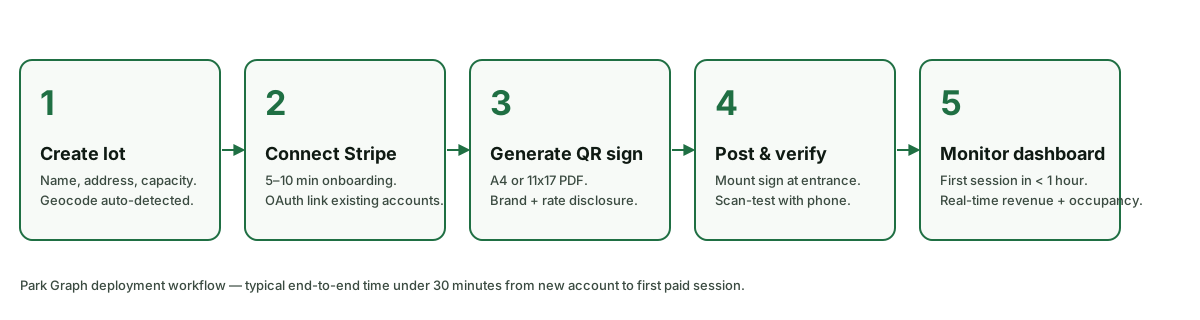
Smart-parking deployment with Park Graph collapses into the same five-step flow as any other Park Graph rollout: create the lot, connect Stripe, generate the QR sign, post it, and optionally enable AI-agent booking. The smart part — real-time occupancy, dynamic pricing, agent discoverability — is on by default rather than an extra hardware project that has to be scoped, budgeted, contracted, installed, and commissioned before the operator sees the first useful data point.
Operators configure pricing rules in the dashboard: time-of-day bands, day-of-week multipliers, occupancy thresholds, and event surge windows. When a configured threshold is crossed (default eighty-five percent occupancy within the next two hours) surge pricing kicks in automatically. When occupancy drops below the threshold, rates revert. All rule changes are versioned and reversible, and every triggered rule logs the conditions that fired it so operators can audit what happened and tune accordingly.
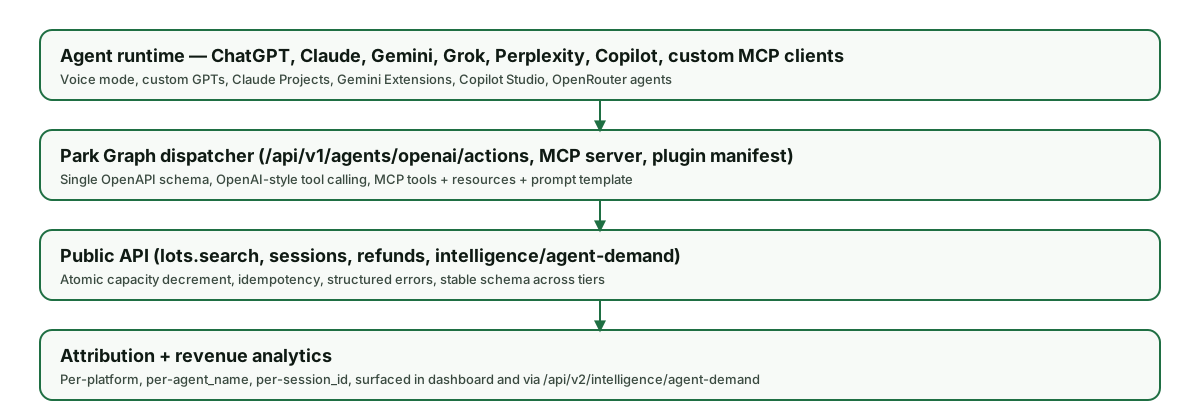
Smart-parking outputs flow into the public API so external systems — mapping platforms, navigation apps, BI tools, custom signage, internal dashboards — can consume the same real-time data the dashboard shows. The optional GeoJSON feed publishes per-lot availability to Google Maps, Apple Maps, Mapbox, and Geoapify so drivers see availability before they arrive rather than after they have circled the block.
Operator pains we measured before we built this
We interviewed roughly forty parking operators before writing the first line of Park Graph code, ranging from a single-lot owner in Cleveland to the parking director of a twelve-garage university system. Five themes came up in more than half of those conversations and they shaped the platform we ultimately built; the response below is what we ship today.
Hardware fails. Meter and kiosk hardware fails in winter, after vandalism, and on its own schedule. Each repair costs four hundred to twenty-five hundred dollars and takes a lot offline for one to three days. Park Graph has zero on-site hardware. A printed QR code is the only physical artifact and a five-dollar reprint replaces a damaged sign without scheduling a contractor or waiting on a part to ship.
Drivers refuse another app. Adoption ceilings on driver-app-first platforms run twenty to thirty-five percent abandoned payment rate and a steady stream of complaint volume. Park Graph runs in the mobile browser. Scan, choose duration, tap Apple Pay, done. No install, no account, no loyalty signup, no email captured involuntarily, no marketing relationship the driver did not ask for.
Rate changes are slow. Many legacy systems require an on-site service visit to adjust pricing. Each visit costs one hundred fifty dollars or more and ties up the operator with stale rates while the work is queued behind whichever other lot the vendor has on the route that week. Park Graph propagates rate updates from the dashboard site-wide in seconds, with full version history and a one-click revert if the change does not perform as expected.
Reconciliation lives across PDFs. Sessions, refunds, and payouts on legacy platforms live across monthly PDF reports that arrive long after a decision could have been informed by them. Park Graph reconciles every session row to a Stripe payment intent and includes it in the daily Stripe payout file. Operators can pull the entire history through CSV export, the API, or a warehouse drop into Snowflake, BigQuery, or Databricks.
Vendors lock data. Most legacy platforms gate revenue and occupancy data behind quarterly reports and partner integrations. Park Graph publishes the full operational dataset through a public API and the dashboard sees the same data the API returns. Operators retain ownership of every record and can take it with them in industry-standard formats if they ever choose to migrate.
Implementation: from sign to first paid session
The Park Graph rollout collapses to five steps and an optional sixth. Step one is creating the lot in the dashboard with name, address, and capacity; geocoding and timezone are auto-detected and the rate table is initialised empty. Step two is connecting Stripe; new operators finish Stripe Connect onboarding in five to ten minutes, and existing accounts link instantly through OAuth without re-entering business details.
Step three is generating the QR sign — pick A4 or 11x17, download the print-ready PDF with brand and rate disclosure, and print on standard office or vendor stock. Step four is posting the sign at the lot entrance and scanning it yourself with your phone to confirm the payment page loads and shows the right rate. Step five is monitoring the dashboard for the first transient session, which typically lands within an hour of the sign going up.
Step six is optional and configures the parts of the platform that make Park Graph more than a payment relay: AI-agent visibility (one toggle, makes the lot discoverable to ChatGPT, Perplexity, Gemini, Grok, and Microsoft Copilot), accounting integration (QuickBooks, Xero, NetSuite), CRM integration, and gate or sensor integration where present. Operators have shipped the entire flow including step six in under thirty minutes; the slowest documented rollout was a four-week phased deployment for a municipality coordinating with sign installers and a streetlight repaint.
The fastest documented Park Graph deployment was eleven minutes from new account creation to first live paid session. The slowest was the four-week municipal rollout above. Nothing about Park Graph forces a slow rollout, and nothing about it forces an operator to rip everything out of a legacy system at once — most operators run a side-by-side deployment with the legacy platform for the first two to four weeks before fully cutting over.
How Park Graph compares to the alternatives
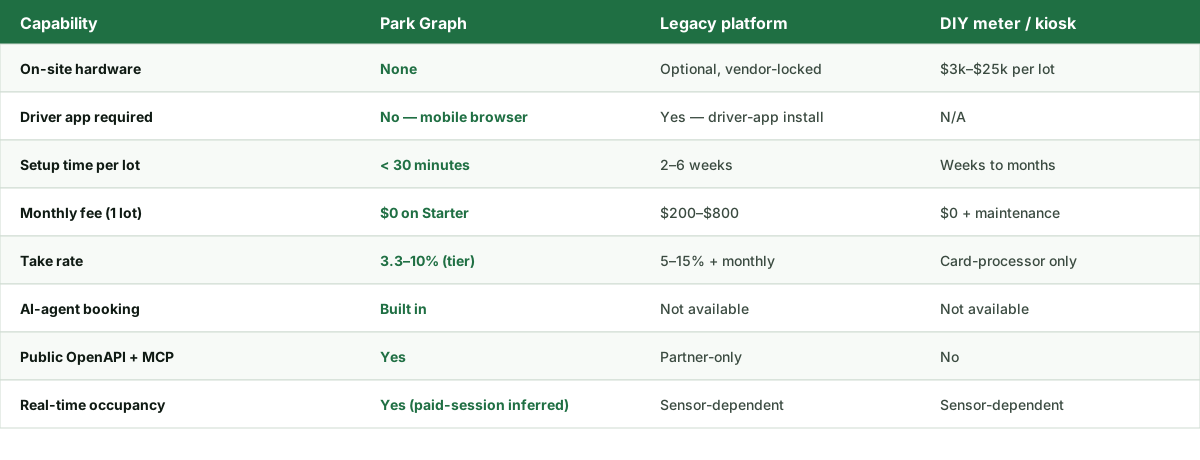
The Park Graph product position is built around three structural differences from legacy platforms. There is no driver app, no on-site hardware, and no multi-week implementation engagement. Drivers transact through the mobile browser, operators install nothing, and the first paid session lands in minutes rather than weeks.
Setup time per lot runs under thirty minutes on Park Graph against two to six weeks on legacy platforms and weeks to months on do-it-yourself meter or kiosk projects. Monthly platform fee for a single lot is zero on Park Graph's Starter tier; legacy platforms typically charge two hundred to eight hundred dollars per month before transaction take. Take rate runs three point three to ten percent on Park Graph depending on tier; legacy take typically runs five to fifteen percent stacked on top of the monthly fee.
AI-agent booking is built in on every Park Graph plan and not available on any major legacy platform. The Park Graph public OpenAPI spec and MCP server are accessible to any developer; legacy platforms restrict API access to certified partners under NDA. Real-time occupancy on Park Graph derives from paid session data without sensors; legacy platforms typically require sensor hardware to provide equivalent data, and that hardware sets a floor on the cost and the timeline of the deployment.
Specific competitor comparisons — ParkMobile, SpotHero, Passport, AirGarage, SKIDATA, Flowbird — are covered line-by-line on the dedicated comparison pages under /compare. The summary above generalises the experience of working with a national meter vendor or a driver-app-first platform; specific feature parity is documented per competitor.
Use cases we see most often
Surface lot, no booth. Replace coin meters and a part-time attendant with a single QR sign. Park Graph handles payment, refund, and dispute resolution without on-site staff. Best fit for lots in the twenty-to-three-hundred-space range where a full-time attendant is not economically justifiable.
Mixed-use garage. Run hourly transient and monthly permit billing through one platform. Permit holders pay nothing on entry; transient drivers scan the QR code. Best fit for operators with both billing relationships and a need to consolidate the data into one analytics stack.
Event venue overflow. Spin up event-only pricing for game days or concerts. The lot turns on at noon, surges during pre-game, and reverts overnight automatically based on configured event windows. Best fit for stadium, arena, and amphitheatre operators that have to handle large but predictable demand pulses.
Hotel valet plus self-park. Self-park guests scan the QR code; valet folio integrates via the API with the property management system. Best fit for hospitality operators with a PMS integration requirement and a desire to keep guest billing centralised on the room folio.
Construction-yard parking. Sub-contractor crews pay per shift via QR code. Foremen pull weekly attendance reports without setting up new accounts per visitor. Best fit for daily transient with a rotating workforce that does not justify the overhead of credentialed access.
Municipal on-street zone. Replace a failing pay-and-display kiosk with QR signage on every block. Officers verify payment by license plate from a phone app driven by the same API that powers the dashboard. Best fit for public-sector parking modernisation projects that need to ship before the next budget cycle.
Operator economics
Park Graph charges no setup fee, no per-lot fee, and no per-space fee. The free Starter plan keeps operators at ninety percent of every transaction with no monthly fee. Pro at four hundred ninety-five dollars per month keeps operators at ninety-five percent. Enterprise at two thousand four hundred ninety-five dollars per month keeps operators at ninety-six point seven percent and unlocks white-label branding and custom integrations.
For a one-hundred-space lot at three dollars fifty per hour with thirty-five percent utilisation, the platform processes about thirty thousand six hundred sixty dollars per month in gross collections. The Pro plan keeps twenty-nine thousand one hundred twenty-seven of that for the operator after Park Graph and Stripe take rates. The same lot on a legacy platform with a three-hundred-dollar monthly fee and a twelve percent take rate keeps twenty-six thousand six hundred eighty-one. The Park Graph delta funds the Pro plan plus a sign reprint plus a small operating reserve every month.
Hardware avoided ranges from three thousand to twenty-five thousand dollars per lot relative to a legacy meter or kiosk install. Setup time runs thirty minutes or less from sign printed to first paid session. Operator take runs up to ninety-six point seven percent of gross at the Enterprise tier. Numbers above are typical first-year deltas reported by Park Graph operators relative to their previous platform; per-operator results vary with utilisation, ticket size, and the specific fee structure of the platform being replaced.
Trust and security
Park Graph operates at PCI DSS Level 1 with all card data tokenised by Stripe — Park Graph never sees raw card numbers. Park Graph is aligned with SOC 2 controls; we are not yet able to share a current SOC 2 attestation report. Data is encrypted with AES-256 at rest and TLS 1.3 in transit using KMS-managed keys.
Driver email and license plate are the only fields retained beyond thirty days; everything else (session metadata, payment intent IDs, operator dashboard interactions) is retained per the documented data-retention schedule. The full security posture, sub-processor list, and incident-response runbook live on the privacy policy and the forthcoming /trust hub.
Read the canonical version
This page mirrors the canonical guide at Smart parking system (canonical). The canonical page receives all link equity and indexing signals; this URL stays live to preserve historical inbound links and bookmarks while the migration window is open.
For related deep-dives, see /parking, /product, /pricing, and the comparison hub. Operators ready to deploy can start at /signup; developers can start at /developers.
Deploy your smart parking system today
No hardware, no contracts, no setup fee. Free forever on the Starter plan.
Frequently asked questions
- What makes a parking system smart?
- A smart parking system continuously knows how many spaces are occupied, adjusts pricing based on demand, exposes inventory to external platforms so drivers and AI agents can find spaces, and gives operators real-time analytics to optimize revenue. Park Graph delivers all four through QR-driven session data instead of sensors and gates.
- Do I need hardware to deploy a smart parking system?
- No. Traditional smart parking systems require ultrasonic sensors per space, ALPR cameras, central processors, and network cabling. Park Graph achieves the same outcomes — real-time occupancy, dynamic pricing, analytics — through software because every paid session is tracked through the QR-payment flow.
- How accurate is session-based occupancy versus sensor-based?
- For lots where the majority of parkers pay (or are required to register a free session), Park Graph's session-based occupancy is functionally equivalent to sensor-based for revenue and pricing purposes. Operators can pair Park Graph with optional ALPR or sensor inputs for lots that need pinpoint per-space accuracy.
- How does dynamic pricing work?
- Operators configure rules in the Park Graph dashboard: time-of-day bands, day-of-week multipliers, occupancy thresholds, and event surge windows. When a configured threshold is crossed (for example occupancy above 85% within the next two hours), surge pricing kicks in automatically. All rule changes are versioned and reversible.
- Can AI agents book spaces in a Park Graph smart parking system?
- Yes. Park Graph publishes an MCP server, an OpenAPI spec, and direct integrations with ChatGPT, Perplexity, Gemini, Grok, and Microsoft Copilot. When operators opt in, AI agents can search inventory, hold a space, and pay programmatically on behalf of a driver.
- What does it cost to deploy a smart parking system with Park Graph?
- Starter is free forever with a 10% transaction fee. Pro is $499/month with a 5% transaction fee and unlimited lots. Enterprise starts at $2,499/month with a 3.3% transaction fee and white-label/custom integrations. There is no hardware bill and no contractor install fee.
- How long does it take to go live?
- Most operators print a QR code, sign up, connect Stripe, and post the sign in under five minutes. The first paid session can land within minutes of posting. There is no waiting on hardware lead times, contractor schedules, or trenching permits.
- Does the system work for municipal lots and on-street parking?
- Yes. Park Graph supports municipal lot deployments and curbside on-street zones with QR signs at each block. Permit holders can be tracked through the same session flow, and citation integrations are available on Pro and Enterprise.