Surface lot, no booth
Replace coin meters and a part-time attendant with a single QR sign.
Best fit: 20-300 spaces
Money page · QR code parking payment
Replace every parking meter, pay station, and cash box with a single QR code. Drivers point their phone camera, choose a duration, and pay. No app download. No account creation. No touching a dirty touchscreen.
A modern smartphone is a payment terminal. It has a camera, a network connection, a tokenised wallet, and a screen large enough to confirm a transaction. The fact that parking lots in 2026 still ask drivers to walk to a coin-fed metal box is an anachronism, and it's an expensive one — for the operator who pays for the box, for the driver who fumbles with change, and for the city whose blocks are cluttered with single-purpose hardware that breaks in winter.
QR code parking payment closes that gap. The driver uses the phone they already own. The operator posts a passive paper sign that costs five dollars to reprint if it's damaged. The funds settle directly to the operator's account on Stripe's normal payout cadence. Every party in the transaction wins; only the meter vendor loses.
Park Graph is the QR code parking payment system built for that transition. The five rows below summarise the operator pains we measured before designing this product.
| Pain today | What it costs you | How Park Graph fixes it |
|---|---|---|
| Coin and bill meters jam, freeze, get vandalised | $400-$2,500/repair, hours of lost revenue | QR signs are passive paper. A $5 reprint replaces a damaged sign. |
| Driver-app payments lose 20-35% of payments to abandonment | Direct revenue loss + complaint volume | Browser checkout has no install step. Conversion rates are dramatically higher. |
| Pay-and-display kiosks are expensive and break in weather | $3k-$25k upfront, plus annual maintenance | Park Graph has zero on-site hardware. The QR sign is the entire infrastructure. |
| Rate changes require an on-site service visit | $150+/visit, slow response to demand | Update rates from the dashboard. Changes propagate in seconds. |
| Driver complaints take days to resolve via the meter vendor | Reputation damage, repeat-business loss | Refunds are 1-click from the dashboard, settling on Stripe's normal timeline. |
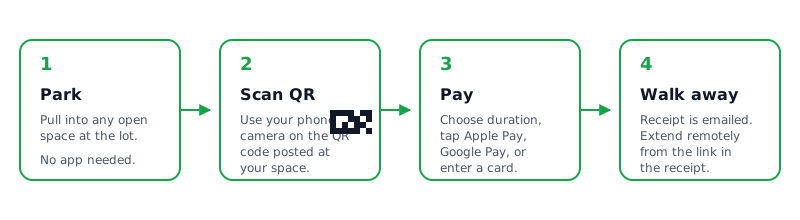
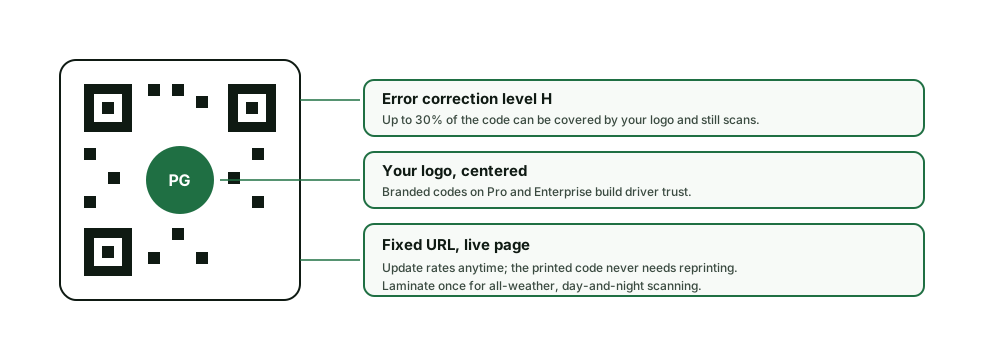
A driver pulls into a Park Graph lot. They see a yard sign with a large QR code, the lot name, the hourly rate, and the daily maximum printed clearly underneath. They open their phone camera, point it at the code, and the link banner appears within a second. They tap it.
The Park Graph payment page loads in under two seconds on the operator's edge domain. The lot name appears in a large header. A duration slider with preset buttons (1h, 2h, 4h, all-day) lets the driver choose how long to park. The total price updates in real time as they move the slider. They tap Apple Pay or Google Pay; if Apple Pay requires Face ID, they hold the phone up. The session is active.
The confirmation page becomes a digital pass with the lot name, the active session countdown, an extend button, and a receipt. The driver gets an email receipt immediately. If they extend, the same flow runs and the new total is appended to the existing session. If they leave early, Park Graph's manual-capture authorisation model lets the operator refund the unused time within minutes.
The phone mockup shows the Park Graph payment page in a real driver's mobile browser. The Apple Pay and Google Pay buttons sit above the fold; the duration slider is the largest interactive element on the page. There is no “create an account” gate.
The page is responsive down to the iPhone SE viewport and tested weekly on the most popular Android browsers as well as Safari. It is WCAG 2.2 AA compliant out of the box.
If the driver returns to the same lot, the page recognises their stored payment method (subject to platform privacy settings) and the second payment is even faster than the first.
Park Graph
Scan QR Code
Point camera at parking sign
Free Starter plan. No credit card required.
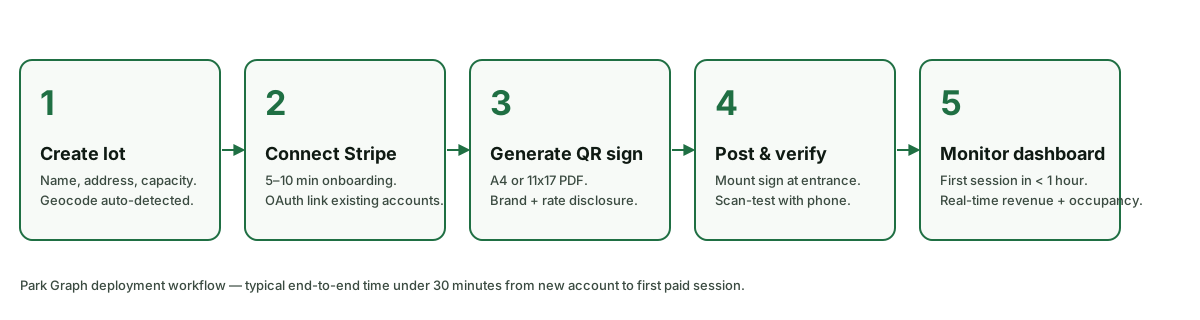
Address, capacity, hourly rate, daily max.
Print-ready PDF with QR, lot name, rates, and the parkgraph.com URL printed underneath.
Mount at the lot entrance and any pay-station-style location.
Scan it yourself with your phone and complete a $1 test transaction.
Sessions appear in real time as drivers scan.
Generate a QR code for your lot. No account required.
QR preview
The generator above produces a real, scannable Park Graph QR code that points at a demo lot. Use it to test the driver flow before signing up.
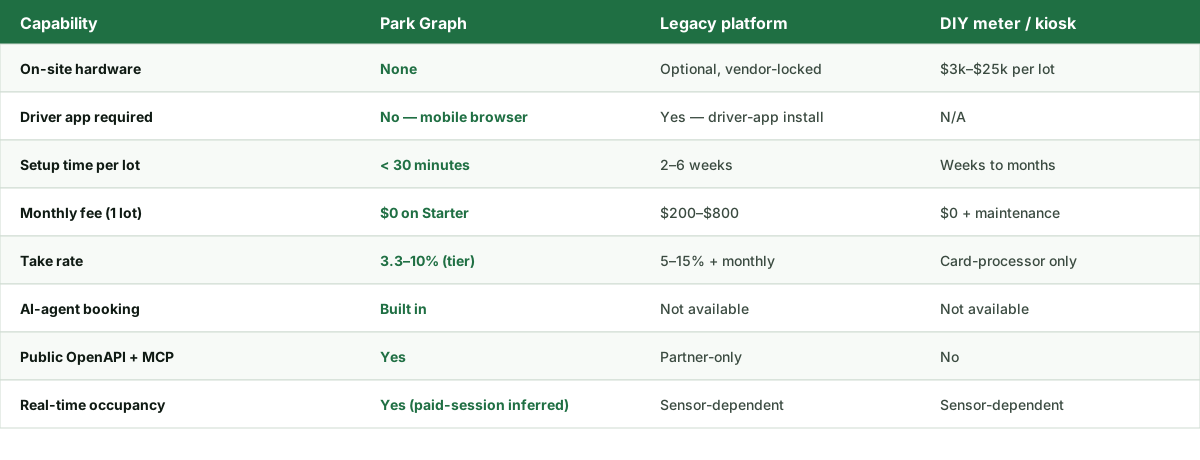
| Capability | Park Graph | Legacy parking platform | DIY / hardware-based |
|---|---|---|---|
| Driver app required | No | Yes (driver app vendor) | N/A (meter / kiosk) |
| On-site hardware | None | Optional | Required |
| Median scan-to-paid | <60s | 60-120s | 120-300s |
| Setup cost (1 lot) | $0 + sign printing | $200-$800/mo | $3k-$25k upfront |
| Conversion rate | High (no app) | Low (install drop-off) | Variable |
| Accessibility (WCAG 2.2 AA) | Yes | Vendor-dependent | Often non-compliant |
| Take rate | 3.3-10% | 5-15% + monthly | Card processor only |
| AI agent discovery | Built in | Not available | N/A |
Replace coin meters and a part-time attendant with a single QR sign.
Best fit: 20-300 spaces
Run hourly transient and monthly permits on the same QR-driven flow.
Permit + transient
Post a temporary QR sign for game-day pricing; switch back overnight.
Surge pricing
Self-park guests scan the QR; valet folio integrates via the API.
Hospitality
Spin up a 1-day lot with a QR sign and a Stripe account; tear it down at sundown.
Pop-up
Sunday-only lots can monetise the other six days with a QR sign.
Civic
QR code parking payment at a glance
Beyond a printed sign
Sign-up to first paid session
Driver-side latency
0s
Median scan-to-paid (target)
$0
Hardware required
0%
Operator take at Pro
0
AI agent platforms supported
Projected targets reflect 2026+ planning and internal pilot modeling — not live customer outcomes.
PCI DSS Level 1 (via Stripe)
Card data tokenized in driver browser; never touches Park Graph.
Anti-spoof signage
Canonical URL printed under every QR; tamper-evident sign material.
WCAG 2.2 AA accessibility
Tested with VoiceOver, TalkBack, large text, and high-contrast modes.
Encrypted transit + storage
TLS 1.3 in transit, AES-256 at rest.
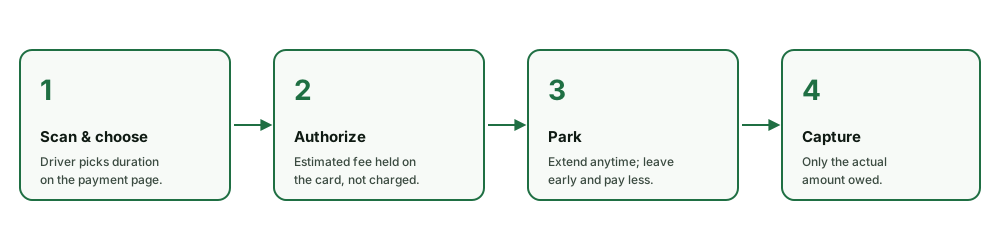
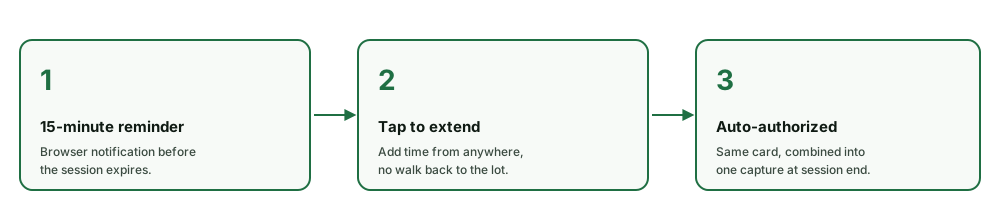
The calculator below estimates monthly take-home revenue across Starter, Pro, and Enterprise plans for any lot size, hourly rate, occupancy, and operating-hour configuration you choose. Numbers update live as you adjust the inputs.
See how much you could earn with Park Graph.
Projected monthly revenue
$86,400
Starter
Platform cost
$8,640/mo
Your net revenue
$77,760/mo
Pro
Best valuePlatform cost
$4,819/mo
Your net revenue
$81,581/mo
Enterprise
Platform cost
$5,350/mo
Your net revenue
$81,050/mo
Free forever on Starter. No credit card to begin.