Parking rate database
Average hourly, daily, and monthly parking rates across 50 major US cities. Use this data to benchmark your rates and identify pricing opportunities.
$11
Avg hourly rate
$27
Avg daily rate
$204
Avg monthly rate
| City | State | Hourly | Daily | Monthly | Airport/Day | Details |
|---|---|---|---|---|---|---|
New York | NY | $25 | $65 | $550 | $35 | View rates |
Los Angeles | CA | $15 | $40 | $300 | $30 | View rates |
Chicago | IL | $18 | $45 | $350 | $28 | View rates |
Houston | TX | $10 | $25 | $200 | $22 | View rates |
Phoenix | AZ | $8 | $20 | $150 | $18 | View rates |
Philadelphia | PA | $16 | $38 | $280 | $25 | View rates |
San Antonio | TX | $8 | $18 | $140 | $16 | View rates |
San Diego | CA | $14 | $35 | $260 | $24 | View rates |
Dallas | TX | $12 | $30 | $220 | $22 | View rates |
San Jose | CA | $12 | $30 | $250 | $22 | View rates |
Austin | TX | $10 | $25 | $200 | $18 | View rates |
San Francisco | CA | $22 | $55 | $450 | $32 | View rates |
Seattle | WA | $16 | $40 | $320 | $28 | View rates |
Denver | CO | $12 | $30 | $240 | $22 | View rates |
Washington | DC | $20 | $50 | $400 | $30 | View rates |
Nashville | TN | $12 | $28 | $200 | $20 | View rates |
Boston | MA | $20 | $48 | $400 | $30 | View rates |
Portland | OR | $12 | $28 | $220 | $22 | View rates |
Las Vegas | NV | $10 | $25 | $180 | $18 | View rates |
Detroit | MI | $10 | $22 | $160 | $16 | View rates |
Memphis | TN | $8 | $18 | $120 | $14 | View rates |
Louisville | KY | $8 | $18 | $130 | $14 | View rates |
Baltimore | MD | $14 | $32 | $240 | $22 | View rates |
Milwaukee | WI | $10 | $22 | $160 | $16 | View rates |
Albuquerque | NM | $6 | $14 | $100 | $12 | View rates |
Tucson | AZ | $6 | $14 | $100 | $12 | View rates |
Atlanta | GA | $14 | $32 | $250 | $24 | View rates |
Miami | FL | $16 | $38 | $300 | $26 | View rates |
Minneapolis | MN | $12 | $28 | $200 | $20 | View rates |
New Orleans | LA | $12 | $28 | $200 | $20 | View rates |
Tampa | FL | $10 | $22 | $160 | $18 | View rates |
Cleveland | OH | $10 | $22 | $160 | $16 | View rates |
Pittsburgh | PA | $12 | $28 | $200 | $20 | View rates |
Orlando | FL | $10 | $24 | $180 | $20 | View rates |
St. Louis | MO | $10 | $22 | $160 | $16 | View rates |
Raleigh | NC | $8 | $18 | $140 | $14 | View rates |
Sacramento | CA | $10 | $22 | $170 | $16 | View rates |
Charlotte | NC | $10 | $22 | $160 | $18 | View rates |
Salt Lake City | UT | $8 | $18 | $140 | $14 | View rates |
Kansas City | MO | $8 | $18 | $130 | $14 | View rates |
Indianapolis | IN | $8 | $18 | $140 | $14 | View rates |
Columbus | OH | $8 | $18 | $140 | $14 | View rates |
Cincinnati | OH | $10 | $22 | $160 | $16 | View rates |
Honolulu | HI | $14 | $35 | $280 | $26 | View rates |
Anchorage | AK | $6 | $14 | $100 | $12 | View rates |
Boise | ID | $6 | $14 | $100 | $12 | View rates |
Richmond | VA | $8 | $18 | $140 | $14 | View rates |
Omaha | NE | $6 | $14 | $100 | $12 | View rates |
Des Moines | IA | $6 | $14 | $90 | $10 | View rates |
Birmingham | AL | $6 | $14 | $100 | $12 | View rates |
How to read and use this parking rate data
The table above shows citywide average parking rates — hourly, daily, monthly, and airport daily — for 50 major US markets. The cities are grouped into three tiers by demand density and real estate cost. Tier one covers the highest-priced markets, where limited supply and dense demand push rates well above the national average. Tier two covers large but less constrained metros, and tier three covers mid-size cities where land is cheaper and competition keeps rates lower. These are averages, not quotes for any specific lot: a premium garage one block from a stadium will charge far more than the city average, while a surface lot on the edge of downtown will charge less. Use the numbers as a benchmark to ask the right question — is my lot priced where its location and quality justify, or am I leaving revenue on the table because I anchored to an outdated rate?
Why parking rates vary so much between cities
Four forces explain almost all of the spread you see in the table. The first is supply scarcity: in dense urban cores, there simply is not enough parking for the demand, so rates rise until occupancy settles. The second is the underlying cost of land — every space sits on real estate that could otherwise be developed, and that opportunity cost is baked into the rate. The third is transit substitution: in cities with strong public transit, drivers have an alternative, which caps how high parking rates can climb. The fourth is local regulation, from minimum-parking mandates to municipal rate caps to taxes layered on every transaction. When you benchmark your lot, weigh these factors rather than copying a competitor's posted rate blindly — two lots a mile apart can justify very different prices.
Turning a benchmark into more revenue per space
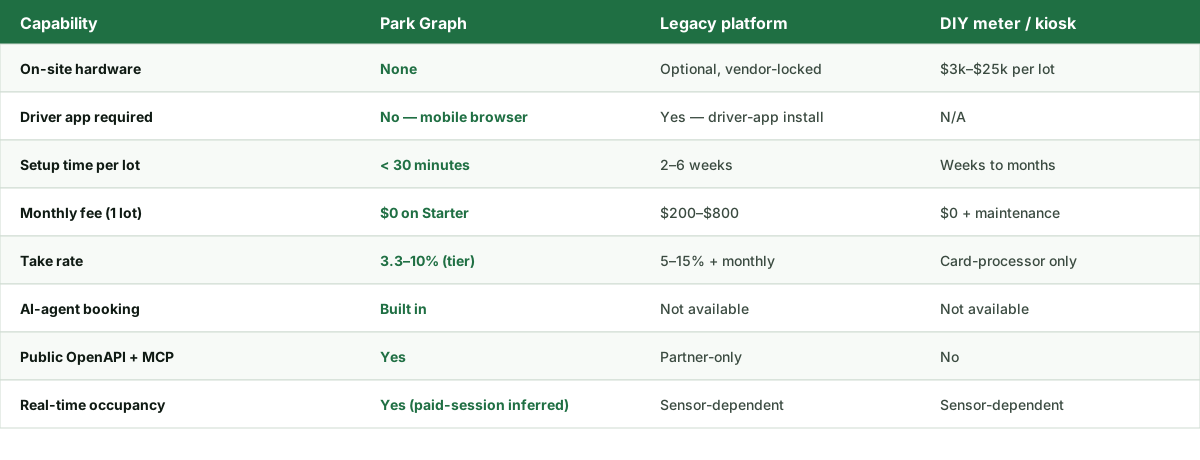
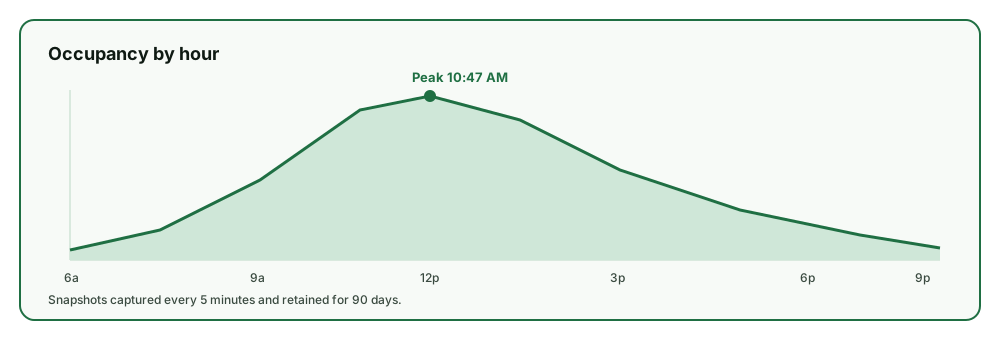
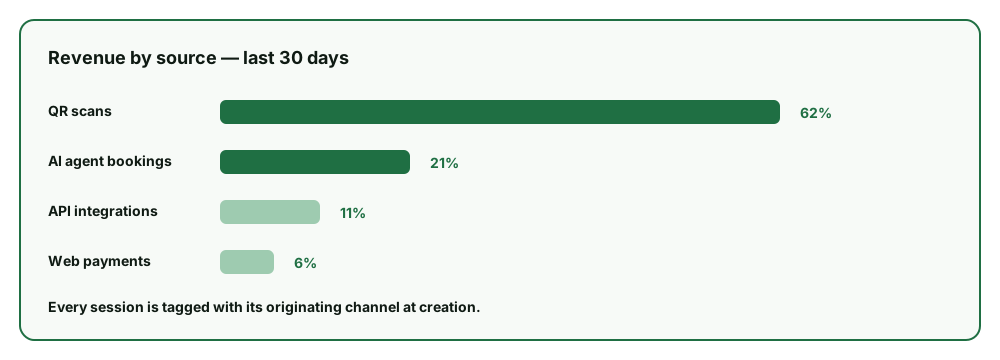
A benchmark only matters if it changes a decision. Once you know where your lot sits relative to its market, the next step is to test whether a rate adjustment improves revenue per space-hour — the metric that actually matters, since it accounts for both price and occupancy. Raising rates on an over-full lot recovers revenue you were giving away; trimming rates on a chronically empty lot can lift occupancy enough to more than offset the lower price. Park Graph attributes revenue back to each pricing rule and each channel, so you can see whether a change paid off rather than guessing. Because the platform is hardware-free, changing a rate is a dashboard edit that propagates to the QR payment screen instantly — no pay-station reprogramming, no site visit. For a deeper look at the methodology, run the parking price calculator or read the revenue optimization guide.
Optimize your rates with rule-based dynamic pricing
Park Graph's pricing engine adjusts your rates against rules you configure — time-of-day bands, occupancy thresholds, and event surge windows. Every rule change is versioned and reversible from the dashboard. Outcomes vary by lot type and demand profile.
Frequently asked questions
How often is the parking rate data updated?
Our parking rate data is compiled from industry surveys, municipal reports, and operator submissions. Rates represent citywide averages and are updated periodically.
Why do parking rates vary so much between cities?
Parking rates are driven by demand density, real estate costs, transit availability, and local regulations. Cities like New York and San Francisco have limited supply and high demand, driving rates significantly higher than mid-size cities.
How can I optimize my parking rates?
Park Graph's dynamic pricing engine adjusts rates based on rules you configure: time-of-day bands, day-of-week multipliers, occupancy thresholds, and event surge windows. Outcomes vary by lot — high-variance demand (event venues, airports during peak season) typically benefits more from rule-based pricing than steady commuter lots.
Get detailed rate analytics for your market
Sign up to access competitive benchmarks, pricing recommendations, and historical rate trends for your specific city and neighborhood.
Start collecting parking revenue today
Set up QR payments in 5 minutes. No hardware, no setup fees. Free forever on Starter.