Stadium event-day
Surge to $40 for the game-day window; revert to $5 base immediately after.
Events
Money page · Parking revenue optimization
Stop pricing your lot once a year. Park Graph applies time-of-day, day-of-week, occupancy, and event-driven pricing rules with operator-set caps and floors — and attributes every revenue dollar to the channel that delivered it.
Parking is one of the last consumer markets where prices change once a year. Hotels re-price by the hour. Airlines re-price by the second. Ride-share platforms re-price based on real-time supply and demand. Parking — same product, same demand pattern — still defaults to a static printed rate set in a budget meeting.
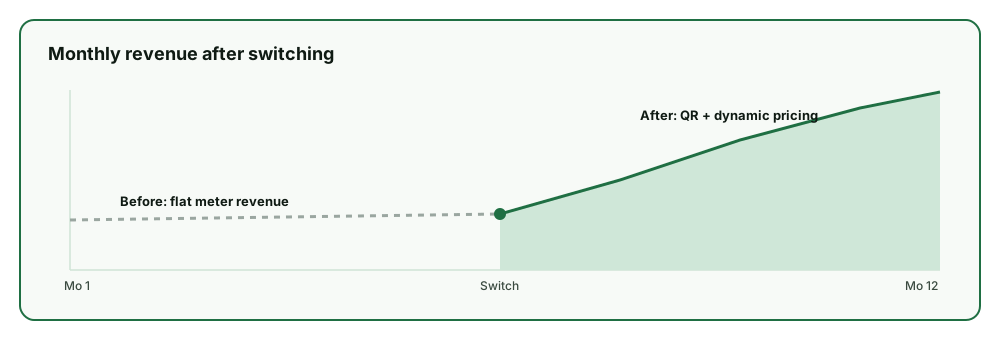
The opportunity for the operator is large. A 200-space downtown garage at $4/hour static, 40% utilisation, generates roughly $700,000 in annual gross. Adding time-of-day pricing (peak vs off-peak) and event-window surges typically lifts that to $810,000 - $875,000 — without changing the lot, the staff, or the marketing. Park Graph is how you get from the first number to the second.
| Pain today | What it costs you | How Park Graph fixes it |
|---|---|---|
| Static rates set once a year leave money on the table during peaks | Material projected gap on event-heavy lots; magnitude varies by demand variance | Time-of-day, day-of-week, and occupancy-based pricing rules with stackable priorities. |
| Operators can't see channel-level revenue mix | Bad investment decisions on driver experience and partnerships | Per-channel attribution dashboard (transient, reservation, permit, validation, AI agent). |
| Permit pricing decisions are made without yield modelling | Capacity over-allocated to lower-yield permits | Per-lot permit-yield score with a recommended sell/hold position. |
| Surge pricing during events requires a service visit on legacy meters | $150+/visit, slow response, missed peaks | Publish surge windows from the dashboard. Live within seconds. |
| AI-agent bookings are invisible to existing revenue tools | Can't attribute or invest in agentic discovery | Per-agent attribution in the dashboard and in CSV exports. |
Dynamic pricing. Time-of-day, day-of-week, occupancy threshold, and event-window rules. Operators set caps and floors so prices never exceed reasonable bounds. The current rate is shown on the QR payment page so drivers always know what they're paying before they commit.
Demand forecasting. Per-lot models trained on at least 30 days of session history produce a 7-day forward forecast. Operators use the forecast to publish event windows in advance, schedule cleaning and staffing, and tune permit issuance.
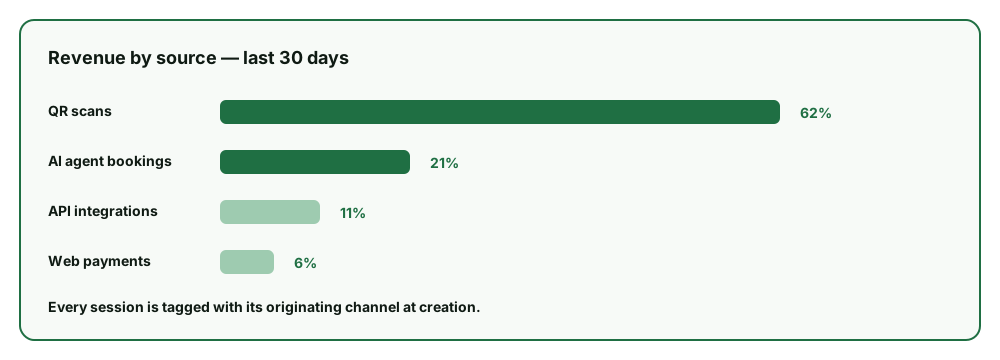
Channel attribution. Every revenue dollar is attributed to the channel that delivered it: transient QR scans, advance reservations, monthly permits, validations, and AI-agent bookings. Operators use the mix to decide where to invest.
Operational controls. Refunds, capacity caps, blackouts, manual overrides, and audit logging. Park Graph never imposes a pricing decision on the operator — the platform suggests, the operator decides.
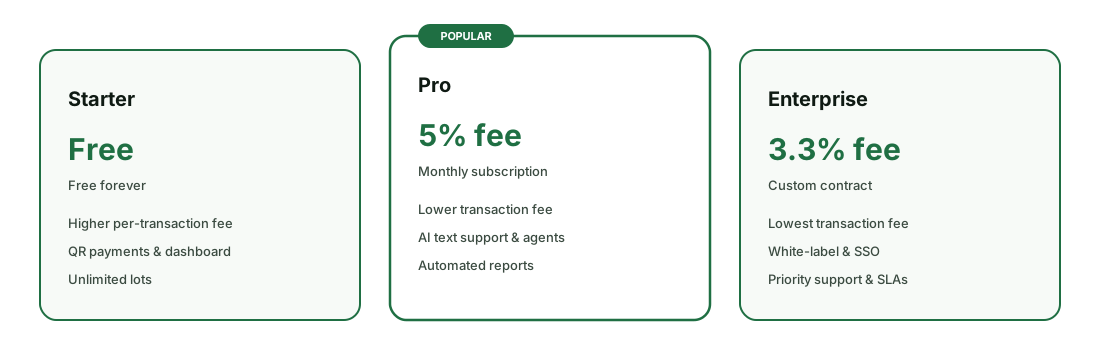
See how much you could earn with Park Graph.
Projected monthly revenue
$86,400
Starter
Platform cost
$8,640/mo
Your net revenue
$77,760/mo
Pro
Best valuePlatform cost
$4,819/mo
Your net revenue
$81,581/mo
Enterprise
Platform cost
$5,350/mo
Your net revenue
$81,050/mo
The calculator above is the same tool we use in customer onboarding to model expected revenue lift. The base scenario is your current lot at its current rate and utilization. The Park Graph scenarios show the typical lift from a) running the same static rates with no friction, and b) enabling time-of-day plus occupancy-based dynamic pricing.
Total Revenue
$12,847
Sessions
342
Occupancy
73%
Avg Rate
$8.40
Revenue by source
Free Starter plan, no credit card required.
Add address, capacity, and base hourly rate.
Time-of-day, day-of-week, occupancy, event-window. Stack with priorities.
Maximum surge multiplier, minimum rate, daily cap.
Model needs ≥30 days of session data per lot.
Dashboard surfaces opportunities and exceptions every Monday.
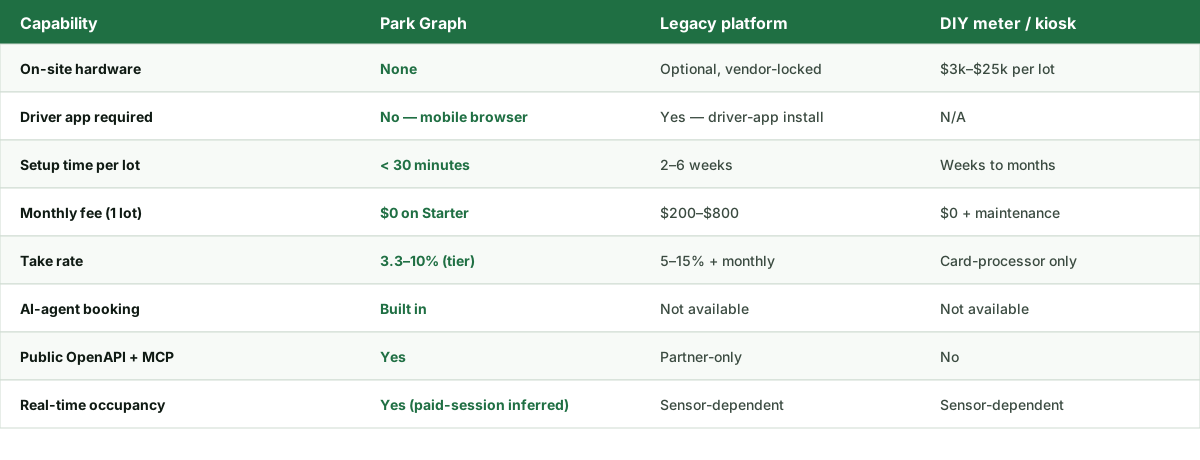
| Capability | Park Graph | Legacy parking platform | DIY / hardware-based |
|---|---|---|---|
| Time-of-day pricing | Built in | Add-on | Build it |
| Occupancy-based pricing | Built in | Add-on | Build it |
| Event-window pricing | Built in | Sometimes | Build it |
| 7-day demand forecast | Built in | Add-on or absent | Build it |
| Per-channel revenue attribution | Built in | Limited | Build it |
| AI-agent attribution | Built in | Not available | Build it |
| Permit-yield modelling | Built in | Not available | Build it |
| Operator-set price caps + floors | Built in | Vendor-dependent | Build it |
Surge to $40 for the game-day window; revert to $5 base immediately after.
Events
Time-of-day rule lifts rate $1/hr from 8-10am and $1/hr from 4-7pm.
Commute
Rate scales with current occupancy and remaining capacity to clear inventory.
Travel
Permit-yield score recommends holding 15% of capacity for higher-paying transient.
Yield
Holiday-calendar rule lifts rates on the 12 highest-tourism days of the year.
Calendar
Rate combines parking + charging with a single transaction; surge applied to overnight slots.
Hospitality
Revenue optimization at a glance
Magnitude depends on demand variance and rule configuration
Retrained nightly per lot
No revenue-management surcharge
0%
Revenue lift target (high-variance lot)
0 day
Forecast horizon
$0
Revenue management surcharge
0
Pricing rule types
Projected targets reflect 2026+ planning and internal pilot modeling — not live customer outcomes.
Operator-set price caps + floors
Park Graph never exceeds the operator's configured maximum or undercuts the floor.
Transparent driver communication
Current rate displayed on the QR payment page before the driver commits.
Audit log on every override
Manual rate changes logged with operator id, time, and reason.
PCI DSS Level 1 (via Stripe)
All payment data tokenised in driver browser.
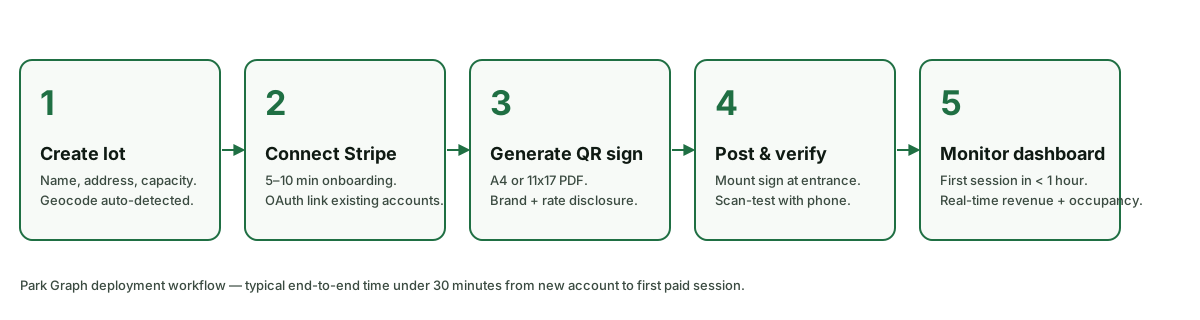
The calculator below estimates monthly take-home revenue across Starter, Pro, and Enterprise plans for any lot size, hourly rate, occupancy, and operating-hour configuration you choose. Numbers update live as you adjust the inputs.
See how much you could earn with Park Graph.
Projected monthly revenue
$86,400
Starter
Platform cost
$8,640/mo
Your net revenue
$77,760/mo
Pro
Best valuePlatform cost
$4,819/mo
Your net revenue
$81,581/mo
Enterprise
Platform cost
$5,350/mo
Your net revenue
$81,050/mo
Free forever on Starter. Pricing rules and forecasting included on every plan.