Hotel PMS integration
Push a room booking into Park Graph as a parking reservation; guest gets one confirmation.
Hospitality
Money page · Parking API integration
Read the spec. Hit the sandbox. Ship. Park Graph publishes the same parking API to every customer — no partner program, no enterprise gate, no “email us for access”.
The Park Graph API is built for four buyer profiles: developers at property tech companies who need parking as a billable line item, integration teams at hospitality and event-venue platforms who need to push room or ticket bookings into parking inventory, AI-agent builders who need a stable parking surface to call from ChatGPT Actions, Gemini, or custom assistants, and ops engineers at parking-operating companies who need to pipe events into their own warehouses for blended analysis.
The common requirement across all four is a public, contract-tested API with sane defaults, a free sandbox, and no sales engineer engagement to get a key. We built Park Graph this way because we have all been on the other side of a partner-only integration program. They are slow, they are expensive, and they discourage exactly the kind of long-tail integration that compounds platform value.
| Pain today | What it costs you | How Park Graph fixes it |
|---|---|---|
| Legacy parking platforms expose partial or partner-only APIs | Custom integrations cost $30k-$200k | Park Graph publishes the same OpenAPI spec to every customer; sandbox + SDKs are free. |
| AI agents can't discover non-API parking | Lost top-of-funnel from agentic search | MCP server + structured availability feed. Drop-in for ChatGPT Actions, Gemini, etc. |
| Webhook reliability is poor or undocumented | Lost events, manual reconciliation | At-least-once delivery, idempotency keys, 24-hour retry, signed payloads. |
| Onboarding requires a sales engineer engagement | Weeks of delay on go-live | Self-serve sandbox, public docs, no sales gate. |
| API keys lack scope or rotation tooling | Security exposure, all-or-nothing breaches | Per-lot and per-capability scoping, rotation, IP allowlists, audit log. |
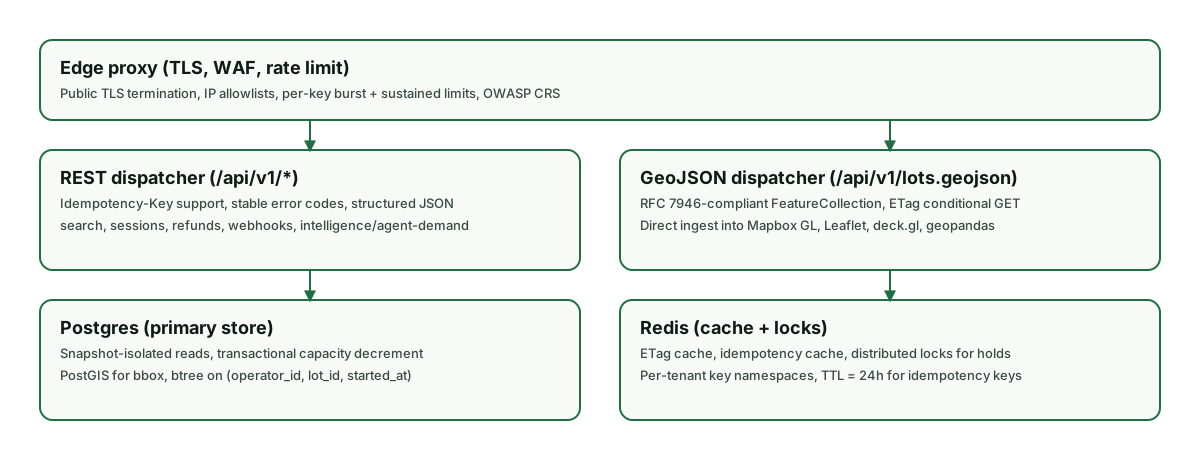
The Park Graph API is organised around six top-level resources: lots (locations and capacity), sessions (paid parking events), reservations (held capacity for a future window), permits (recurring billing relationships), validations(third-party comp or discount codes), and payouts(Stripe Connect settlements). Each resource supports the standard CRUD verbs plus resource-specific actions (refund a session, redeem a reservation, etc.).
Beneath those resources sit two query APIs: availability(real-time fullness and price for a lot or geographic region) and analytics(revenue, occupancy, channel attribution by timeframe). These are the read paths AI-agent integrations and BI tools query most heavily.
Webhooks fire on every state change with a typed payload that matches the OpenAPI spec. Delivery is at-least-once with HMAC-SHA256 signing, idempotency keys, and 24 hours of exponential-backoff retries on failure. Subscribe to specific event types (session.created, payout.completed) or to a wildcard for everything.
Total Revenue
$12,847
Sessions
342
Occupancy
73%
Avg Rate
$8.40
Revenue by source
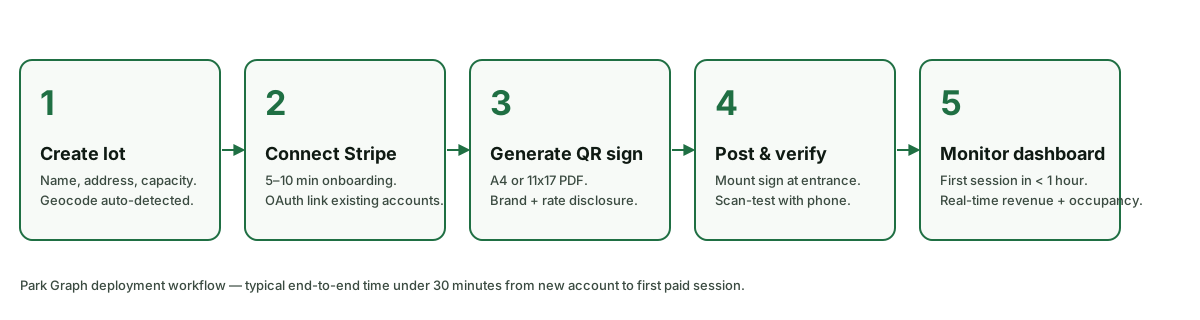
Free Starter plan, no credit card.
Dashboard → Developers → Keys. Choose scope.
Run a curl request against the sandbox endpoint to verify auth.
TypeScript or Python; both generated from the OpenAPI spec.
Subscribe to session.created and session.refunded.
Swap sandbox base URL and key; same payloads, real money.
| Capability | Park Graph | Legacy parking platform | DIY / hardware-based |
|---|---|---|---|
| Public OpenAPI spec | Yes (3.1) | Partial / partner-only | Build it |
| MCP server for AI agents | Yes | Not available | Build it |
| Official SDKs (TS + Python) | Yes | Vendor-dependent | Build it |
| Sandbox environment | Yes (free) | Paid / Enterprise | Build it |
| Webhook delivery | At-least-once + retries | Variable | Build it |
| Self-serve API key | Yes | Often gated | N/A |
| Rate limits scale with plan | Yes | Vendor-dependent | N/A |
| OAuth 2.0 client credentials | Yes | Vendor-dependent | Build it |
Push a room booking into Park Graph as a parking reservation; guest gets one confirmation.
Hospitality
Auto-create a Salesforce account when a new operator signs up; sync revenue per lot.
CRM
Webhook → QuickBooks invoice on every payout. CSV export for monthly reconciliation.
Accounting
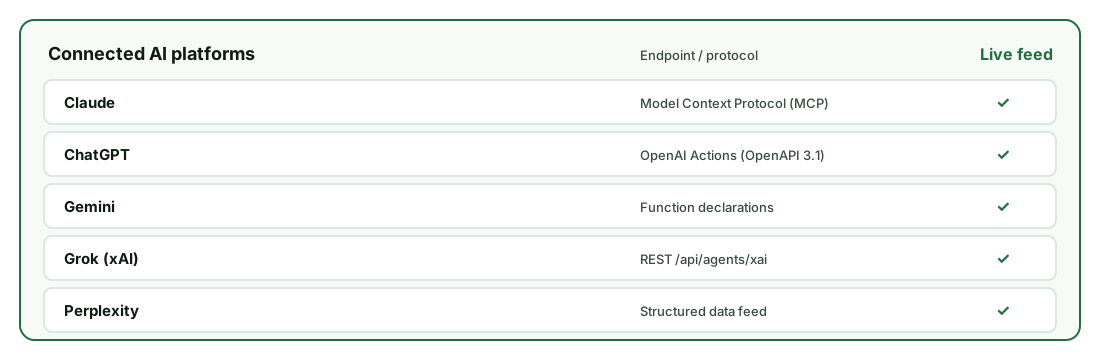
ChatGPT books parking through the MCP server alongside hotel and dinner reservations.
AI
Autonomous-vehicle dispatcher books staging spots through the developer API.
Fleet
Embed Park Graph parking inside a multi-tenant property app via the API + webhooks.
PropTech
API at a glance
Sign-up → curl response
Included on every plan
Same payloads as production
0 min
Time to first API call (target)
$0
API surcharge
0%
API uptime target
0
AI agents supported
Projected targets reflect 2026+ planning and internal pilot modeling — not live customer outcomes.
OpenAPI 3.1 spec is the contract
Semver discipline; deprecation notices for breaking changes.
Webhook signing (HMAC-SHA256)
Every webhook is signed; rotate signing secrets at any time.
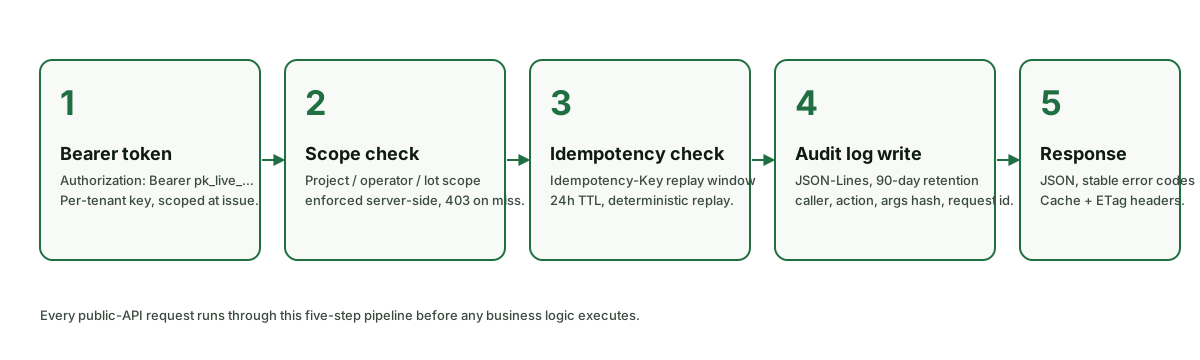
Per-key scope + IP allowlist
Limit blast radius of any single key compromise.
99.9% API uptime target
Status published in real time; Enterprise SLAs available.
The most common build on top of the Park Graph parking API integration is a companion app — a parking marketplace, a ride-share extension, a map overlay, a hotel concierge product, an EV-routing tool — that needs real-time availability, deterministic pricing, and the ability to actually transact a session without shipping the user to a third-party flow. Park Graph supports all three with one OpenAPI document, one set of credentials, and one webhook stream.
A second common build is internal: an operator's own data team backfilling a warehouse with session-level events, joining them to CRM data, and building dashboards that the platform UI doesn't expose. The same API that powers the Park Graph dashboard powers the warehouse export and the AI-agent integration — there is no second-class read path.
A third, increasingly common build is the AI-agent client itself. Agents are first-class API consumers on Park Graph, with rate limits, audit logs, and per-agent reservation policies. The MCP server, OpenAI Actions manifest, and Gemini function definitions are generated from the same OpenAPI spec, so an agent built against any of them gets parity with a hand-rolled REST client.
The calculator below estimates monthly take-home revenue across Starter, Pro, and Enterprise plans for any lot size, hourly rate, occupancy, and operating-hour configuration you choose. Numbers update live as you adjust the inputs.
See how much you could earn with Park Graph.
Projected monthly revenue
$86,400
Starter
Platform cost
$8,640/mo
Your net revenue
$77,760/mo
Pro
Best valuePlatform cost
$4,819/mo
Your net revenue
$81,581/mo
Enterprise
Platform cost
$5,350/mo
Your net revenue
$81,050/mo
Free API access on every plan. No sales gate.