Surface lot operator
20-500 spaces, no booth. Park Graph is the entire operations stack.
Most common
Money page · Parking lot software
Run any number of lots from one cloud dashboard. No per-lot subscription, no on-premise install, no proprietary hardware. Update rates from your phone. Get paid directly to your Stripe account.
Park Graph is built for the operator. We don't sell to a national meter vendor and let them re-skin our platform; we sell to the person whose name is on the lease, whose email gets the Stripe payout receipt, and who would prefer to spend a Tuesday afternoon doing literally anything other than filing a service ticket because the credit card reader on a meter is offline.
That includes single-lot owners, multi-lot regional operators, mixed-use developers, municipalities, hospitals, hotels, event venues, and faith-and-community organisations. The common thread is operators who want software that does not require on-site service contracts, proprietary terminals, or a multi-week onboarding consultancy.
| Pain today | What it costs you | How Park Graph fixes it |
|---|---|---|
| On-premise software requires IT staff and breaks on the vendor's schedule | $10k-$50k/yr in IT overhead, weeks of downtime per major upgrade | Cloud-based — Park Graph deploys updates automatically with no operator action. |
| Vendor-locked hardware ties you to one supplier | Premium hardware prices, slow innovation | Hardware-optional. Bring your own gate, sensor, LPR, or skip them entirely. |
| Per-lot pricing punishes growth | Each new lot adds a monthly line item | Park Graph charges per operator account; lot count is unlimited on every plan. |
| Drivers refuse to install another app | 20-35% abandoned payments | Browser checkout — no app, no account. |
| Reporting requires waiting for a vendor PDF | Slow operational and pricing decisions | Real-time dashboard, CSV/JSON exports, webhook stream, Postgres read replica. |
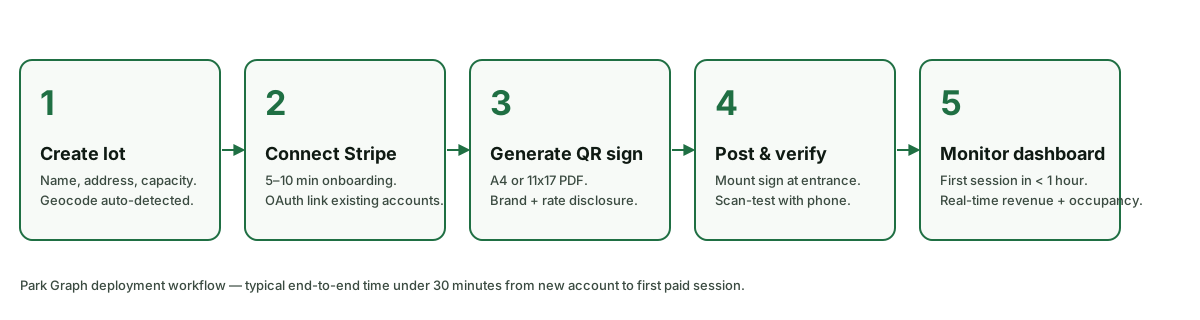
You sign up at parkgraph.com. You create your first lot in the dashboard with the street address, capacity, hourly rate, and daily maximum. You connect a Stripe account (existing accounts link instantly; new accounts onboard in 5-10 minutes). You download the print-ready QR sign PDF and post it at the lot.
Drivers pull in, scan the QR code with their phone camera, pay in their browser with Apple Pay or Google Pay or any major card, and receive a digital pass. Sessions appear on your dashboard in real time. Stripe payouts settle to your bank on Stripe's normal cadence. Refunds are 1-click. Disputes are auto-evidenced. Reporting is real-time, exportable, and warehouse-friendly.
When you want more capability — gate integration, sensor enrichment, EV charging, AI-agent visibility, permit billing, validations, accounting integration — you turn it on in the same dashboard. Nothing requires a service ticket; nothing requires a new contract.
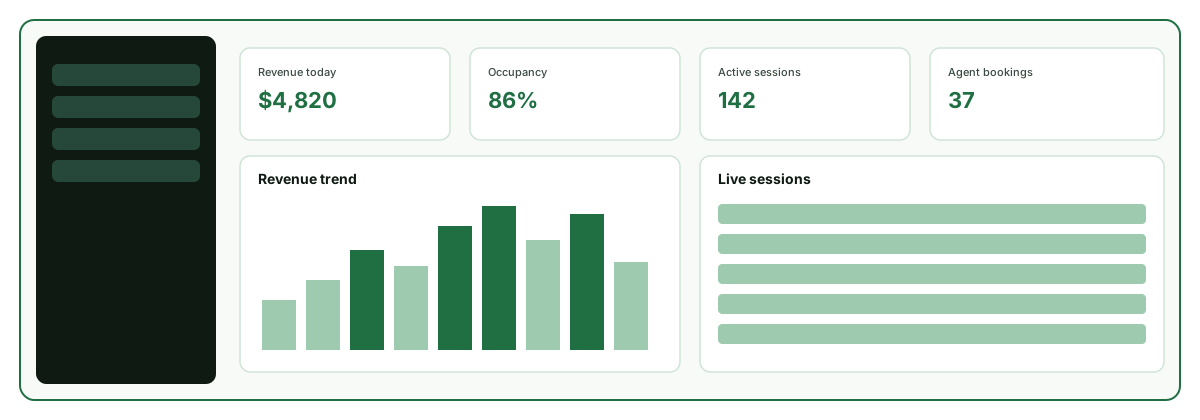
Total Revenue
$12,847
Sessions
342
Occupancy
73%
Avg Rate
$8.40
Revenue by source
Free Starter plan; no credit card required.
Address, capacity, hourly and daily rates.
Existing Stripe accounts link instantly.
Download the print-ready PDF.
Same flow; no per-lot fee.
Gate, sensor, LPR, EV charging, accounting, CRM, AI agent visibility — all via the dashboard.
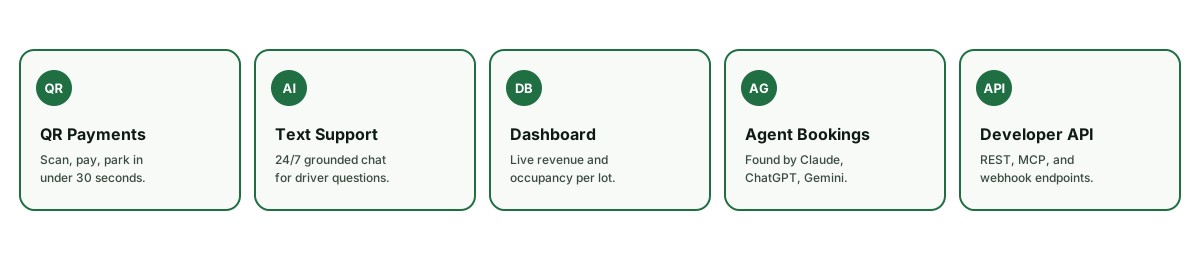
From QR-based payments to AI agent integrations — Park Graph is the complete infrastructure layer.
Drivers scan, pay, and park in under 30 seconds. No app download, no account required.
Revenue tracking, occupancy heatmaps, source breakdown, and weekly performance reports.
Connect to ChatGPT, Claude, Gemini, and every AI assistant through a single API.
Automatic surge pricing based on events, occupancy, time of day, and demand signals.
Aligned with SOC 2 controls — row-level security, scoped API keys, and comprehensive audit logs.
REST API, MCP, OpenAI Actions, Gemini Functions — every platform, one integration.
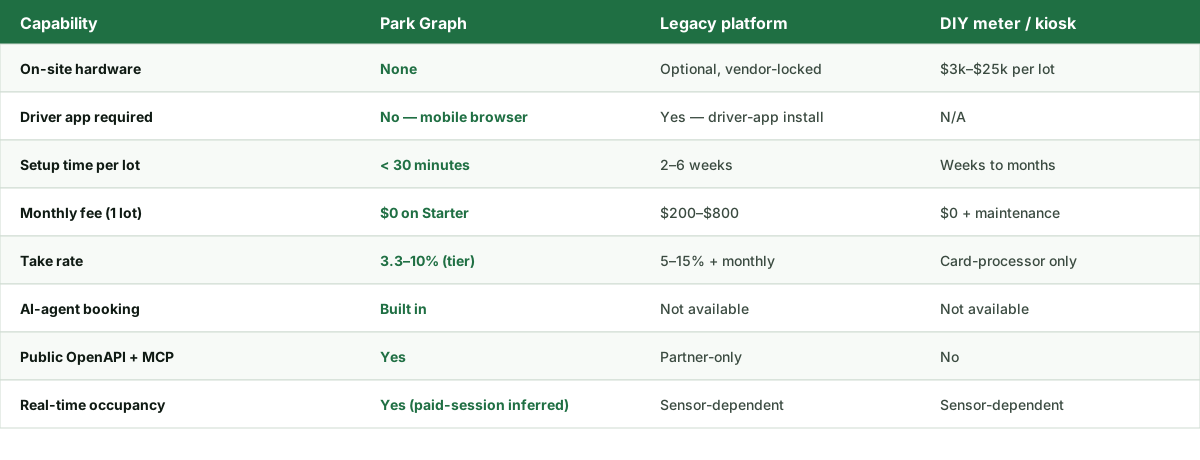
| Capability | Park Graph | Legacy parking platform | DIY / hardware-based |
|---|---|---|---|
| Cloud-based | Yes | Often on-prem | On-prem |
| Per-lot pricing | No (unlimited lots) | Yes | N/A |
| Hardware required | None | Often required | Required |
| Driver app required | No | Yes | N/A |
| Real-time dashboard | Yes | Add-on | Build it |
| Public API | Yes | Partial | N/A |
| AI agent booking | Built in | Not available | Build it |
| Take rate | 3.3-10% | 5-15% + monthly + per-lot | Stripe only |
20-500 spaces, no booth. Park Graph is the entire operations stack.
Most common
10-200 lots across a region, consolidated dashboard, rollups by manager.
Multi-lot
Apartment + office + retail with shared parking; Park Graph handles permits, validations, and transient on one platform.
Mixed-use
On-street zones plus surface lots plus garages, all on one Park Graph account.
Public sector
Self-park, valet, and EV charging on one platform.
Hospitality
Sunday-only lot monetised the other six days with a QR sign.
Civic
Parking lot software at a glance
Unlimited lots on every plan
QR sign is the only physical artifact
Per lot
$0
Per-lot fee on any plan
$0
Hardware required
0 min
First-lot setup
0
AI agent platforms supported
Projected targets reflect 2026+ planning and internal pilot modeling — not live customer outcomes.
Cloud-native, multi-region
Distributed infrastructure for high availability.
PCI DSS Level 1 (via Stripe)
Card data tokenised in driver browser.
Per-operator data isolation
Row-level security on the underlying Postgres cluster.
Audit log on every change
Rate, refund, and configuration changes logged with operator id.
The historical assumption in parking lot software was that the platform existed to drive a piece of hardware — a gate, a meter, a pay-on-foot kiosk, an LPR camera. The software was an attachment to the hardware, sold and renewed alongside it. That assumption is the reason most operators experience their parking platform as a permanently-stale system that no one quite owns and no one can change.
Park Graph inverts the assumption. The software is the system of record. Hardware, where present, is an optional input or output: a gate that can be triggered by an API call, a sensor whose readings can be ingested, an LPR camera whose plate reads can be matched against active sessions. None of it is required, none of it is locked to a single vendor, and none of it blocks the operator from running a QR-only lot tomorrow morning while a hardware decision is still being debated.
This is why a brand-new operator can open a Park Graph account, list a lot, generate a QR sign, and accept a real Apple Pay session before lunch — and why a 200-lot operator can migrate the same way, lot by lot, with no rip-and-replace and no parallel platform period. The software does the work that hardware used to gatekeep.
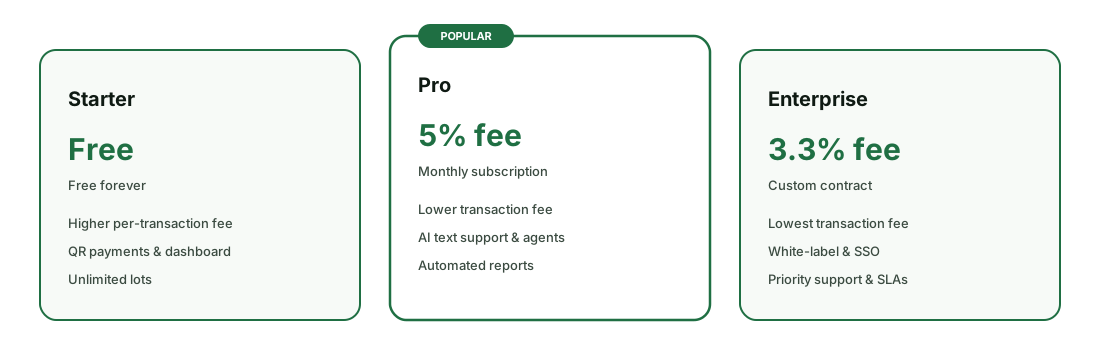
The calculator below estimates monthly take-home revenue across Starter, Pro, and Enterprise plans for any lot size, hourly rate, occupancy, and operating-hour configuration you choose. Numbers update live as you adjust the inputs.
See how much you could earn with Park Graph.
Projected monthly revenue
$86,400
Starter
Platform cost
$8,640/mo
Your net revenue
$77,760/mo
Pro
Best valuePlatform cost
$4,819/mo
Your net revenue
$81,581/mo
Enterprise
Platform cost
$5,350/mo
Your net revenue
$81,050/mo
Free forever on Starter. Unlimited lots on every plan.