Asset manager review
Quarterly review uses the executive PDF; ad hoc questions answered in the dashboard the same day.
Real estate
Money page · Parking lot analytics
Stop running your parking business off month-old PDFs. Park Graph's analytics surface every metric that matters in real time, attributes every dollar to the channel that delivered it, and exports cleanly to whatever warehouse or BI tool you already use.
Almost every operator we've onboarded started by complaining about visibility. Their previous platform shipped a quarterly PDF. Their meter vendor sent a monthly spreadsheet that didn't reconcile to the bank. Their permit system lived in a separate tool. Their AI-agent integrations — when they had any — produced no data they could see.
Real-time analytics is the foundation that makes every other Park Graph capability useful. Dynamic pricing without real-time occupancy is guesswork. AI-agent discoverability without per-agent attribution is invisible. Forecasting without historical data is fantasy. The dashboard is the place where every Park Graph signal becomes legible.
| Pain today | What it costs you | How Park Graph fixes it |
|---|---|---|
| End-of-month spreadsheets are the only revenue visibility | 30+ days of lag on pricing and operational decisions | Real-time dashboard updates within seconds of every event. |
| Vendor reports are static PDFs that arrive quarterly | Slow operator reaction, no ad hoc questions | Self-serve dashboard, CSV/JSON export, warehouse webhook stream. |
| Channel attribution is impossible (transient vs reservation vs permit vs AI) | Bad investment decisions on driver experience | Per-channel revenue breakdown built in. |
| AI-agent activity is invisible | Can't prioritise integrations or learn which agents drive value | Per-agent attribution: queries served, reservations booked, revenue attributed. |
| BI tooling requires custom data pipelines built by operators | $10k-$50k engineering cost per integration | Webhooks + Postgres read replica + OpenAPI spec — pipeline templates documented. |
Total Revenue
$12,847
Sessions
342
Occupancy
73%
Avg Rate
$8.40
Revenue by source
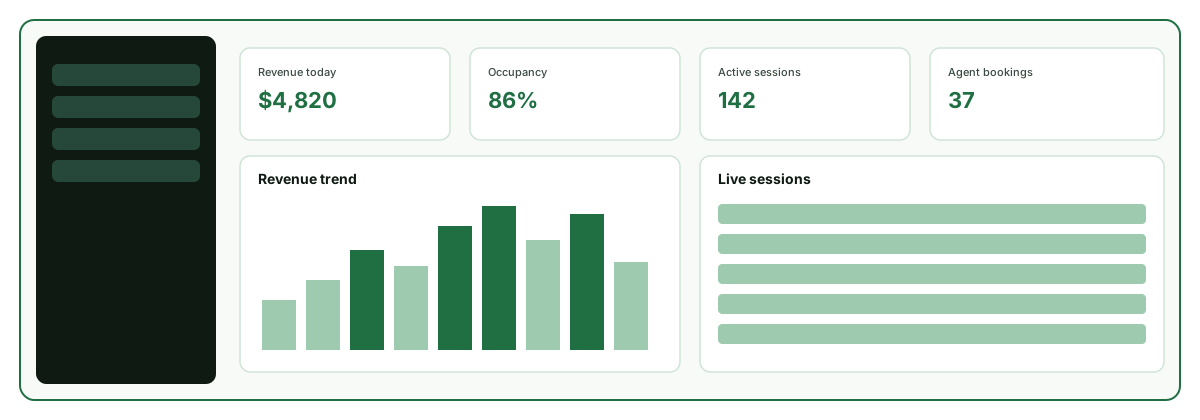
The dashboard preview above is a snapshot of the real interface. Tiles include revenue (gross + net + per-channel), occupancy (current + 24-hour spark + 7-day forecast), session count, AI-agent activity, refund rate, and lot health. Operators can pin custom tiles and rearrange the layout. The same view is available on mobile for on-the-go checks.
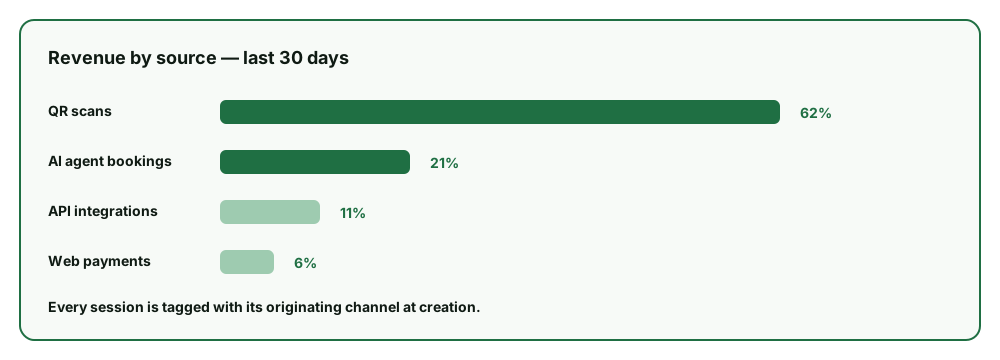
Park Graph models every paid session as belonging to one of five channels: transient QR scans (the default — driver arrives, scans, pays); reservations (driver booked in advance); permits (recurring monthly billing); validations (a third party — restaurant, hotel, hospital — comped or discounted the session); AI-agent bookings (an agent reserved on the driver's behalf).
Channel attribution lets operators see where revenue is concentrated, where pricing power lives, and where to invest in driver experience. A lot that is 80% transient and 20% AI-agent is a different business than a lot that is 60% permit and 30% reservation, even at the same gross revenue.
Free Starter plan.
Standard onboarding.
Real-time tiles populate as sessions come in.
Multi-lot operators tag lots by region or manager for grouped reporting.
Pipe events into your warehouse with the OpenAPI-typed payload.
Weekly or monthly auto-emailed snapshot.
From QR-based payments to AI agent integrations — Park Graph is the complete infrastructure layer.
Drivers scan, pay, and park in under 30 seconds. No app download, no account required.
Revenue tracking, occupancy heatmaps, source breakdown, and weekly performance reports.
Connect to ChatGPT, Claude, Gemini, and every AI assistant through a single API.
Automatic surge pricing based on events, occupancy, time of day, and demand signals.
Aligned with SOC 2 controls — row-level security, scoped API keys, and comprehensive audit logs.
REST API, MCP, OpenAI Actions, Gemini Functions — every platform, one integration.
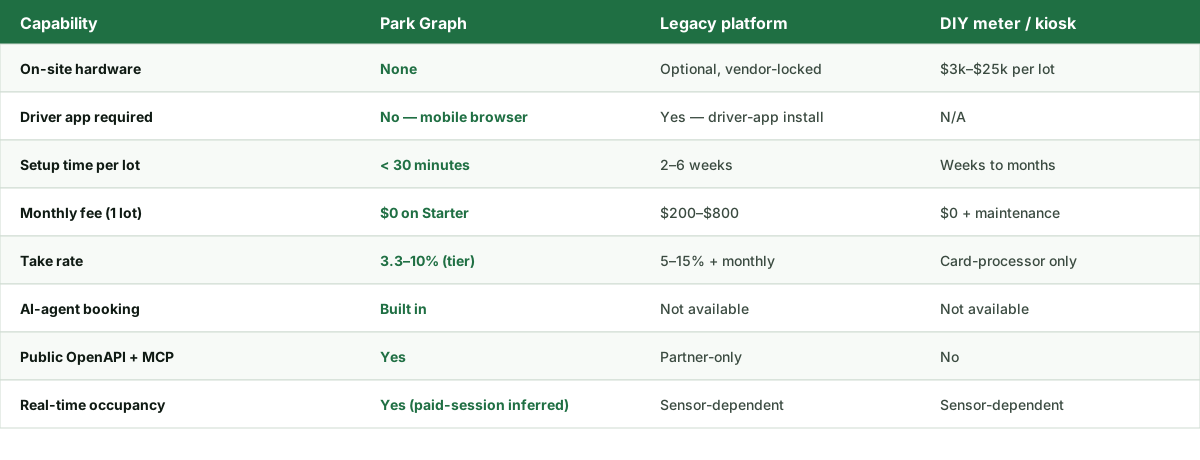
| Capability | Park Graph | Legacy parking platform | DIY / hardware-based |
|---|---|---|---|
| Real-time tiles | Yes (<5s latency) | Hourly or daily refresh | Custom |
| Per-channel attribution | Built in | Limited | Build it |
| AI-agent attribution | Built in | Not available | Build it |
| 7-day forecast | Built in | Add-on | Build it |
| Webhook event stream | Built in | Partial | Build it |
| Postgres read replica | Pro/Enterprise | Enterprise-only / extra | N/A |
| CSV/JSON export | Free tier | Paid tier | Build it |
| Print-friendly executive PDF | Built in | Paid add-on | Build it |
Quarterly review uses the executive PDF; ad hoc questions answered in the dashboard the same day.
Real estate
City parking director pulls the consolidated view and exports PDF for council session.
Civic
Operator shares a password-protected snapshot link with investors monthly.
Investor
Revenue manager uses the per-channel mix to decide whether to lift permit or transient prices.
Yield
Per-agent attribution shows which agent platform drives the most reservations — invest accordingly.
AI
Engineering team pipes Park Graph events into Snowflake for blended-revenue analysis with other property metrics.
Data team
Analytics included, no surcharge
From event to dashboard
Retrained nightly per lot
Included on every plan
0s
Tile latency (target)
0 day
Forecast horizon
$0
Analytics surcharge
0
Channels attributed
Projected targets reflect 2026+ planning and internal pilot modeling — not live customer outcomes.
Per-operator data isolation
Row-level security on the underlying Postgres cluster.
Privacy-first analytics
Driver PII minimised; license plates hashed; raw plate retained only for active session.
Audit log on every export
Every CSV and PDF export is logged with operator id, time, and scope.
GDPR + CCPA aligned
Driver data subject access requests fulfilled within statutory deadlines.
Most legacy parking platforms ship a monthly PDF — sometimes weekly, occasionally quarterly — that arrives long after any decision could have been informed by it. The PDF is hard to compare year-over-year, impossible to drill into, and disconnected from the bank statement that shows whether the operator was actually paid the right amount. Park Graph exists in part to retire that workflow.
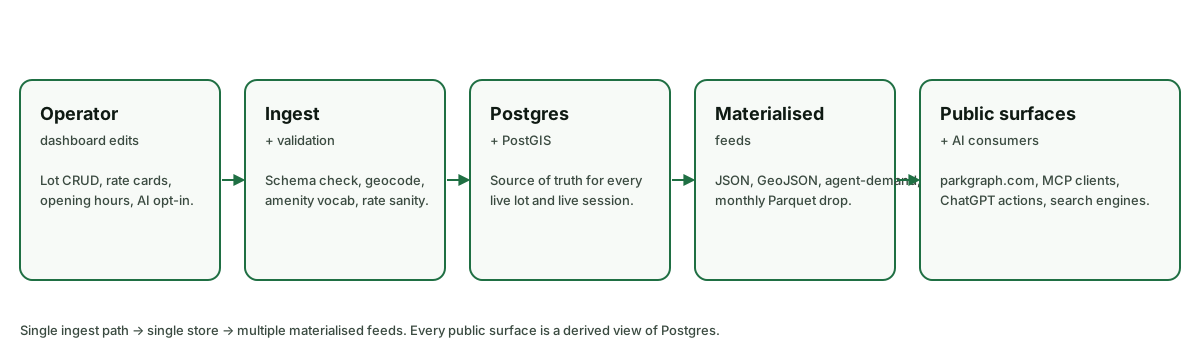
The replacement is simple in principle: every event the platform sees becomes a row in a queryable table within seconds, and every row is reachable from the dashboard, the API, and the warehouse export at the same time. CFOs read the dashboard during the board meeting; analysts pull the API into Looker before the board meeting; and the controller reconciles the bank export against the daily payout file the morning after. No one waits on a PDF.
Operators on Park Graph analytics report a measurable shift in pricing cadence within the first quarter of switching. Rate reviews move from quarterly to monthly, surge rules get tuned weekly, and abandoned-payment investigations move from anecdote to a tracked funnel. The data was always there; what changes is the speed at which the operator can act on it.
The calculator below estimates monthly take-home revenue across Starter, Pro, and Enterprise plans for any lot size, hourly rate, occupancy, and operating-hour configuration you choose. Numbers update live as you adjust the inputs.
See how much you could earn with Park Graph.
Projected monthly revenue
$86,400
Starter
Platform cost
$8,640/mo
Your net revenue
$77,760/mo
Pro
Best valuePlatform cost
$4,819/mo
Your net revenue
$81,581/mo
Enterprise
Platform cost
$5,350/mo
Your net revenue
$81,050/mo
Free forever on Starter. Real-time analytics included on every plan.