Free calculator
Parking hardware cost calculator: meters, pay stations, gates, and QR
Last updated: . Every calculation runs entirely in your browser; nothing is sent to our servers unless you opt in to email your result.
Why total cost of ownership matters more than capex
Parking hardware vendors quote capex because capex is the number that buys the order. The number that determines whether the order made financial sense five years later is total cost of ownership — capex plus maintenance plus merchant fees plus software, all summed across the hardware's useful life. The calculator above computes TCO so the comparison is honest.
The most common mistake operators make is comparing a $9.5K pay station to a $12 QR sign and concluding the pay station is "more substantial" or "more durable". Both perceptions are correct in isolation and irrelevant to the financial decision. Across 5 years, the pay station's maintenance and merchant fees dominate its capex by 4-5×; the QR sign has none of those costs but does carry a software subscription. Only the all-in number reveals the right answer.
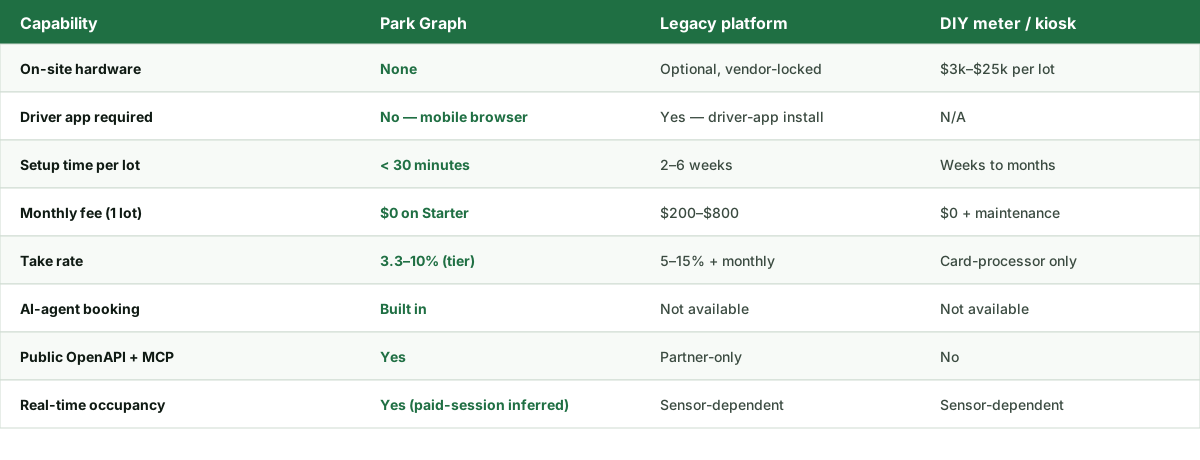
How the four major hardware categories compare
Single-space coin/card meters. Lowest per-unit capex but highest unit count — a 100-space lot needs 100 meters, so total capex scales linearly. Best for low-density paid street parking where a pay station would be too far from individual spaces. Worst for any lot where consolidating to a pay station is feasible.
Multi-space pay stations. Capex per station is high but per-space cost is moderate. Best for medium-density surface lots (15-50 spaces per station) with line-of-sight from spaces to station. Worst when the station is the only payment surface — a single failure takes the whole lot offline.
Entry/exit gates. Highest capex by far — $35-45K per lane. Best for paid-permit garages, access control, and high-control environments where physical gating delivers value beyond just collection. Worst for surface lots where the gate adds no enforcement value (drivers can just leave without paying via QR).
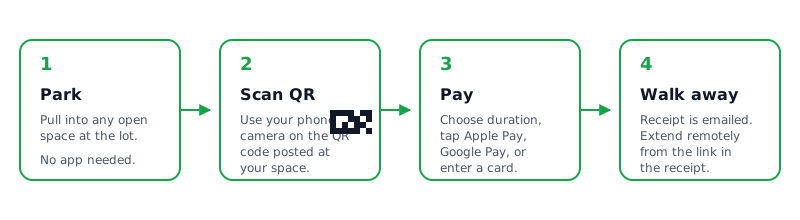
Printed QR signs. Negligible capex, zero ongoing maintenance, no merchant hardware to manage. Best for almost every surface lot under 500 spaces. Worst if your driver demographic is heavily non-smartphone (rare in 2026, persistent in some senior or rural communities). Mitigation: pair QR signs with a phone IVR fallback (call a number, pay by voice).
Reading the cost breakdown table
The breakdown table separates four cost lines so you can argue with each line individually if your numbers differ. Hardware capex is the one-time purchase and install cost. Maintenance is the contractual or expected ongoing service spend across the horizon you selected. Merchant / platform fee is what the payment rail takes on each transaction. Software subscription is the recurring SaaS or management software cost.
For legacy stacks, software subscription is usually $0 because the "software" is a flash-memory firmware on the hardware itself. The trade-off is that you can't add features without replacing the hardware — adding tap-to-pay to a 5-year-old meter costs ~$500/unit in retrofits. For QR + Park Graph, software subscription is the recurring fee but features ship continuously without operator action.
When the calculator's verdict shouldn't change your mind
The calculator answers a specific financial question. There are three legitimate reasons to choose the more expensive option anyway.
Regulatory mandate. Some municipalities require physical pay stations for on-street paid parking. Verify with your local public works department before assuming QR-only is permissible.
Access control. If physical gating is part of the lot's security model (e.g., overnight lockout for monthly permit holders), gates are non- negotiable. The calculator assumes you're comparing collection methods, not security measures.
Driver demographic mismatch. A lot serving a population without smartphones (some senior communities, some rural lots, tourists from regions without QR adoption) needs cash-and-card collection. Default to a hybrid setup — QR plus a pay station — rather than QR-only.
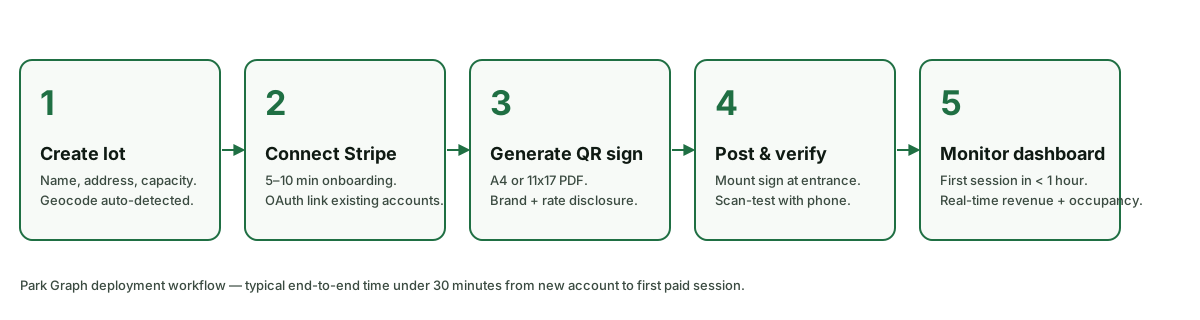
Build a hardware refresh business case in three steps
Most operators don't have an open budget line for "parking hardware refresh," so any modernization spend has to win on financial merit against other priorities. The strongest business case for a hardware refresh combines three numbers: current annual hardware spend (the line you are replacing), expected annual spend with the new approach (what the calculator projects), and the implementation cost amortized across the depreciation horizon. The difference between the first two, less the third, is the recurring annual benefit. Divide implementation cost by annual benefit to get payback period in years.
Step one is documenting the current state honestly, including the costs vendors avoid mentioning on quarterly invoices: cash-handling labor, downtime revenue loss during repair windows, vandalism-related repairs, and merchant-fee creep when processors quietly raise rates. Step two is modelling the new approach with the same line items, pulling defaults from the calculator and adjusting for known operational facts (e.g., a lot in a flood-prone area should add 10-15% to maintenance to account for weather-related accelerated wear, regardless of the hardware choice).
Step three is presenting the comparison side by side, ideally as a single page. Decision-makers approve refreshes when the comparison is legible at a glance — a one-line summary at top ("Switching from pay stations to QR saves $42K over 5 years on a 100-space lot"), a four-row table breaking out capex, maintenance, fees, and software, and a one-paragraph risks-and-mitigations note. Use the calculator's share link to send the live model along with the summary so stakeholders can adjust assumptions themselves.
Two patterns derail otherwise-sound business cases. The first is over-claiming the savings — assuming 100% adoption of the new payment method on day one, when in reality adoption ramps over 6-12 weeks as signage propagates and drivers adjust. Discount year-one savings by 25% to account for ramp. The second is under-counting transition risk. Budget 2-4% of annual gross for staff training, customer-support volume during the transition, and rollback contingency if the new approach under-performs. The calculator gives you the steady- state TCO; your business case adds these first-year frictions.
Related calculators
- ROI calculator — once you have a TCO number, the ROI calculator computes payback period and net benefit.
- Revenue calculator — model the gross revenue side that drives the merchant-fee line in this TCO.
- Parking payment system overview — deeper background on QR-first payment architecture and how it differs from legacy stacks.
Ready to turn this estimate into real revenue?
Print a QR sign, post it at your lot, and start accepting payments today. The Starter plan is free forever.
FAQ — Parking Hardware Cost Calculator
- How much does a single-space parking meter cost?
- A modern coin/card single-space meter costs $750-1,200 per unit installed, with annual maintenance running $200-350 per meter. Solar-powered smart meters from major OEMs (IPS, Duncan, Parkeon) sit at the higher end of capex but reduce ongoing maintenance by ~30% versus mechanical meters. Lifecycle is typically 7-10 years before head replacement.
- What does a multi-space pay station cost?
- Multi-space pay stations from vendors like Cale, Parkeon, and Flowbird run $8,500-12,000 installed for a unit serving roughly 25 spaces. Annual maintenance contracts add $1,500-2,500 per station. They consolidate hardware count but introduce single points of failure — when one fails, all 25 spaces lose paid-collection capability until repair.
- How does a QR-only setup compare on cost?
- Printed QR signs cost roughly $12 each — vinyl, weatherproof, with rate and lot ID burned in. A 100-space lot needs ~4 signs (one per cluster), so total signage capex is under $50. Software runs as a subscription (Park Graph Pro is $495/month, Starter is free). There is zero on-site maintenance: no mechanical parts, no batteries, no card reader to clean. Failure mode is print fade, mitigated by reprinting at 5-year marks.
- Why is the merchant fee shown as a separate line?
- Hardware-based collections (meters, pay stations, gates) usually route payments through a third-party processor (Heartland, Worldpay, etc.) at 2.4-3.5% of gross revenue. QR-based collections through Park Graph route through Stripe at our published platform fee (which includes the processor cost). Showing fees separately makes the comparison apples-to-apples — the all-in cost of ownership is capex + maintenance + fees + software, not capex alone.
- Should I include credit-card terminal cards in the capex?
- Yes if they're new spend, no if they came bundled with the meter or station. Most modern meters include EMV-capable readers as standard; older units that only accept coins need a $400-600 reader retrofit if you want to accept cards. The calculator's default capex assumes EMV-capable units; adjust upward if you're retrofitting.
- What's the average lifecycle of parking hardware?
- Coin/card meters: 7-10 years. Multi-space pay stations: 8-12 years. Entry gates and ticket spitters: 12-15 years for the chassis (motors and tickets dispensers replaced more frequently). Printed QR signs: 5 years before fade affects scan reliability. All of these assume reasonable maintenance — neglected hardware fails 30-50% sooner.
- What about gates and access-controlled garages?
- Entry/exit gates are the most expensive hardware category — $35-45K per lane for the gate, ticket spitter, and exit verification, plus $400-500/month per lane in maintenance. They make sense for high-revenue, high-control environments (airport garages, parking decks with monthly contracts). For surface lots, the math rarely works versus QR-based collection unless the lot is already gated for security reasons.
- Can I model a hybrid setup (gates at entry, QR at spaces)?
- Yes — run the calculator twice. First with gate hardware for the access-control cost. Then with QR for the in-space payment cost. Add the two totals. Many operators land on this hybrid for paid-permit garages where gates serve monthly contract holders and QR serves transient drivers. The hybrid avoids the per-space hardware cost while retaining gate-level enforcement for permit holders.