Case study
City of Riverbend: retiring the meters across seven paid lots
Municipal · City parking division
City of Riverbend paid parking
- Paid lots
- 7
- Curbside + off-street spaces
- 1,250
- Went live
- 2025
- Setup time
- 6 days
- Scan-to-pay adoption
- 85%
- Paid-parking revenue change
- +120%
Figures are operator-reported by the City of Riverbend parking division and authorized for publication. Revenue change is relative to the prior metered setup; absolute dollar amounts were not disclosed.
The problem: aging meters, coin boxes, and no clean ledger
Municipal parking is held to a standard most operators are not: the revenue is public money, and every dollar has to be auditable. The City of Riverbend ran curbside zones and off-street lots — 1,250 paid spaces across seven sites — on aging single-space and pay-and-display meters. That meant routine coin collection, field maintenance on hardware that kept failing, and reconciling revenue against meter counters rather than a clean record. Rates were hard to change without touching every unit, and the division had no single, defensible source for what each lot actually collected.
The fix: QR signage, no hardware, revenue it can audit
The division replaced the meters with printed Park Graph QR signage at each curbside zone and off-street lot. A driver scans the code, pays in their browser, and parks — no app, no account, no meter to feed. The division reported 85% scan-to-pay adoption across the paid lots and that all seven sites were live in six days, with no per-meter installation, coin collection, or field maintenance.
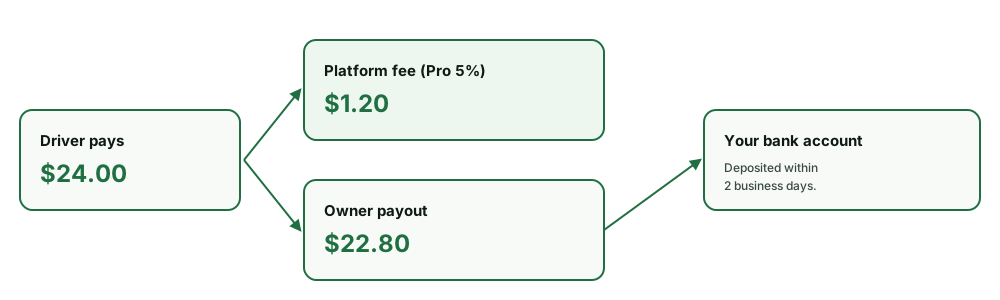
The decisive gain for a public agency was on reporting. Because Park Graph runs on Stripe Connect, paid-parking revenue settles directly into the division's own account and every session produces a reconcilable record it can audit against its bank deposits. With friction at the curb removed and pricing transparent to drivers, the division reported a 120% increase in paid-parking revenue against its prior metered setup.
How these numbers were measured
We hold ourselves to a clear standard on how we publish case studies. The figures above are operator-reported by the City of Riverbend parking division and authorized for publication. They reflect the division's own before-and-after measurement of scan-to-pay adoption and paid-parking revenue. We have not independently audited the underlying ledgers, so we present these as operator-reported rather than Stripe-verified. Revenue is stated as a percentage change relative to the prior metered setup because absolute dollar amounts were not disclosed for publication. A named, attributable operator quote is not included; we do not publish quotes we cannot attribute.
Explore the playbook behind this deployment
Frequently asked questions
- Are these figures verified?
- The metrics on this page are operator-reported and authorized for publication by the City of Riverbend's parking division. They reflect the division's own measurement of scan-to-pay adoption and paid-parking revenue change before and after switching to Park Graph. Revenue change is expressed as a percentage relative to the prior metered setup; absolute dollar figures were not disclosed for publication.
- How does a city audit the revenue?
- Park Graph runs on Stripe Connect, so paid-parking revenue settles directly into the division's own account and every session produces a reconcilable record. Instead of emptying coin boxes and reconciling against meter counters, the division reviews a clean ledger it can audit against its bank deposits — which is what a public agency needs for transparent, defensible reporting.
- What happened to the meters?
- They were retired. The deployment was hardware-free: printed QR signage at each curbside zone and off-street lot replaced the prior single-space and pay-and-display meters. The division reported all seven paid lots were live in six days, with no per-meter installation, coin collection, or field maintenance overhead.