Free tool
Parking demand estimator: daily trips, occupancy, and overflow risk
Last updated: . Every calculation runs entirely in your browser; nothing is sent to our servers unless you opt in to email your result.
Why parking demand estimation matters before you build
The cost of getting parking demand wrong is asymmetric. Build too many spaces and you carry land cost, maintenance, and lighting on inventory that never generates revenue — typical capex over-build penalty for a 50-space surplus is $400-800K plus $15-30K/year in carrying cost. Build too few spaces and you turn away revenue daily, drive customers to competitors, and accumulate complaints that depress reviews.
Industry practice has historically erred toward over-build because the cost is amortized over decades and the political consequences of under-build are immediate. The result is an estimated 2-3 billion surplus parking spaces in the US, much of which is vacant most of the time. Modern demand estimation aims to size lots tighter — closer to peak demand rather than 1.5× peak — and use dynamic pricing to shift edge demand into off-peak hours.
How the estimator's math works
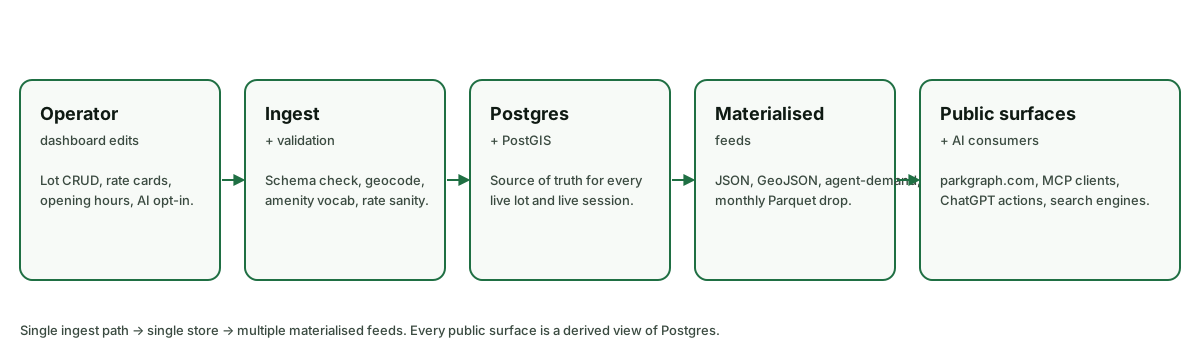
For the three population-driven lot types (retail, office, mixed-use), the estimator computes ambient trips from nearby population using a trip-generation ratio of roughly 1 daily parking trip per 50 residents. This is a simplification of the ITE Parking Generation Manual, which has hundreds of land-use categories with category-specific rates. The 1:50 ratio approximates the blended rate across mixed residential and commercial neighborhoods.
For airport and event lots, the estimator switches to a capacity-driven model: daily trips = spaces × peak occupancy × (24 / dwell hours). The intuition is that these lots fill near capacity during their peak window and the throughput is bounded by how fast spaces turn over, not by ambient demand. An airport long-stay lot with 8-hour dwell turns ~3 times per day per space; at 78% peak occupancy and 100 spaces, that's ~234 daily trips.
Capture share applies to all lot types: your share of ambient demand = your spaces / (your spaces + competing spaces). This is a crude approximation that assumes drivers split evenly across capacity. Real-world capture varies by price, distance, and quality, and a paid demand study would refine this — but the approximation is reasonable for sanity-checking a site.
Reading occupancy and overflow risk
Projected occupancy is the time-weighted utilization of the lot — the fraction of space-hours that are sold across a 24-hour day. A 50% occupancy lot has 50 of 100 spaces filled on average across the day, not necessarily 50 spaces filled at any single moment. This matters because peak occupancy is typically 1.5-2× the daily average.
Peak-hour trips approximates the volume during the busiest hour using the typical rule-of-thumb of 18% of daily volume in the peak hour. Combined with average dwell time, this gives a workable estimate of how many cars are physically in the lot at peak. For event lots, peak is sharper (sometimes 40-60% of daily volume in a single hour pre-event); for airports and offices, peak is flatter.
Overflow risk is a categorical summary of the occupancy projection. Low (under 70%) means comfortable headroom; moderate (70-85%) means you'll occasionally fill at peak; high (over 85%) means routine turnaways. The right operational response to high overflow risk is some combination of dynamic pricing (shift demand to off-peak), reservation gates (guarantee a space for premium drivers), and lot expansion (a last resort because of cost and amortization).
When to commission a paid demand study instead
The estimator above is fit for a 1-page sanity check. For binding decisions — site selection, lender pro-formas, formal land-use applications — commission a paid study from a transportation engineering firm. Typical scope is a 2-4 week observation period at the candidate site, traffic counts at adjacent intersections, occupancy surveys at competing lots, and a calibrated trip-generation model. Cost ranges from $5K (small surface lot) to $40K (large mixed-use garage).
Use the estimator's output as a starting hypothesis for the paid study. If the estimator says 80 daily trips and the study measures 200, the model under-estimated capture share — usually because the site has an unmeasured demand driver (a hospital, a tourist attraction, a transit hub) the population input didn't reflect. If the estimator and study agree within ±25%, the model is well-calibrated for the site.
Related calculators and tools
- Revenue calculator — combine the demand projection with a target rate to get a revenue estimate for the lot.
- Dynamic pricing calculator — if overflow risk is moderate or high, model how dynamic pricing shifts demand into off-peak hours.
- Optimal price calculator — for the simpler problem of finding the right rate given current occupancy.
Ready to turn this estimate into real revenue?
Print a QR sign, post it at your lot, and start accepting payments today. The Starter plan is free forever.
FAQ — Parking Demand Estimator
- What is parking demand estimation?
- Parking demand estimation predicts how many parking trips a site will generate in a typical day, the average dwell time per trip, and the resulting peak-hour volume and occupancy. It's used at site planning (to size a new lot), at acquisition (to validate a seller's revenue claim), and at operations (to plan for events or seasonal swings). The Institute of Transportation Engineers Parking Generation Manual is the industry-standard reference.
- How is daily parking demand calculated?
- For most lot types, demand is a function of nearby population (or floor area for non-residential), trip-generation rate per land use, and capture share against competing parking. The estimator above uses a simplified model: ambient trips = nearby population / 50, then capture share = your spaces / (your spaces + competing spaces). Airport and event lots use a capacity-driven model instead because demand is bounded by physical capacity, not population.
- What's a typical dwell time for each lot type?
- Airport long-stay: 6-10 hours (round trips averaged with multi-day stays). Retail: 1-2 hours. Office / commuter: 6-8 hours. Event / stadium: 3-4 hours (concentrated around event time). Mixed-use urban: 2-3 hours blended. The estimator above uses these as defaults; if your specific use case differs, the projection scales linearly with dwell time so adjust expectations accordingly.
- Why does the estimator ask for nearby competing spaces?
- Because demand is split across all available parking. A 100-space lot in an area with 1,000 competing spaces captures roughly 1/11 of ambient trips; the same lot with no competition captures all of them. The capture-share calculation is an approximation — real-world capture depends on price, distance, and quality — but it bounds the projection in a reasonable way.
- What's the overflow risk metric telling me?
- Overflow risk indicates whether projected occupancy at peak hour exceeds capacity. 'Low' means peak occupancy stays below 70% — the lot has comfortable headroom. 'Moderate' (70-85%) means peak nears capacity but is workable; budget for occasional turnaways during truly peak events. 'High' (>85%) means you'll routinely turn drivers away at peak; consider expansion, better demand-shifting via dynamic pricing, or reservation-only access.
- How accurate is this for site-planning use?
- Directional, not precise. The estimator is good enough to validate that a 100-space proposal isn't 10× too big or 10× too small. It is not good enough to commit to a final stall count. For binding site-planning decisions, commission a paid demand study from a transportation engineering firm (typically $5-15K for a small lot) which will measure actual nearby trip patterns over 2-4 weeks rather than relying on regional averages.
- What's missing from the model?
- Three significant factors. (1) Time-of-day demand variance (the model gives daily totals; real demand peaks 2-4× the daily average during peak hours). (2) Seasonality — beach lots double in summer, ski lots double in winter, neither is captured. (3) Event spillover — proximity to a stadium adds peak demand the population number doesn't reflect. For each of these, run the estimator separately for peak and off-peak scenarios and treat them as bounding cases.
- Can I use this to compare two candidate sites?
- Yes — that's one of the most valuable uses. Run the estimator twice with each site's population, competition, and lot type, then compare the projected daily trips and overflow risk. Pair this with a revenue calculator run at each site's expected rate to get a side-by-side acquisition comparison. Most operators do exactly this when sourcing acquisitions.
- What's 'turns per space per day' and why does it matter?
- Turns per space = 24 / average dwell hours. A retail lot turns ~12 times per day per space; an airport long-stay lot turns ~3 times. Higher turns mean more transactions, higher transaction-fee leakage, and tighter operational requirements (faster reset between drivers). Turns also drive infrastructure wear — high-turn lots need more durable signage and pavement maintenance.