Free tool
Parking lot audit checklist: 30 questions across 5 categories, scored out of 100
Last updated: . Every calculation runs entirely in your browser; nothing is sent to our servers unless you opt in to email your result.
Why a structured audit beats a gut check
Operators who've been managing parking for a decade develop strong intuitions about which lots are well-run. The intuitions are usually right but they're not transferable. A structured audit produces a number that survives staff turnover, that lenders and acquirers can compare across properties, and that can be tracked over time as an operational KPI.
The 30 questions in this checklist were assembled from three sources: published guidance from the National Parking Association on operator readiness, the audit checklists used by the largest parking REITs at acquisition, and Park Graph's own onboarding checklist for new operators. They cover the same ground as a $5K consultant engagement, with the consultant's narrative replaced by a numeric score and a printable remediation plan.
What the five categories test
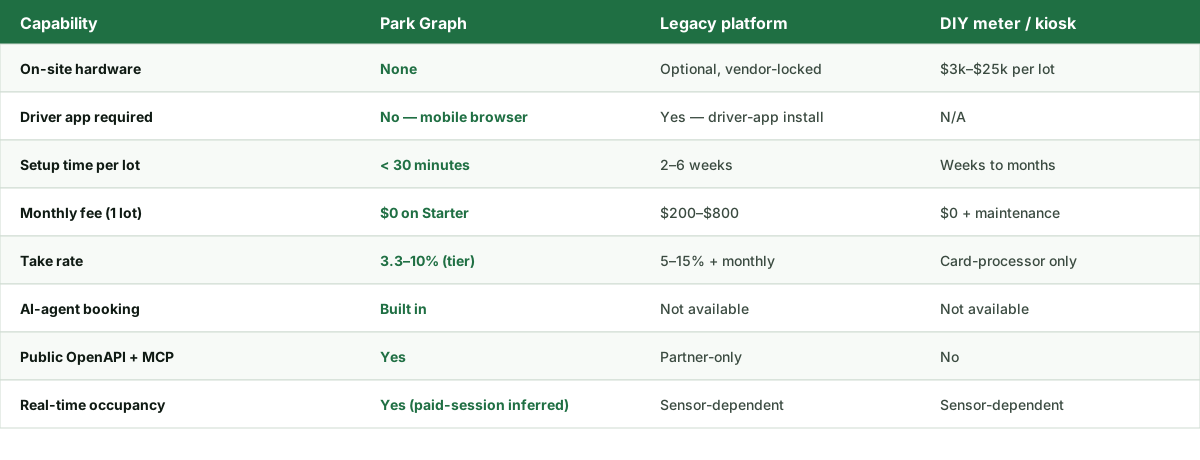
Payment infrastructure (six items). Tests whether drivers can pay quickly, with the methods they actually use. App-free QR payment, Apple Pay / Google Pay support, automatic receipts, painless refunds, demand-based pricing, and failed-payment recovery. A lot that fails three or more of these is losing 20-40% of would-be paying customers to friction.
Signage and wayfinding (six items). Tests whether the lot is legible to a first-time driver — visible QR, posted rate, weather resistance, WCAG-compliant contrast, clear lot identity, attendant contact. Failures here show up as lower occupancy at any given price (drivers can't figure out if the lot is open).
Compliance and accessibility (six items). Tests ADA conformance, tax remittance, PCI compliance, and privacy posting. Three of these carry maximum weight because failures create federal liability. Get this category right before optimizing anything else.
Operations and enforcement (six items). Tests the day-to-day workflow: occupancy visibility, LPR enforcement, daily reconciliation, staff session management, after-hours support, lighting compliance. Failures show up as revenue leakage and customer complaints.
Discoverability (six items). Tests whether drivers and AI agents can find the lot — Google Maps presence, AI-assistant results, structured data, real-time API, recent reviews, shareable URL. Failures show up as occupancy below the lot's potential because demand goes elsewhere.
How to interpret your score
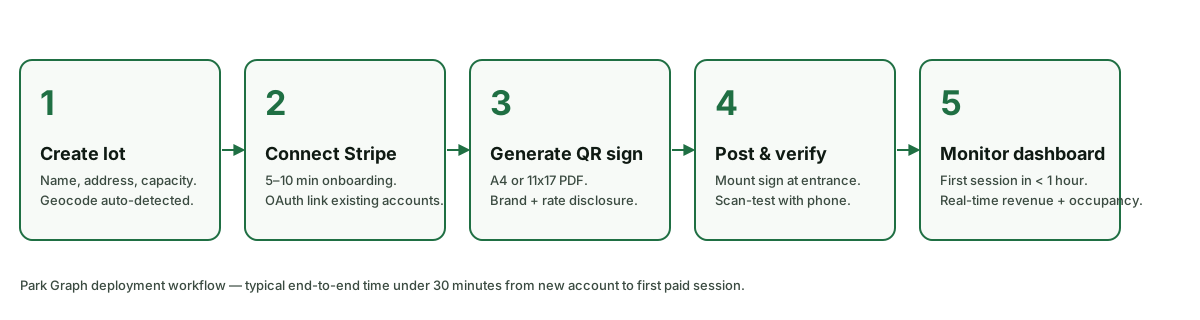
85-100: Operator-ready. The lot is competitive in the modern parking market. Continue quarterly re-audits to catch regressions. Most score improvements at this level come from chasing the last 1-2 weighted-1 items rather than any structural change.
65-84: Solid foundation, a few gaps. The lot is well-run but missing 2-4 specific modernization items — typically dynamic pricing, AI-agent discoverability, or LPR enforcement. Remediation is targeted and usually under $5K per gap.
40-64: Material modernization needed. The lot is operating but leaving meaningful revenue on the table and accumulating compliance risk. Remediation is multi-faceted but typically pays back within 6-12 months.
Under 40: High risk. The lot has fundamental gaps in payment infrastructure or compliance. Start with payment infrastructure (the fastest-payback fix); leave aesthetic improvements for later.
Turning the score into a fix list
The score is a number; the fix list is the actionable output. After requesting the remediation plan, you receive a prioritized list of every unchecked item with: a one-paragraph description of the fix, a rough cost estimate, a typical implementation timeline, a recommended vendor or in-house workflow, and the expected score-impact (in points) of completing the fix.
Sequence the fix list by score-points-per-dollar. Some fixes are nearly free (posting a privacy policy, publishing rates to Google Maps) and worth 1-2 points each. Some fixes are expensive (replacing pay stations with QR + LPR) and worth 8-15 points. The right sequence depends on your budget and timeline; the plan presents both an aggressive (90-day) and a sustainable (12-month) sequencing option.
How to run the audit on a portfolio, not just one lot
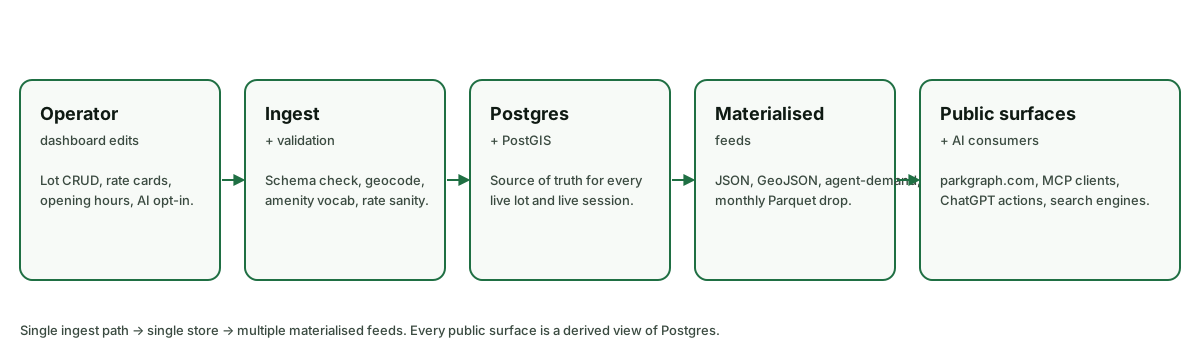
Single-lot audits are useful but the real operational payoff comes from running the same audit across a portfolio. A portfolio view turns the per-lot score into a comparative ranking — which lots are dragging the portfolio average down, which are pulling it up, and where the highest-leverage remediation dollars should go. Operators with 5+ lots routinely find that two or three properties account for the majority of portfolio-wide compliance risk and revenue leakage, even when those properties don't feel like obvious problems day-to-day.
The mechanical setup is straightforward. Walk each lot using the printed checklist, enter responses into a separate browser tab per lot (the local-storage persistence keeps each lot's state isolated), and capture the share-URL for each lot in a spreadsheet. Add a column for the score and a column for the top three unchecked items. The resulting table is the portfolio dashboard — sortable by score, filterable by which categories failed, ready to hand to the operations director or to a board.
For larger portfolios (20+ lots), the right cadence is a quarterly mini-audit on every lot and a deep annual audit on the lowest-scoring quartile. The mini-audit re-checks just the high-weight items (ADA, payment infrastructure, signage visibility) to catch regressions; the deep audit walks the full 30 questions and produces an updated remediation plan. This split keeps the operational overhead bounded while focusing attention where it matters most.
Two failure modes are worth flagging. The first is self-grading inflation — when a property manager audits their own lot, the score systematically runs 5-10 points high. Counter this by rotating auditors across properties, or by having a regional manager spot-check a sample of items in person. The second is checklist drift — staff start treating the checklist as a compliance ritual rather than an operational tool, ticking items without verifying. Counter this by re-running the highest-weighted items in person at least annually, regardless of what the digital checklist says.
Related tools and resources
- ROI calculator — quantify the financial impact of closing the gaps this audit identifies.
- QR sign generator — produce print-ready signage if your audit flagged signage items as unchecked.
- Dynamic pricing calculator — model the revenue impact if your audit flagged the "rates reflect demand" item.
Ready to turn this estimate into real revenue?
Print a QR sign, post it at your lot, and start accepting payments today. The Starter plan is free forever.
FAQ — Parking Lot Audit Checklist
- What is a parking lot audit?
- A structured review of how a parking lot performs across the dimensions that drive revenue and compliance: payment infrastructure, signage and wayfinding, ADA and tax compliance, day-to-day operations, and discoverability. A formal audit results in a numeric score and a remediation plan with prioritized fixes. Operators run them at acquisition, after switching platforms, and annually.
- How is the audit score calculated?
- Each of the 30 questions has a weight from 1 to 3 based on how much it affects revenue or compliance risk. Items worth 3 points are non-negotiable (e.g., ADA accessible space count, payment infrastructure for app-free drivers). Items worth 1 point are nice-to-have polish (e.g., reflective signage at night, after-hours support). Your score is the sum of weights for items you've checked, divided by the total weight (53), expressed as a percentage.
- What score should a healthy parking operation reach?
- 85+ is operator-ready and competitive in the modern parking market. 65-84 indicates a solid foundation with a few specific gaps worth addressing. 40-64 is material modernization needed — typically the lot is missing dynamic pricing, AI discoverability, or LPR enforcement. Below 40 indicates high risk; the most common pattern is a legacy lot that hasn't been touched operationally in 5+ years.
- Does my progress save if I close the browser?
- Yes. The checklist persists to your browser's local storage so you can come back and pick up where you left off. To clear progress and start over, click 'Reset' in the score panel. To share progress with a partner or send it to a contractor, click 'Share these inputs' to generate a URL with your checked items encoded.
- Can I print this checklist for a physical site walk?
- Yes — click 'Print checklist' in the score panel to print a paper-friendly version. Most operators do the actual site walk on paper, then enter responses into the digital checklist back at the office to compute the score. The print version includes a notes column for each item.
- How often should I re-run the audit?
- Quarterly for a single lot, annually for a portfolio. Re-audit immediately after any major operational change: switching platforms, completing a hardware refresh, expanding the lot, or onboarding new staff. The score trend over time is a useful operational KPI — if the score drops without an obvious cause, something has degraded that's worth investigating.
- What categories does the checklist cover?
- Five: (1) Payment infrastructure — friction, methods, pricing, refunds. (2) Signage and wayfinding — visibility, contrast, weatherproofing. (3) Compliance and accessibility — ADA, tax, PCI, privacy. (4) Operations and enforcement — occupancy visibility, LPR workflow, lighting, staff process. (5) Discoverability — Google Maps, AI agents, structured data, reviews. Each contributes ~20% of the total score.
- Why is ADA compliance weighted so heavily?
- Three of the four ADA-related items carry the maximum weight of 3 because non-compliance creates federal liability. The minimum accessible space count (ADAAG Table 208.2), the 1-in-6 van-accessible rule, and the shortest accessible route requirement are the three items most often cited in DOJ enforcement actions against private parking operators. Get these right before chasing revenue improvements.
- What does the remediation plan include?
- After leaving your email, you'll receive a 30/60/90-day prioritized remediation plan tailored to your specific unchecked items. Each item gets a rough cost estimate, a typical timeline, a recommended vendor or in-house workflow, and an expected score-impact figure so you can sequence fixes by ROI per dollar.
- Is this checklist a substitute for a formal compliance audit?
- No. The checklist is operationally useful but it is not legal advice. For binding ADA, tax, or PCI compliance, engage a licensed inspector or counsel for your jurisdiction. The checklist will tell you whether you're likely to pass; only a credentialed inspector can certify that you actually do.