Comparison
Park Graph vs ParkWhiz: Which Parking Platform Fits Your Operation?
Last updated: . Every competitor claim on this page is sourced to the public material listed in the Sources section at the bottom, with the date the claim was verified.
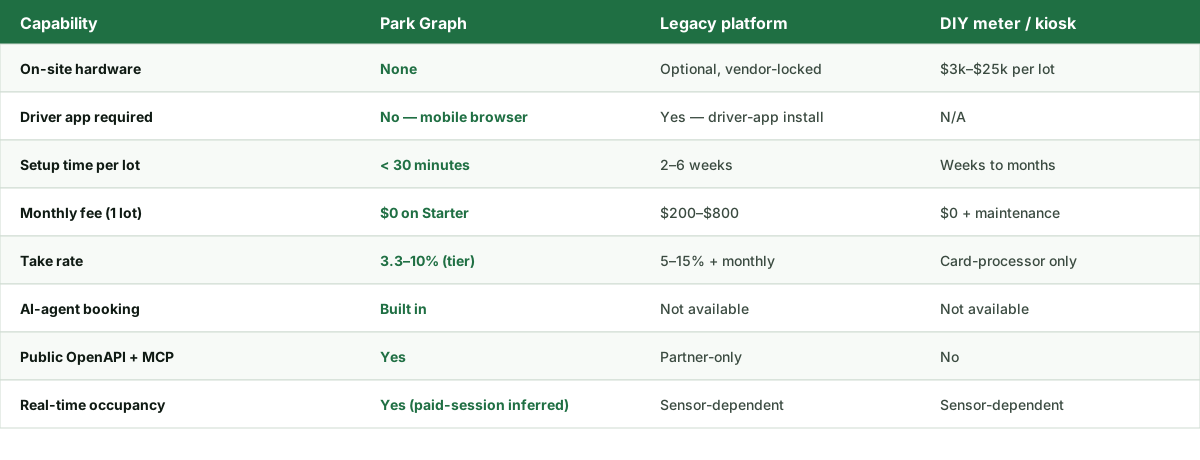
Snapshot: Park Graph vs ParkWhiz at a glance
Eight dimensions, two columns, no fluff. The values come directly from each vendor's public material — see the Sources section at the bottom of this page for the URLs and verification dates behind every cell in the ParkWhiz column.
| Dimension | Park Graph | ParkWhiz |
|---|---|---|
| Deployment model | SaaS dashboard + printed QR sign at the lot | Inventory listed on a consumer reservation marketplace |
| Hardware required | None — printable QR sign | None for the operator; driver uses the ParkWhiz app or website |
| Driver QR-pay flow | Scan, pay, drive — no account | Driver pre-books in the ParkWhiz app or web; entry via reservation barcode or license-plate match |
| AI-agent / MCP ready | Public MCP + ChatGPT Actions | No public MCP server or agent SDK as of 2026-05-04 |
| Operator API depth | Full public REST + webhooks | Partner-and-integrator gated; no public self-serve developer signup as of 2026-05-04 |
| Pricing model | Per-transaction software fee + optional plan | Operator commission + driver booking fee per ParkWhiz public material |
| Strongest vertical | Surface lots, garages, events, hotels, hospitals, universities | Event parking, airport parking, downtown daily/monthly |
| Typical time to first paid session | Minutes (print + post the QR sign) | Days to weeks (inventory onboarding + listing review) |
Best for ParkWhiz
A fair comparison starts by acknowledging where the other vendor is the right call. ParkWhiz is a real product with a real fit. These are the buyer profiles who should probably stick with ParkWhiz (or pick it new), not replace it with Park Graph.
Venue lots that already get inbound from parkwhiz.com
If a meaningful share of your bookings already arrive from ParkWhiz searches around a stadium, theatre, or airport, staying listed on the marketplace keeps that demand flowing.
Event-driven operators with predictable peak windows
ParkWhiz's pre-booking flow is well-suited to ticketed events where drivers commit to a parking slot at the same time they buy a ticket.
Operators who only want a marketing channel
If you do not want to run an operator dashboard, a price ladder, or an AI-agent surface — and you are happy to give up a slice of revenue for distribution — a marketplace is the simpler trade.
Best for Park Graph
And these are the buyer profiles where Park Graph is the better fit — the cases where the operating shape, the cost model, or the AI-agent surface tilt the comparison toward operator-side software.
Operators who want to keep more of every dollar
Park Graph is a per-transaction software fee, not a marketplace commission. The operator owns the customer relationship, the receipt, and the price ladder.
Operators who want AI-agent reachability
Park Graph publishes a Model Context Protocol server and ChatGPT Actions surface so AI assistants can discover, quote, and pay for your lot. ParkWhiz's marketplace is not AI-agent native as of 2026-05-04.
Surface lots and small garages without staff
Print a QR sign, sit it on a stake, and accept payments. There is no listing review, no inventory team, and no driver app required.
Operators who need a real operator dashboard
Park Graph ships an operator dashboard with sessions, revenue, occupancy, and payouts wired to your bank account; ParkWhiz reporting is built around marketplace bookings.
Feature matrix
A row-by-row look at how the two products handle the things operators actually have to deliver — the driver flow, the operator dashboard, the API surface, the brand on the receipt. Where ParkWhiz's row reads “not publicly documented” or “partner-only,” we checked their public site on the date noted in the Sources section.
| Feature | Park Graph | ParkWhiz |
|---|---|---|
| Operator dashboard | Full sessions, revenue, occupancy, payouts | Booking and payout reporting per their operator portal |
| Driver experience | Scan QR → pay → done; no app install | Search, reserve, and pay in the ParkWhiz app or website |
| Dynamic pricing | Server-side rules + AI-suggested overrides | Operator-set rates with marketplace promo overlays |
| AI-agent booking | Public MCP + ChatGPT Actions | Not publicly documented as of 2026-05-04 |
| Public REST API | Yes, with webhooks | Partner-and-integrator gated per public docs |
| White-label option | Yes (Pro / Enterprise) | No — bookings are ParkWhiz-branded |
| Operator hardware | None required | None required |
| Pricing model | Per-transaction software fee + optional plan | Operator commission + driver booking fee |
| Driver receipts | Operator-branded email/SMS | ParkWhiz-branded receipt |
| Refund control | Operator-initiated, dashboard one-click | Subject to ParkWhiz refund policy + buyer protection rules |
| Time to first paid session | Minutes after sign-up | Days to weeks (listing review) |
| Parking types covered | Daily, monthly, event, hotel, valet, EV | Daily, monthly, event, airport per public site |
Pricing model — qualitative comparison
Park Graph charges a per-transaction software fee with a transparent plan ladder (Starter is free, Pro and Enterprise step the fee down). The operator owns 100% of the rate, the discount, and the receipt. ParkWhiz's public operator pages describe a marketplace model where the platform takes an operator commission and adds a driver booking fee. Exact commission depends on the deal and is not published as a single number, so we do not quote one. The high-order point is that software fees are bounded and predictable; marketplace commissions scale linearly with revenue and convert distribution into a permanent line item.
We deliberately do not quote a ParkWhiz percentage, per-transaction fee, or contract minimum on this page. Public material from ParkWhiz does not always publish those numbers as a single rate, and inventing a number to make a comparison chart look tidier would be the exact kind of fake claim this page is built to avoid. For your specific deal, ask your ParkWhiz account manager — and for Park Graph, our pricing is published at /pricing with no hidden contract minimums.
Deployment, hardware, and time to launch
Park Graph deploys with a printed QR sign — there is no kiosk to install, no gate to wire, and no integrator to schedule. Most operators print, post, and start accepting payments the same afternoon. ParkWhiz deployment is a listing process: the operator submits inventory, photos, hours, and entry instructions; the inventory team reviews and publishes the listing; drivers can then book that listing through the ParkWhiz app or website. Both models avoid hardware capex, but the time-to-first-paid-session is meaningfully different, and so is the relationship the operator owns at the end of it.
The single biggest practical difference between Park Graph and ParkWhiz on most lots is how long it takes to accept the first paid session. Print, post, and accept payments — same day — is a different shape of operating motion than a procurement, install, or marketplace listing review.
AI-agent readiness, public API, and MCP
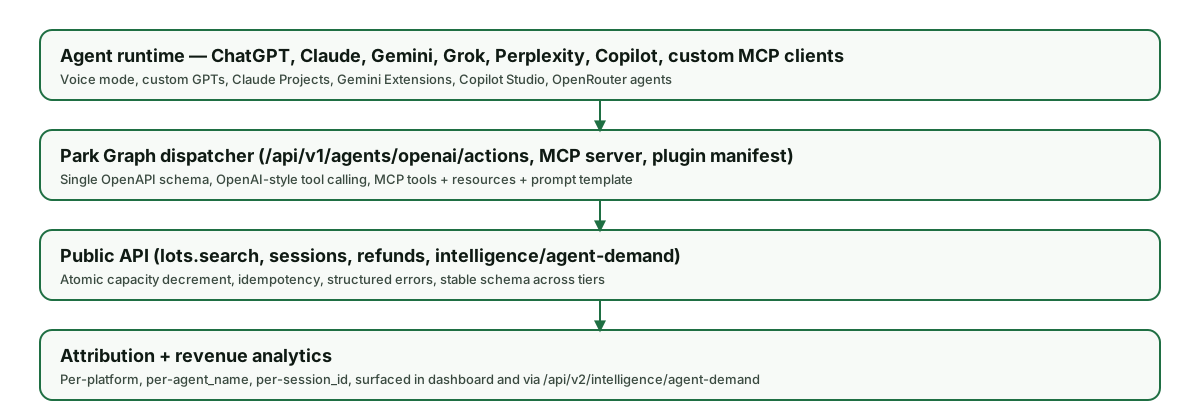
Park Graph publishes a Model Context Protocol server and a ChatGPT Actions integration so a driver can ask ChatGPT, Claude, Gemini, or any MCP-aware client to find, quote, and pay for parking at one of your lots. We also publish a public REST API with webhooks. ParkWhiz, as of 2026-05-04, does not publish an MCP endpoint, a ChatGPT Action manifest, or a self-serve developer SDK on parkwhiz.com or its corporate Arrive site. ParkWhiz does provide partner integrations under contract; if you need AI-agent reachability without going through enterprise procurement, the gap matters.
AI-agent commerce moved from theory to a real distribution channel in 2025 and 2026. Drivers ask ChatGPT, Claude, Gemini, and Perplexity to find and pay for parking at the destination they are headed to, and assistants that speak Model Context Protocol can complete that transaction inside the chat. Park Graph publishes a public MCP server and ChatGPT Actions manifest so any lot in the network is reachable to those assistants. See our MCP server and ChatGPT Actions docs for the full surface.
QR-payment comparison
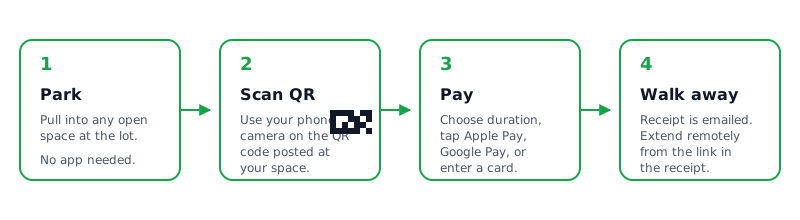
Park Graph is QR-first: a driver pulls in, scans the printed sign with their phone camera, taps a payment method, and drives. No app install, no account creation, no reservation. ParkWhiz's flow is reservation-first: the driver searches for the destination on the ParkWhiz app or website, picks a lot, pays in advance, and shows the reservation barcode at entry. Both flows work; they serve different driver intents. Operators who want to capture 100% of unplanned, walk-up demand need a QR-pay surface; operators whose demand is planned (events, airports) can complement a QR sign with a marketplace listing.
A working QR-pay flow is now table stakes for any operator who wants to capture walk-up demand. The right comparison question is not “does the vendor support QR” (most do at this point) — it is “is QR the default driver flow with no app install required, or is it an add-on to the primary flow?” That distinction shows up directly in driver conversion at the lot.
Migration path
Operators moving from a ParkWhiz-only model to Park Graph typically run both in parallel for one billing cycle. Step 1: sign up for Park Graph and print the QR sign. Step 2: post the sign at the entry, pay station, and walk-up; existing ParkWhiz reservations continue to honor as-is. Step 3: monitor the split between QR-pay sessions (kept at full revenue) and ParkWhiz bookings (kept net of commission) for thirty days. Step 4: decide per-lot whether to keep the ParkWhiz listing for distribution, downgrade it, or delist it entirely. Park Graph does not require any contract change with ParkWhiz — both can run side by side indefinitely.
Most operators run both products side by side for thirty days before making a per-lot decision. The cost of running both is small (a printed sign and a free Starter plan on the Park Graph side); the cost of switching prematurely on a single hunch is much larger. We are happy to help design that thirty-day comparison — see our contact page.
About ParkWhiz
ParkWhiz was founded in 2006 in Chicago and grew into one of the better-known consumer parking reservation brands in North America before being acquired by Arrive in 2018. The product is a two-sided marketplace: drivers browse parking inventory by destination, time, and price; operators list their lots and pay a commission on each booking that converts. ParkWhiz's strengths are its event-parking partnerships, airport coverage, and integration with major ticketing platforms that put parking next to the rest of the trip. Operators who already get inbound demand from parkwhiz.com are reasonable to keep listed; operators who want to own the customer relationship, the price ladder, and the AI-agent surface generally end up wanting an operator-side platform alongside (or instead of) the marketplace.
ParkWhiz was founded in 2006 and is headquartered in Chicago, Illinois. ParkWhiz is owned by Arrive (since 2018). The company's public site is parkwhiz.com.
About Park Graph
Park Graph is AI-native parking management software. The product turns any parking lot into a QR-pay surface in under five minutes, ships an operator dashboard with sessions, revenue, occupancy, and payouts, and publishes a public REST API, an MCP server, and a ChatGPT Actions integration so AI assistants can find, quote, and pay for parking on behalf of drivers. Pricing is a per-transaction software fee with a three-tier ladder (Starter is free, Pro is monthly, Enterprise is monthly with a lower transaction fee and white-label). There is no hardware to buy, no integrator to schedule, and no contract minimum on Starter.
See the product overview, how Park Graph works, QR-code payments, AI-agent booking, developer docs, the MCP server, and pricing.
Sources
Every claim on this page about ParkWhiz is verified against a public source on the date listed below. If you find a stale claim, reach out and we will refresh it.
- ParkWhiz — homepage — verified May 4, 2026
- ParkWhiz for Operators — verified May 4, 2026
- ParkWhiz — Help / refund policy — verified May 4, 2026
- Arrive (parent company) — verified May 4, 2026
Switching from ParkWhiz? Try Park Graph in an afternoon.
Print a QR sign, post it at your lot, and accept payments today. Run side by side with ParkWhiz for thirty days, then decide per lot.
FAQ — Park Graph vs ParkWhiz
- Is Park Graph a ParkWhiz competitor?
- Park Graph and ParkWhiz solve overlapping problems with different shapes. ParkWhiz is a consumer marketplace where drivers reserve parking ahead of time. Park Graph is operator-side software where any vehicle that pulls into your lot can pay by QR code. The two can run in parallel; many operators do exactly that during their first month with Park Graph.
- How does Park Graph pricing compare to ParkWhiz?
- Park Graph charges a per-transaction software fee that you can lower by upgrading from Starter to Pro or Enterprise. ParkWhiz's public operator material describes a marketplace-commission model with a separate driver booking fee. We do not quote a ParkWhiz commission number because ParkWhiz does not publish one as a single rate; ask your ParkWhiz account manager for your specific deal.
- Can I keep my ParkWhiz listing while using Park Graph?
- Yes. Park Graph does not require any contractual change with ParkWhiz or any other distribution channel. Most operators run both during their first month, then decide per lot whether the marketplace listing is still earning its commission.
- Does ParkWhiz have an MCP server or AI-agent integration?
- We did not find a public MCP server, ChatGPT Action manifest, or self-serve agent SDK on parkwhiz.com as of 2026-05-04. Park Graph publishes both a public MCP server and a ChatGPT Actions integration so AI assistants can discover, quote, and pay for parking at your lots.
- Do I need hardware to switch from ParkWhiz to Park Graph?
- No. Park Graph is a printable QR-code sign at the lot plus a web dashboard. There are no gates, kiosks, or sensors to install, and no integrator visit.
- Will ParkWhiz refund and buyer-protection rules still apply if I switch?
- ParkWhiz refunds are governed by ParkWhiz's policy and continue to apply to bookings made through ParkWhiz. Park Graph refunds are operator-initiated from the dashboard and follow your own refund policy.
- Does Park Graph offer dynamic pricing like ParkWhiz event surge?
- Yes. Park Graph supports rule-based dynamic pricing (time-of-day, day-of-week, demand) and AI-suggested overrides at the operator's option. ParkWhiz's marketplace can layer promotional discounts on top of an operator's set rate; the two pricing systems can coexist.
- Can drivers book my Park Graph lot through ChatGPT or Claude?
- Yes. When you publish your lot through Park Graph it becomes reachable to MCP-aware assistants and to ChatGPT Actions clients. The booking and payment happen end-to-end inside the assistant.
- Does Park Graph handle airport and event parking the way ParkWhiz does?
- Park Graph supports event windows, surge pricing, and pre-paid passes for ticketed events, plus multi-day sessions for airport lots. ParkWhiz's strength is its consumer reach for those use cases; Park Graph's strength is the operator-owned QR pay surface for the same lots. Operators with large recurring events typically use both.
- Where can I read the public sources behind these claims?
- Every factual claim about ParkWhiz on this page is taken from a public source listed in the Sources section at the bottom of the page, with the verified date.