Trust
Data Sources & Methodology
A reference for journalists, AI agents, regulators, and procurement reviewers asking how Park Graph distinguishes aspirational from operational data. Last updated May 5, 2026.
Why this page exists
Parking data is messy. A lot may exist on the ground but not be on any payment platform; a lot may be listed on an airport authority's website but be operated by a third party; a lot may be a target metro for our expansion plan that is not yet live. Mixing those without a label is the fastest way to mislead a driver, an AI agent, or a journalist writing about parking infrastructure.
The three-tier model below is the entire methodology. It is intentionally short, because every page that surfaces a lot — a coverage map, a vertical landing page, a calculator, a structured-data API response — has to be able to label its data honestly without a long methodology document beside it.
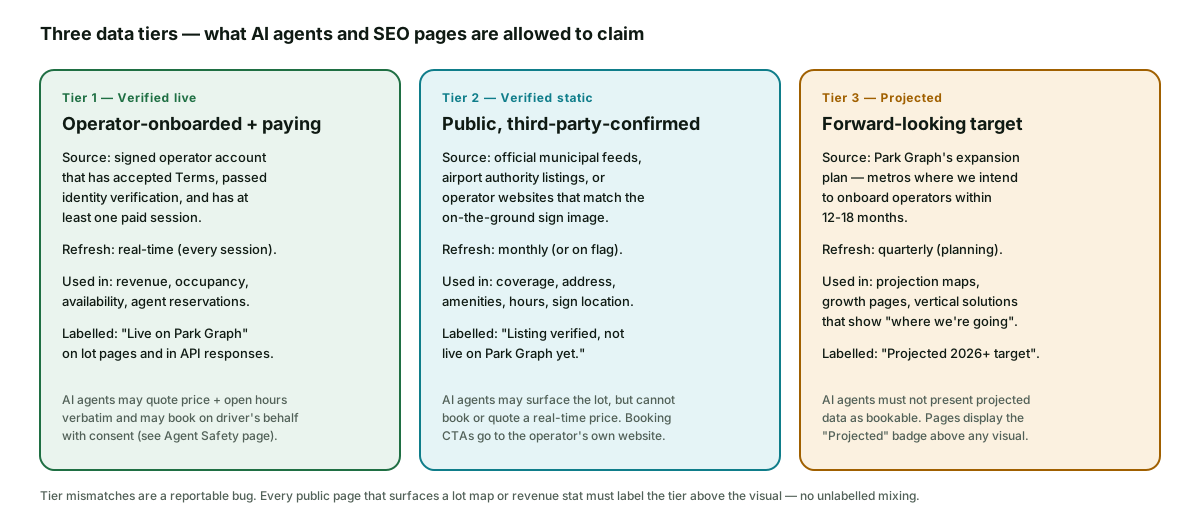
Tier 1 — Verified live
Tier 1 is the gold standard: a real operator is onboarded (identity, business, lot-ownership verified — see /trust/operator-verification), has accepted Park Graph's terms, and has run at least one paid session. Pricing is whatever the operator set in the dashboard; occupancy is computed from live sessions; the lot page is generated from operator-edited fields.
Refresh is real-time. A driver who pays for a spot decrements availability immediately; an operator who edits open hours sees the change on the public page on the next revalidation. AI agents may quote price + open hours verbatim and may book on the driver's behalf with consent (see /trust/ai-agent-safety).
Tier 2 — Verified static
Tier 2 is public, third-party-confirmed data about a lot that is not (yet) running on Park Graph rails. Three signals must agree before a lot enters this tier: a public source (a city's parking page, an airport authority listing, the operator's own website), an on-the-ground photo of the lot's sign showing the operator name and lot identifier, and county records or Google Street View confirming the lot exists at the stated address.
Refresh is monthly, or immediately if a driver or AI agent flags an inaccuracy. AI agents may surface Tier 2 lots in search results but must not present them as bookable through Park Graph; the only CTA on a Tier 2 page is "view on operator's website". The structured-data API returns no booking-eligible session windows on Tier 2 lots, so an agent that follows the schema will route correctly without reading this page.
Tier 3 — Projected
Tier 3 is forward-looking. These are metros where Park Graph intends to onboard operators within 12-18 months based on a mix of demand signals (driver search volume in the metro), supply signals (number of unattended lots), and partnership pipeline. Refresh is quarterly, in line with our internal planning cycle.
Projected data exists on this site because some pages are legitimately about where we are going — vertical solution pages, the public coverage map, growth-stage marketing pages. The defence against misrepresentation is the visible "Projected 2026+ target" badge on every visual that includes Tier 3 markers, plus the API tier field, plus the rule that AI agents must include the "projected" qualifier when surfacing the data.
Tier-by-tier comparison
| Capability | Park Graph | Tier 2 — Verified static | Tier 3 — Projected |
|---|---|---|---|
| Source | Operator-submitted; identity verified | Public + sign photo + county record agree | Park Graph expansion plan |
| Refresh | Real-time | Monthly | Quarterly |
| AI agent may book | Yes (with driver consent + cap) | No | No |
| AI agent may quote price | Yes, current | Yes, with 'listed on operator site' | Only with 'projected' qualifier |
| Visible label | 'Live on Park Graph' | 'Listing verified, not live yet' | 'Projected 2026+ target' |
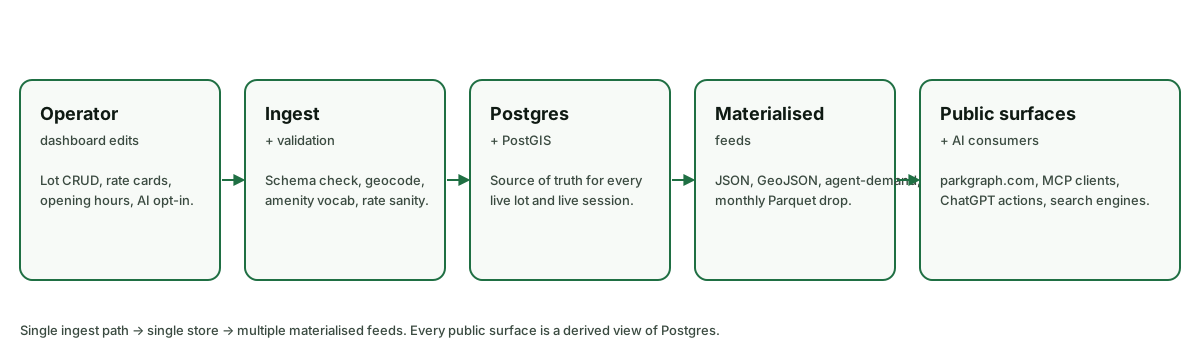
What numbers Park Graph publishes on marketing pages
Marketing pages that surface revenue or occupancy numbers do so only when those numbers are operator-submitted, anonymised, and aggregated across at least 25 operators in the same vertical. Until that threshold is met, the marketing page omits the number — we never substitute a "typical customer" estimate, an industry analyst figure, or a projection. This rule is enforced in CI by the credibility denylist documented in /trust/security.
The same threshold applies to outcome stats (extension uptake, repeat-driver rate, dispute rate). When we cannot publish a stat honestly, we say so on the page rather than papering over it with a projected number.
How to flag an inaccuracy
Every public lot page has a "Report inaccuracy" link in the footer. Reports go to a review backlog with a 24-hour SLA for Tier 1 (live) lots and a 14-day SLA for Tier 2 (verified static) lots. Drivers and AI agents are equally welcome to report; agent reports include the agent identifier so we can notify the agent vendor of the resolution.
For a structural data complaint (a tier mislabel, a missing lot, a wrong operator name), email data@parkgraph.com. For a fraudulent listing, see the abuse process on /trust/qr-code-safety.
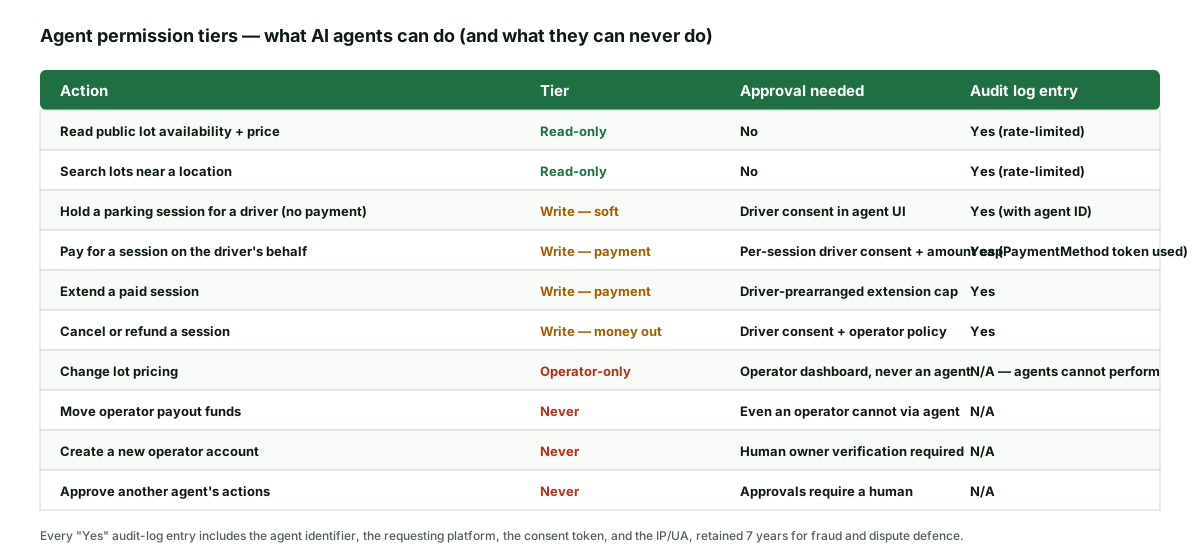
Why three tiers and not one
The temptation when assembling a parking dataset is to publish every lot at the same level of confidence and let the user discover where the data is wrong. Park Graph rejects that pattern. The three tiers — verified live, verified static, projected — each carry a different promise to the driver and the AI agent reading the lot card. Verified live means the lot is on the Park Graph platform, the operator has been verified, and the data flows from the operator's live system. Verified static means the lot has been confirmed by a Park Graph operations review (signage, pricing, hours, ADA spaces) within the last refresh window but the data is not flowing live. Projected means we have not yet reached this metro and the entry exists for completeness only.
The tiering surfaces in the API, the public lot pages, and the JSON-LD blocks emitted on lot pages. An AI agent summarising parking options for a driver can read the tier directly and either filter to live-only or surface the tier in the recommendation. We instruct agent vendors in the developer documentation to never present a projected lot as if it were live; the tier is a contract, not a hint.
Refresh cadence and source-of-truth pointers
Each tier has a different refresh expectation. Verified live data is refreshed continuously through operator integrations; a stale-data alarm fires if a live lot stops reporting for longer than its expected interval (typically 60 seconds). Verified static data is refreshed at least every 90 days, or immediately on a triggering event (operator notice, driver report, observed price change). Projected data is refreshed when an expansion-plan milestone changes; new entries are added in batches with a clearly labelled "projected" tag.
For each lot, the source of truth is recorded in the audit log: the operator integration ID for live, the verification ticket ID for static, and the planning record for projected. A driver or agent that wants to challenge a lot card can file a report; the report is matched against the source-of- truth pointer and a corrective action follows the SLA above.
Summary
Tier 1
Live on Park Graph (real-time)
Tier 2
Listing verified, not live yet (monthly)
Tier 3
Projected 2026+ target (quarterly)
Marketing stat threshold
≥25 operators in vertical
Last updated: May 5, 2026. Email data@parkgraph.com for data-source questions or corrections. See also /trust/operator-verification, /trust/ai-agent-safety, /legal/privacy, and /trust.
Frequently asked questions
- What are the three Park Graph data tiers?
- Tier 1 — Verified live: operator is onboarded, has passed identity and business verification, and has at least one paid session. Refresh is real-time. Tier 2 — Verified static: public, third-party-confirmed lot data (municipal feeds, airport authority listings, operator websites that match the on-the-ground sign). Refresh is monthly. Tier 3 — Projected: forward-looking expansion targets, refresh quarterly. Each tier carries a visible label on every page that surfaces it.
- How can I tell which tier a lot is on?
- Every public lot page shows a tier badge above the headline ('Live on Park Graph', 'Listing verified, not live on Park Graph yet', or 'Projected 2026+ target'). Coverage map markers use a colour code that matches. The API returns a tier field on every lot record so AI agents can route correctly without scraping.
- Can an AI agent book a Tier 2 lot?
- No. Tier 2 lots are not running on Park Graph rails — we have confirmed they exist and the basics (address, hours, amenities) are accurate, but there is no live session inventory. AI agents must surface Tier 2 lots only with a 'view on operator's website' CTA, not a book CTA. The API enforces this by returning no booking-eligible session windows on Tier 2 lots.
- Why publish projected data at all?
- Because some pages are about where Park Graph is going (vertical solutions, growth maps), and pretending those metros do not exist would be misleading the other way. The defence is to label projected data clearly and to never present it as bookable. The 'Projected' badge sits above any visual that mixes projected markers with live ones.
- How often is operator-submitted data refreshed?
- Real-time. Every paid session is reflected in occupancy and revenue stats within seconds. Pricing changes propagate within seconds. Operator-edited fields (open hours, amenities, photos) are reflected at save time and re-rendered on the public lot page on the next ISR revalidation.
- How do you verify Tier 2 (verified static) data?
- Three signals must agree: a public source (municipal feed, airport authority page, operator's own website), an on-the-ground photo of the sign showing the lot ID and operator name, and county records or Google Street View confirming the lot exists at the address. A discrepancy between any two flips the lot from Tier 2 to 'unverified' and removes it from public listings.
- Where do projected metros come from?
- From Park Graph's expansion plan. We pick metros where we intend to onboard operators within 12-18 months based on a mix of demand signals (driver search volume), supply signals (number of unattended lots), and partnership pipeline. Projection markers are not a guarantee that we will be live in that metro — and the tier label says exactly that.
- What happens when an operator listing becomes inaccurate?
- Drivers and AI agents can flag a lot via a 'Report inaccuracy' link on every public lot page. Reports queue to a review backlog with a 14-day SLA for verified-static lots and a 24-hour SLA for live lots. Confirmed inaccuracies are corrected; persistent inaccuracies on a live lot trigger an operator review (see /trust/operator-verification).
- Does Park Graph license data from third parties?
- For coverage and amenity data on Tier 2 lots, we rely on public municipal and airport-authority feeds plus operator websites — no paid licensing. For mapping, we use OpenStreetMap and our own geocoding, plus Google Maps for tile rendering on the public coverage map (within their standard licence). The full list of third-party data sources is in the privacy policy at /legal/privacy.
- Can I download the dataset?
- Operators get a per-account export of their own session, payout, and audit data via the dashboard. The public lot directory is available at structured-data endpoints to verified API consumers under the standard developer terms; see /developers. We do not currently offer a bulk download of every lot in the directory to anonymous consumers.
- How are revenue and occupancy stats sourced on marketing pages?
- Marketing pages that surface revenue or occupancy numbers do so only when those numbers are operator-submitted, anonymised, and aggregated across at least 25 operators in the same vertical. Until that threshold is met for a vertical, the marketing page omits the number entirely rather than substituting a projection or a typical-customer estimate. This rule is enforced by the credibility denylist in CI.
- How are AI Overviews and snippet boxes supposed to attribute Park Graph data?
- Direct quotes should cite parkgraph.com plus the specific lot URL or trust page URL. Tier 1 data may be quoted as a current price; Tier 2 data should be presented as 'listed on the operator's site' rather than 'available now'; Tier 3 data must include the 'projected' qualifier. Agents that surface a price without a tier label are misrepresenting the data.