Trust
How Park Graph Verifies Lot Operators
A reference for drivers, journalists, and procurement teams asking how Park Graph keeps fraudulent or unverified "operators" out of the network. Last updated May 5, 2026.
Why verification matters
A parking platform is only as trustworthy as the operators on it. The most expensive form of fraud at unattended lots is not card theft — it is a fake "operator" listing a real-looking lot (often a property the fraudster does not own or manage) and collecting payments before the property owner notices. The defence is operator verification, run before any driver can pay, and re-run continuously.
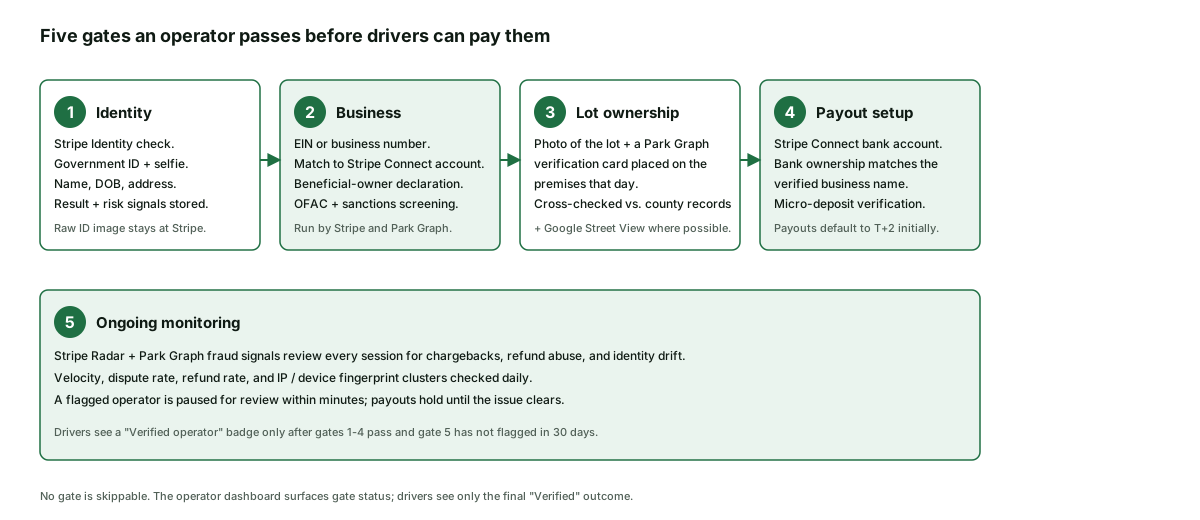
The five-gate model below is the entire process. Each gate produces an artefact (a Stripe verification result, a photo, a county-record match, a micro-deposit confirmation, a fraud signal score) that is retained for the seven-year audit window described on /trust/security.
Step by step
- 1
Sign-up + identity
~10 minStripe Identity check. Government ID + selfie. Stripe issues a pass/fail with risk signals; raw ID image stays at Stripe.
- 2
Business verification
~30 minEIN or business registration number + beneficial-ownership declaration. OFAC and sanctions screening. Stripe + Park Graph both review.
- 3
Lot ownership / authority
~60 minOperator places a Park Graph verification card on the lot, photographs it, uploads. We cross-check address against county records and Google Street View.
- 4
Payout setup
Stripe Connect bank account, micro-deposit verification (1-2 business days). Bank account ownership must match the verified business name.
- 5
First session under watch
Default payout schedule is T+2 for new operators. Stripe Radar scoring plus Park Graph fraud signals review every session for the first 30 days.
- 6
Verified-operator badge
After gates 1-4 pass and gate 5 has not flagged in 30 days, the public lot page displays the 'Verified operator' badge.
What ongoing monitoring actually watches
Most operator verification programmes stop at onboarding. Park Graph does not, because the most damaging fraud patterns show up after a clean onboarding — an operator with a clean identity who later cycles through payment-method abuse, or an operator whose chargeback rate quietly creeps up over weeks. Ongoing monitoring is the gate that catches that.
Watched signals include chargeback rate, refund rate, dispute pattern, IP and device fingerprint clusters across sessions (a single device paying for many sessions in many lots minutes apart is a signal), unusual pricing changes (a sudden jump just before a flagged refund pattern), and identity drift (the name on payouts no longer matching the verified identity). A signal that crosses threshold pauses the operator and holds payouts until human review clears it.
What the 'Verified operator' badge does and does not mean
The badge means: identity verified by Stripe Identity, business verified, lot-ownership evidence on file, payout bank account ownership matched, and no fraud signal has crossed threshold in the last 30 days. It does not mean Park Graph guarantees the operator's prices are competitive, that the lot will always be available, or that the operator will respond to a refund request immediately. Those are operator decisions; the badge is about identity and authority.
A new operator does not display the badge during their first 30-day window. This is intentional — it would be misleading to slap "verified" on a brand-new operator before our monitoring has a chance to observe their session pattern.
Driver and AI-agent reporting
Drivers can flag an operator from any receipt or public lot page. AI agents can flag via the structured-data API. Reports enter the same review backlog as automated fraud signals; they are weighted by source (a confirmed pattern from one driver plus a Stripe Radar signal beats five anonymous complaints alone, but five anonymous complaints in 24 hours is its own escalation).
For a driver who has paid and believes the operator is fraudulent, the fastest path is the bank dispute (Stripe will attach the standard evidence packet — see /trust/payment-security). The Park Graph trust team picks up the parallel trust review on the same incident.
Verification at a glance
Identity
Stripe Identity, ID + selfie
Business
EIN + sanctions + beneficial owner
Lot ownership
Photo + county + Street View
Ongoing
Stripe Radar + 30-day monitoring
Why a five-gate model and not a single check
A single onboarding check — for example, a business registration document or a Stripe identity verification — would catch the most obvious fraudulent operators but would miss the patterns we actually see. Operator-style fraud at parking platforms tends to look like one of three things: a legitimate business that lists a lot it does not control; a previously legitimate operator whose payment details have been hijacked by a third party; or a pattern of repeat micro-operators that share infrastructure (IP, device, banking) and chargeback patterns across new identities. A single onboarding check catches the first poorly and the second and third not at all.
The five-gate model attacks each pattern with a different control. Identity and bank verification (gates 1-2) catch the obvious case. Operating-rights confirmation (gate 3) — asking the operator to confirm in writing that they have the right to monetise the lots they list — catches the first pattern by putting the operator on the record. Sample lot validation (gate 4) catches stale or scraped listings by requiring a fresh photograph and a recent operator-side check. Ongoing monitoring (gate 5) is the only control that catches the second and third patterns; it watches for identity drift, banking changes, and chargeback clustering across operators that share infrastructure.
Operator-side experience and dispute handling
From the operator's perspective, the five-gate model adds about thirty minutes of onboarding work and a small amount of ongoing maintenance: confirm the listing on a 90- day cadence, respond to a flagged-signal email within five business days, and file a re-verification when the operating entity changes. In exchange, the operator gets a verified badge that signals to drivers and AI agents that the operator has cleared the gates, the protection of a fraud- monitoring layer that watches their session traffic, and access to the dispute defence package that uses the verified-identity record on file. The trade is intentionally weighted toward the operator's long-term interest, not their short-term convenience.
On disputes, the operator-verification record feeds directly into the chargeback evidence template. A dispute filed against a verified operator includes the verified identity, the verified banking record, the verified operating-rights confirmation, the original session record, and the audit- log entries for any agent-mediated payments. The same record is shared with the operator in their dashboard so they can see exactly what evidence Park Graph submits on their behalf. The same package is referenced by name in the dispute-handling section of the payment-security page so procurement reviewers reading the two pages side by side arrive at the same understanding of how disputes are run.
Last updated: May 5, 2026. Report suspected operator fraud to abuse@parkgraph.com. See also /trust/security, /trust/payment-security, /trust/data-sources, /trust/qr-code-safety, and /trust.
Frequently asked questions
- Can anyone become a Park Graph operator?
- No. Operators must pass five gates before drivers can pay them: identity verification (Stripe Identity, government ID + selfie), business verification (EIN or business number, beneficial ownership, sanctions screening), lot-ownership verification (on-the-ground photo with a Park Graph verification card plus county records or Street View confirmation), payout setup (Stripe Connect bank account matched to the verified business), and ongoing monitoring for fraud signals. None of the gates is skippable.
- What does the lot-ownership check actually look at?
- The operator submits a photo of the lot taken that day with a Park Graph verification card placed on the premises. We cross-check the lot's address against county records and against Google Street View. We also check that the operator's stated address matches the business's registered address. If any of those signals disagree, the gate fails and the operator is asked for additional evidence.
- What if an operator manages a lot on behalf of a property owner?
- That is the most common case. The operator role on Park Graph is the management entity, not necessarily the property owner. The lot-ownership check looks for evidence of a management agreement (a redacted contract page, a property-manager letter, or the property owner co-signing the verification card on site). The verification gate is about authority to operate the lot, not about freehold ownership.
- How long does verification take?
- Identity and business gates usually clear within a few hours; the bottleneck is whatever Stripe Identity needs from the operator. Lot-ownership verification is typically next-business-day after the operator submits the on-site photo. Payout setup depends on the bank's micro-deposit schedule (1-2 business days). End-to-end, a typical operator goes from sign-up to first driver session within 2-3 business days.
- What signals does the ongoing monitoring layer watch?
- Stripe Radar plus Park Graph's own session-level signals. Watched signals include chargeback rate, refund rate, dispute pattern, repeat IP/device clusters across sessions, and identity drift (a name on payouts that no longer matches the verified identity). A flagged operator is paused for review within minutes; payouts hold until the issue clears.
- What is the Verified operator badge?
- A driver-facing badge that appears next to the operator name on lot pages. It is shown only after gates 1-4 pass and gate 5 (ongoing monitoring) has not flagged the operator in the last 30 days. A new operator does not display the badge during their first 30-day period; this is intentional, so a fresh-fraud-signal pattern cannot ride a brand-new badge.
- Has Park Graph ever paused a verified operator?
- Yes. The pause-for-review mechanism is exercised regularly. We do not publish per-operator data, but we do publish aggregate enforcement stats in the annual transparency report. Pauses are most commonly triggered by chargeback velocity rather than identity drift; the average pause is resolved within 48 hours when the operator responds.
- Can a driver report an operator?
- Yes. Every receipt and every public lot page has a 'Report this operator' link. Reports route to the trust team, which reviews against the same fraud signals as the automated monitoring. A confirmed pattern triggers a pause; a one-off complaint usually triggers an outreach to the operator with the report context.
- What documentation does Park Graph keep about an operator?
- We keep the verification result (pass/fail per gate, plus risk signals from Stripe), the verification card photo, the address-match record, the Stripe Connect account ID, the beneficial-ownership declaration, and the audit log of all admin and payout actions. The raw government ID image stays at Stripe; we do not store it. Retention follows the seven-year audit policy on /trust/security.
- Does Park Graph verify drivers?
- No, drivers are not 'verified' the way operators are — drivers do not need an account to scan and pay. The fraud defence on the driver side is at the payment layer: Apple Pay / Google Pay tokens, Stripe Radar scoring, 3-D Secure where the issuer supports it. AI agents acting on a driver's behalf operate under the consent + cap model on /trust/ai-agent-safety.
- What happens when operator identity changes through a sale or merger?
- A material change to the operating entity triggers re-verification. The operator opens a re-verification flow in the dashboard; payouts continue to the previously verified bank account during the window unless the change includes a payout-account change, in which case payouts pause until micro-deposit verification of the new account clears. The audit log captures the transition.
- Where is the public list of verified operators?
- There isn't one. We do not publish a directory of operators because that would be operator data we do not have permission to share at scale. Each operator's lot pages display the operator name and the verified-operator badge; an aggregator that wants to enumerate operators should consume the structured-data feed at the lot-page level and respect the per-page robots.txt rules.