Comparison
Park Graph vs PayByPhone: Which Parking Platform Fits Your Operation?
Last updated: . Every competitor claim on this page is sourced to the public material listed in the Sources section at the bottom, with the date the claim was verified.
Snapshot: Park Graph vs PayByPhone at a glance
Eight dimensions, two columns, no fluff. The values come directly from each vendor's public material — see the Sources section at the bottom of this page for the URLs and verification dates behind every cell in the PayByPhone column.
| Dimension | Park Graph | PayByPhone |
|---|---|---|
| Deployment model | Operator dashboard + printed QR sign | Location codes printed on signs; driver uses the PayByPhone app or website |
| Hardware required | None | None for the operator; driver app or mobile site required |
| Driver QR-pay flow | Scan, pay, drive — no app | Driver opens the PayByPhone app, enters the location code, sets duration, and pays |
| AI-agent / MCP ready | Public MCP + ChatGPT Actions | No public MCP or agent SDK as of 2026-05-04 |
| Operator API depth | Full public REST + webhooks | Partner/enterprise integration per their business contact path; no public self-serve REST API found as of 2026-05-04 |
| Pricing model | Per-transaction software fee | Per-transaction convenience/service fee charged to the driver, plus operator/municipal contracts |
| Strongest vertical | Surface lots, garages, events, universities, hotels | On-street municipal and city-lot parking |
| Typical time to first paid session | Minutes (print + post the QR sign) | Procurement & contracting cycle for municipal deployments |
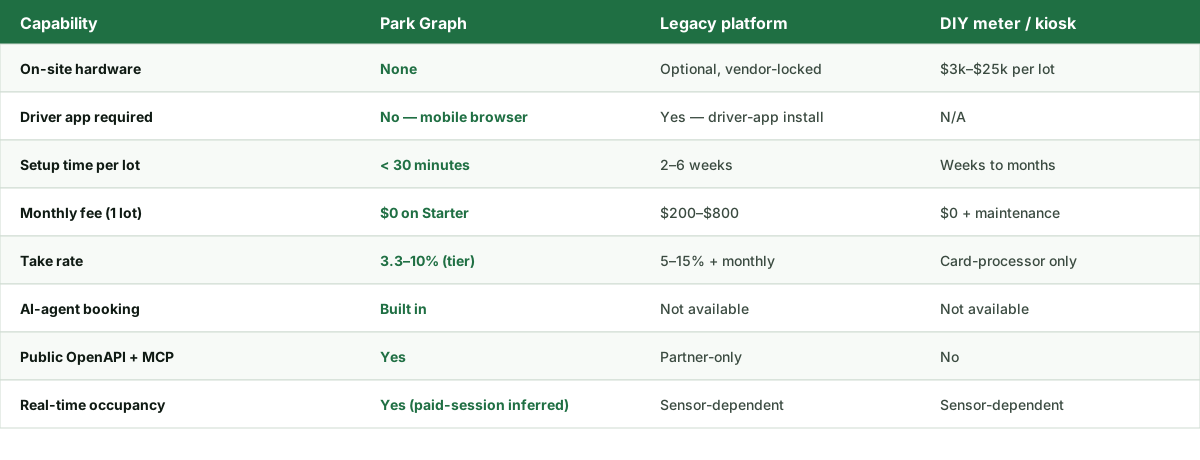
Best for PayByPhone
A fair comparison starts by acknowledging where the other vendor is the right call. PayByPhone is a real product with a real fit. These are the buyer profiles who should probably stick with PayByPhone (or pick it new), not replace it with Park Graph.
Cities standardizing on a single pay-by-app vendor
PayByPhone was built for curbside and municipal-lot parking with location codes and integrates with city meter and enforcement programs across many markets.
Operators in markets where drivers already use the app
PayByPhone reports a large registered user base across North America and Europe; in cities where the app is the local default, listing your lot keeps you visible to that habit.
Buyers comfortable with multi-month procurement
Municipal contracting is PayByPhone's home turf. If your buying process already runs on RFPs and master service agreements, the fit is natural.
Best for Park Graph
And these are the buyer profiles where Park Graph is the better fit — the cases where the operating shape, the cost model, or the AI-agent surface tilt the comparison toward operator-side software.
Private operators who want to skip app installs
Park Graph's QR flow does not require the driver to download anything; for lots where every minute of friction matters, that is a meaningful conversion lift over an app-and-code flow.
Operators who want AI-agent discoverability
Park Graph publishes an MCP server and ChatGPT Actions surface; PayByPhone does not publish either as of 2026-05-04.
Operators outside the on-street municipal use case
PayByPhone's strongest fit is curbside and city-lot parking; Park Graph fits surface lots, garages, hotels, universities, hospitals, and events without the location-code overhead.
Operators who want a real operator dashboard
Park Graph ships a per-lot operator dashboard with sessions, revenue, occupancy, and payouts wired to the operator's own Stripe account.
Feature matrix
A row-by-row look at how the two products handle the things operators actually have to deliver — the driver flow, the operator dashboard, the API surface, the brand on the receipt. Where PayByPhone's row reads “not publicly documented” or “partner-only,” we checked their public site on the date noted in the Sources section.
| Feature | Park Graph | PayByPhone |
|---|---|---|
| Driver flow | Scan QR → tap pay → done | Open app → enter location code → set duration → pay |
| App install required for driver | No | App or mobile-site session (account typically required) |
| On-street meter integration | Out-of-scope | Yes — PayByPhone's primary use case |
| Operator dashboard | Sessions, revenue, occupancy, payouts | Per their municipal/operator portal |
| Public REST API | Yes, with webhooks | Partner/enterprise contact required per public site |
| AI-agent / MCP | Public MCP + ChatGPT Actions | Not publicly documented as of 2026-05-04 |
| Dynamic pricing | Rule-based + AI overrides | Per municipal rate cards; varies by deployment |
| Pricing model | Per-transaction software fee | Driver convenience/service fee + operator/municipal contract |
| Hardware required | None | None for operator; app for driver |
| Refund control | Operator-initiated, dashboard one-click | Per PayByPhone refund policy |
| Time to first paid session | Minutes after sign-up | Procurement-dependent for municipal contracts |
| White-label option | Yes (Pro / Enterprise) | PayByPhone-branded driver experience |
Pricing model — qualitative comparison
Park Graph charges a per-transaction software fee on the operator side and does not add a separate convenience fee on the driver. PayByPhone, per its public fees documentation, charges a per-transaction convenience/service fee to the driver in addition to the parking rate, and runs separate operator/municipal contracts on top. The two models produce different driver receipts: the Park Graph receipt shows the operator's rate and the operator's brand; the PayByPhone receipt shows the parking rate plus a PayByPhone service fee. Operators who care about the driver perception of total cost tend to prefer a model where the software fee sits on the operator side.
We deliberately do not quote a PayByPhone percentage, per-transaction fee, or contract minimum on this page. Public material from PayByPhone does not always publish those numbers as a single rate, and inventing a number to make a comparison chart look tidier would be the exact kind of fake claim this page is built to avoid. For your specific deal, see PayByPhone's own published pricing at www.paybyphone.com/fees or ask your PayByPhone account manager — and for Park Graph, our pricing is published at /pricing with no hidden contract minimums.
Deployment, hardware, and time to launch
Park Graph deploys as a printed QR sign and a web dashboard; the typical operator is taking payments the same day. PayByPhone, in its primary on-street and municipal-lot deployment, requires location codes to be assigned, signs printed, and the city's meter and enforcement systems to integrate; private off-street operators can list lots but the driver still uses the PayByPhone app or mobile site with the location code. Neither approach requires capex hardware, but the friction profile on the driver side is materially different.
The single biggest practical difference between Park Graph and PayByPhone on most lots is how long it takes to accept the first paid session. Print, post, and accept payments — same day — is a different shape of operating motion than a procurement, install, or marketplace listing review.
AI-agent readiness, public API, and MCP
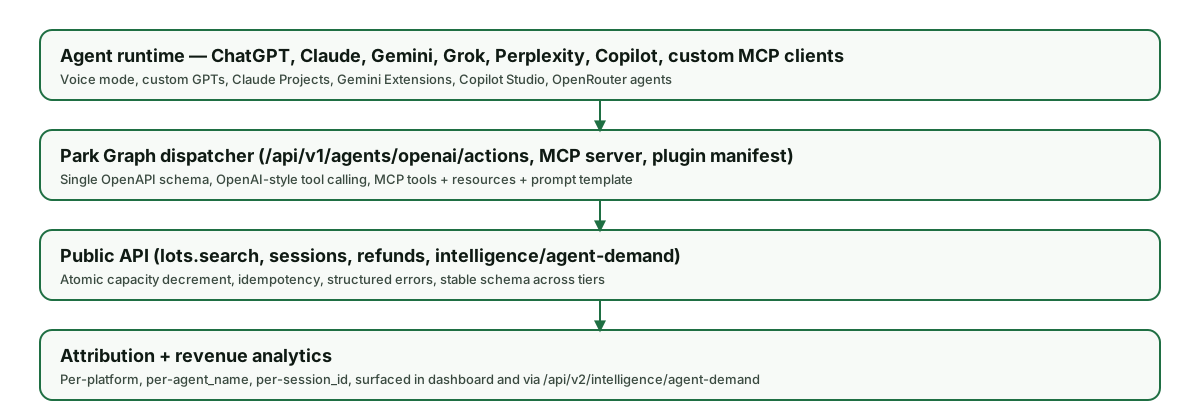
Park Graph publishes a Model Context Protocol server and a ChatGPT Actions manifest so AI assistants can discover, quote, and pay for parking at one of your lots without leaving the chat, plus a public REST API with webhooks. PayByPhone, as of 2026-05-04, does not publish an MCP server, a ChatGPT Action manifest, or a public self-serve agent SDK on paybyphone.com or its business-contact path. PayByPhone does provide partner/enterprise integrations under contract; if you need AI-agent reachability without going through enterprise procurement, the gap matters.
AI-agent commerce moved from theory to a real distribution channel in 2025 and 2026. Drivers ask ChatGPT, Claude, Gemini, and Perplexity to find and pay for parking at the destination they are headed to, and assistants that speak Model Context Protocol can complete that transaction inside the chat. Park Graph publishes a public MCP server and ChatGPT Actions manifest so any lot in the network is reachable to those assistants. See our MCP server and ChatGPT Actions docs for the full surface.
QR-payment comparison
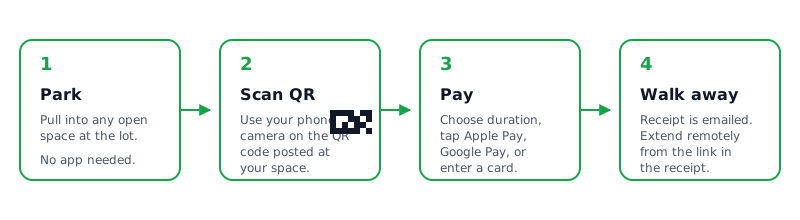
Park Graph is QR-first and app-free for the driver. PayByPhone's flow centers on the driver opening the PayByPhone app (or mobile site), entering the location code printed on the meter or sign, setting a duration, and paying. The app is well-built and widely installed in its core markets, which helps where it is the local default. In any lot where a driver does not already have the app, the install-and-register step is real friction and the QR-first flow tends to convert higher.
A working QR-pay flow is now table stakes for any operator who wants to capture walk-up demand. The right comparison question is not “does the vendor support QR” (most do at this point) — it is “is QR the default driver flow with no app install required, or is it an add-on to the primary flow?” That distinction shows up directly in driver conversion at the lot.
Migration path
Operators moving from PayByPhone to Park Graph at private off-street lots typically run both in parallel for one billing cycle. Step 1: print the Park Graph QR sign and post it next to the existing PayByPhone sign. Step 2: leave the PayByPhone location code in place so existing app users can still pay there. Step 3: track the split between QR-pay sessions and PayByPhone sessions for thirty days. Step 4: decide whether to keep both signs or retire the PayByPhone sign at lots where QR has clearly won. On-street municipal deployments are governed by the municipal contract with PayByPhone and require working through the city.
Most operators run both products side by side for thirty days before making a per-lot decision. The cost of running both is small (a printed sign and a free Starter plan on the Park Graph side); the cost of switching prematurely on a single hunch is much larger. We are happy to help design that thirty-day comparison — see our contact page.
About PayByPhone
PayByPhone was founded in 2000 and has been part of Volkswagen Financial Services since 2017. The company is best known for its mobile app for paying on-street and city-lot parking across North America and Europe; drivers enter a location code and pay from the app or mobile site. PayByPhone's strengths are a large registered driver base in its core markets and deep integration with municipal meter and enforcement programs. The product was designed for a context where the city, not the private operator, owns the rate and the receipt.
PayByPhone was founded in 2000 and is headquartered in Vancouver, Canada. PayByPhone is owned by Volkswagen Financial Services (since 2017). The company's public site is www.paybyphone.com.
About Park Graph
Park Graph is AI-native parking management software. The product turns any parking lot into a QR-pay surface in under five minutes, ships an operator dashboard with sessions, revenue, occupancy, and payouts, and publishes a public REST API, an MCP server, and a ChatGPT Actions integration so AI assistants can find, quote, and pay for parking on behalf of drivers. Pricing is a per-transaction software fee with a three-tier ladder (Starter is free, Pro is monthly, Enterprise is monthly with a lower transaction fee and white-label). There is no hardware to buy, no integrator to schedule, and no contract minimum on Starter.
See the product overview, how Park Graph works, QR-code payments, AI-agent booking, developer docs, the MCP server, and pricing.
Sources
Every claim on this page about PayByPhone is verified against a public source on the date listed below. If you find a stale claim, reach out and we will refresh it.
- PayByPhone — homepage — verified May 4, 2026
- PayByPhone — fees / how it works — verified May 4, 2026
- PayByPhone — about / company — verified May 4, 2026
- Volkswagen Financial Services — PayByPhone acquisition (2017) — verified May 4, 2026
- PayByPhone — for businesses / operators — verified May 4, 2026
Switching from PayByPhone? Try Park Graph in an afternoon.
Print a QR sign, post it at your lot, and accept payments today. Run side by side with PayByPhone for thirty days, then decide per lot.
FAQ — Park Graph vs PayByPhone
- Is Park Graph a PayByPhone alternative?
- Yes for off-street lots, garages, events, hotels, hospitals, and university parking. PayByPhone's strongest fit is on-street and municipal-lot parking governed by the city; Park Graph is not a curbside meter system.
- How does Park Graph compare to PayByPhone on driver experience?
- Park Graph is QR-first and app-free: a driver scans the printed sign and pays in their phone's browser. PayByPhone asks the driver to use the app or mobile site and enter a location code, which is a meaningful friction point for one-time visitors.
- Does PayByPhone have a public API?
- PayByPhone offers partner/enterprise integrations under contract; we did not find a public, self-serve REST API or developer signup on paybyphone.com as of 2026-05-04. Park Graph publishes a public REST API plus webhooks any operator can use.
- Does PayByPhone support AI-agent booking?
- We did not find a public MCP server, ChatGPT Action manifest, or agent SDK on paybyphone.com as of 2026-05-04. Park Graph publishes both a public MCP server and a ChatGPT Actions integration.
- Can I list my lot on PayByPhone and Park Graph at the same time?
- Yes. They are independent payment surfaces; running both for thirty days is the most common way operators decide which sign to keep at each lot.
- Why do drivers see a service fee on PayByPhone receipts?
- Per PayByPhone's public fees documentation, a per-transaction convenience/service fee is charged to the driver in addition to the parking rate. Park Graph's software fee is charged on the operator side, so the driver receipt shows only the operator's rate.
- Do I need hardware to switch from PayByPhone?
- No. Park Graph is a printable QR sign plus a web dashboard; no gates, kiosks, or sensors are involved.
- Does Park Graph integrate with city meter enforcement?
- Park Graph is built for off-street operators and does not directly integrate with city meter or enforcement systems. For on-street curbside parking, the city's contract with PayByPhone or a similar pay-by-app vendor is the right tool.
- How long does it take to switch?
- Most off-street operators move from a PayByPhone-only setup to a side-by-side Park Graph + PayByPhone setup in an afternoon — print the QR sign, post it, watch the dashboard.
- Where are the public sources for these claims?
- Every factual claim about PayByPhone on this page is sourced to public material listed in the Sources section at the bottom of the page, with the verified date.