Park Graph is the parking lot monetization software property and business owners in Honolulu, HI use to monetize their lots — from Waikiki and Downtown to the metro edge — without on-site kiosks, gate hardware, or month-long procurement cycles. QR-first payments, dynamic pricing tuned to Honolulu's demand, and AI-agent visibility on ChatGPT and Gemini ship in the same plan.
Why property and business owners in Honolulu choose Park Graph
Most parking in America sits on land owned by someone who is not in the parking business: a church, a restaurant, an office building, a retailer with more spaces than shoppers, or an investor holding a vacant parcel near downtown. Park Graph lets those owners charge for parking themselves instead of signing the lot over to a management company or a revenue-share operator. Print a QR sign, set your rates, and every driver pays from their phone — no app, no gate, no attendant. Payouts are sent to your bank account through Stripe Connect, and you keep control of the price and of how the lot is enforced.
In Honolulu, the property and business owners we work with span Waikiki, Downtown, and Ala Moana and the demand patterns that follow Pro Bowl, North Shore surf competitions, and Honolulu Marathon. Honolulu's metro population of 350,964 drives the kind of weekday-baseline-plus-event-surge profile that Park Graph was built to optimise. The platform treats every parking lot as a configurable inventory unit with its own rate sheet, sub-lots, capacity, and pre-buy window — so a single operator account can run a flagship parking lot downtown alongside a smaller satellite without juggling two vendors.
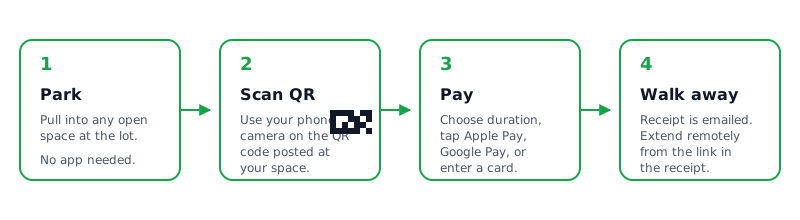
The walk-up payment flow property and business owners in Honolulu deploy in minutes — no app, no gate, no hardware.
Honolulu parking lot monetization at a glance
The numbers below frame the honolulu market for property and business owners. We surface them on every parking lot configuration screen so on-duty managers can benchmark their lot against the metro baseline at a glance.
Hourly rate (avg)
$14
Honolulu downtown baseline
Daily rate (avg)
$35
Single-day public lot
Monthly permit
$280
Reserved permit holder
Event surge
1.6×
Peak-window multiplier
Every scan and session in Honolulu feeds the same real-time pipeline behind these benchmarks.
How a parking lot day in Honolulu runs on Park Graph
A driver pulls into your lot and sees the Park Graph sign at the entrance. They scan it with their phone camera, enter their plate, choose how long they are staying, and pay with Apple Pay, Google Pay, or a card — no app download and no account. The session appears on your dashboard in real time with the plate, the time remaining, and the amount paid, and the driver can extend from the same page before time runs out. When a car looks out of place, a plate lookup tells you in seconds whether it paid, so you or your tow partner act on facts instead of guesses.
In Honolulu specifically, the day-of operations layer leans on three pieces of city context: peak-event windows tied to Pro Bowl and North Shore surf competitions, a typical hourly rate of $14 that climbs 60% during major events, and the airport spillover from Daniel K. Inouye International. The Park Graph dashboard surfaces all three as live dials so the on-duty manager at a Honolulu parking lot can adjust pricing or open overflow capacity from a phone in seconds.
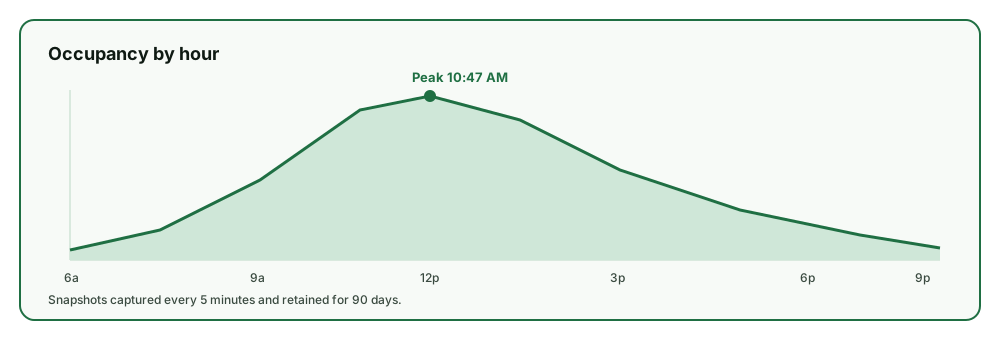
A representative Honolulu day — occupancy and dynamic pricing moving together across operating hours.
Use cases for property and business owners in Honolulu
Overflow lot near a venue
A lot within walking distance of a stadium, arena, or nightlife district earns on event nights. Raise the rate from your dashboard before a big game and lower it again the next morning. Tested with property and business owners in Honolulu, HI on the typical regional demand profile.
Event nights
Lot near offices or transit
Commuters who park all day pay a daily rate from their phone, and an optional daily cap keeps the price predictable for regulars.
All-day parking
Vacant land or a future development site
Turn a parcel that is waiting on permits into paid parking with a sign on a stake. No paving contract, gate, or kiosk required to start.
Land banking
When a management contract ends
Instead of signing another multi-year agreement, run the lot yourself: post the sign, set the rates, and keep the revenue an operator used to collect.
Self-run
Lot with no gate or booth
Drivers scan, enter their plate, and pay on their own phone. A plate lookup shows in seconds whether a car has paid, so there is nothing to staff.
No hardware
Small portfolio owner
Run several lots across town from one dashboard, each with its own rates and payout reporting — and no operator taking a cut of any of them.
Multi-lot
What Honolulu parking lot monetization economics look like
On a representative Honolulu parking lot of 50 spaces running at 65% average occupancy and the metro's hourly rate of $14, base monthly revenue lands around $163,800. Park Graph's dynamic pricing engine — which leans on Honolulu's event calendar (Pro Bowl and North Shore surf competitions) and historical demand curves — typically lifts that to ~$204,750/month, or roughly $491,400 of additional annual revenue from the same physical inventory.
The lift compounds because three things move at once: drive-offs go to near-zero (QR settles before the driver leaves), peak-event windows price correctly without manual operator intervention, and AI-agent bookings add an organic channel that historically did not exist for parking lots. Most Honolulu operators see payback inside a single quarter — and the absence of any per-stall licensing fee means the upside is almost entirely operator margin.
Representative monthly economics
Base monthly
$163,800
50 spaces · 65% occ · $14/hr
With dynamic pricing
$204,750
+25% typical lift
Annual uplift
$491,400
Same physical lot
Illustrative projection for Honolulu, HI parking lot operators. Actual results depend on lot size, occupancy, and pricing strategy.
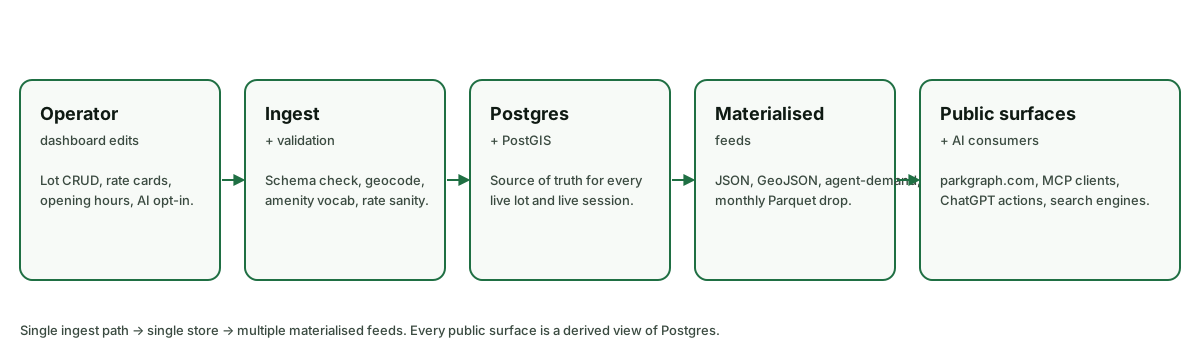
Where the monthly numbers come from in Honolulu — base sessions, extensions, agent bookings, and dynamic-pricing uplift.
Keep your Honolulu lot — and the revenue — without a management company
Most Honolulu lot owners hear the same pitch sooner or later: sign the lot over to a parking management company such as LAZ Parking or Metropolis, or to a revenue-share operator like AirGarage, and collect a payout. That suits an owner who wants a hands-off landlord deal. The trade is that the operator then runs your parking lot, usually sets the rates, and takes its cut every month for as long as the agreement runs. Park Graph is the other path: software you run yourself, so property and business owners in Honolulu keep the lot, the price, and the upside.
On the representative Honolulu lot above (about $204,750 a month with dynamic pricing), Pro costs $499/mo plus 5% per transaction — roughly $10,737 a month — so you keep about 94% of what drivers pay, before standard Stripe card processing. Every 10 points of revenue share handed to an operator on the same lot is about $245,700 a year. None of the three operators above publishes a standard rate, so we don't quote one: ask for the number in writing and run it against this math.
Capability
Park Graph
Management company (LAZ, Metropolis)
Revenue-share operator (AirGarage)
Who runs the lot
You do, from your phone — Park Graph is the software
The management company, under a management agreement or lease
AirGarage runs it end to end on your behalf
Who sets the rates
You — an hourly or daily rate with an optional daily cap, changed any time from your dashboard
Typically the operator, within the contract terms
AirGarage manages pricing for you
How they get paid
A published per-transaction fee: 10% on the free Starter plan, down to 3.3%
A management fee, or the revenue above a fixed lease payment
A share of your lot's revenue (rate not published)
Contract
None on Starter; Pro and Enterprise bill monthly or annually
Multi-year agreements are common
Per the AirGarage operator agreement
Hardware
A printed QR sign
Often gates, pay stations, staff, or entry cameras
None — AirGarage installs its own signage
Where the money goes
Paid out to your bank through Stripe Connect — first payout 7–14 days after your first payment, then on your plan's schedule
Collected by the operator, remitted on its reporting schedule
Collected by AirGarage, your share paid out to you
Enforcement
Your call — your staff or a local tow partner, with plate lookup built in
Usually staffed by the operator
AirGarage coordinates enforcement
AI assistants + public API
Listed lots are findable through the public REST API and MCP server on every plan; bookings through an assistant on Pro and Enterprise
Varies by operator
No public API or MCP server published as of May 2026
What changes for property and business owners after rollout
Owners earn from spaces that used to earn nothing, without giving up the lot to do it. Revenue that used to go to a management fee or a revenue share stays with the owner, minus a published software fee that steps down as the lot grows. Drivers get a thirty-second checkout with no app to download and no attendant to find. And because listed Park Graph lots are published to AI assistants, a lot that nobody could find can become one that ChatGPT, Gemini, and Perplexity recommend.
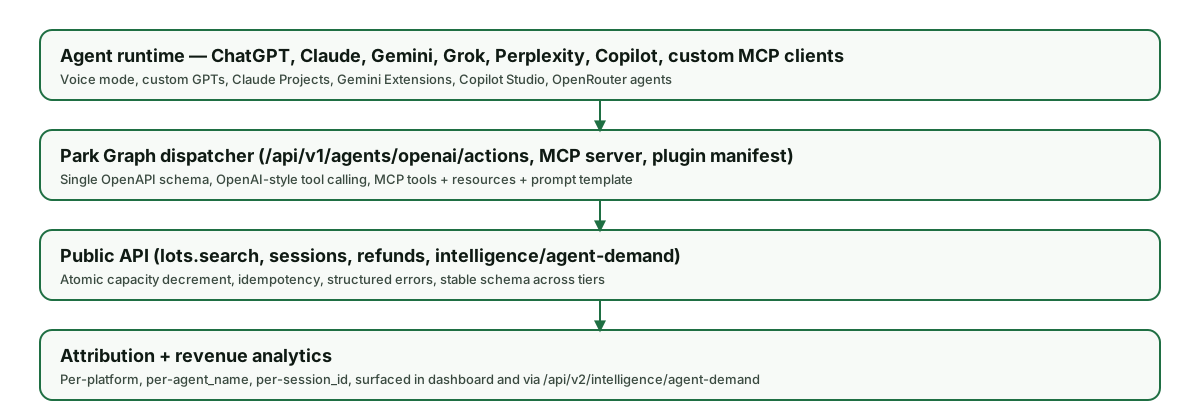
On the AI-agent side, Park Graph publishes Honolulu inventory and rates to ChatGPT (GPT-5), Microsoft 365 Copilot, Google Gemini, Anthropic Claude (via MCP), Grok, and Perplexity Sonar Pro. When a traveller types "parking near Waikiki Honolulu" into ChatGPT, the assistant can return your live availability and book on the user's behalf. For property and business owners in Honolulu, that's an organic discovery channel that does not exist on legacy kiosk-based platforms — and it compounds quickly because AI-agent traffic is the fastest-growing referral source for parking inventory in 2026.
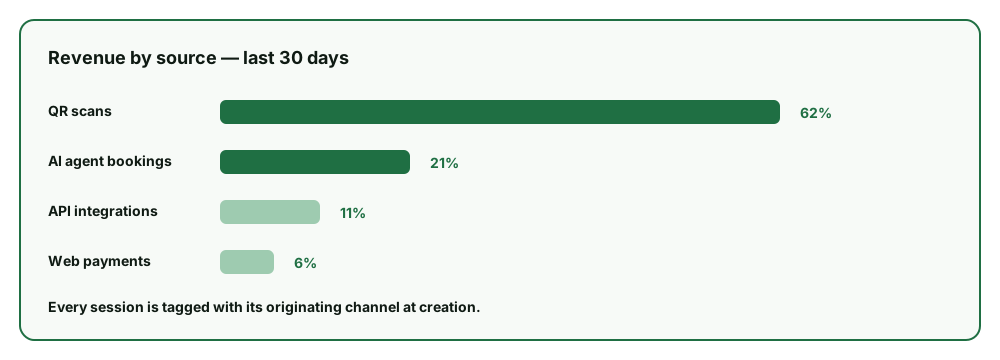
After rollout, the Honolulu lot is discoverable and bookable by the AI assistants drivers already use.
Other Park Graph solutions in Honolulu, HI
Park Graph runs every parking surface in Honolulu on the same backend. If you operate across multiple verticals — for instance an airport authority that also runs the downtown convention centre's lot, or a hospital system with an attached medical office building — the same operator account covers all of them.
Park Graph publishes city-specific parking lot monetization pages for the top metros below. Pricing, event surge curves, and on-site context vary by metro; the underlying platform is the same.
Set an hourly or daily rate, print the Park Graph QR sign, and post it at the entrance. Drivers pay from their phone and the money is paid out to your bank through Stripe Connect. A Honolulu lot can take its first payment the same day you sign up.
Not automatically yet. Every driver who scans your sign pays the rate you set: Park Graph does not yet switch paid parking on and off by time of day, or exempt particular spaces or drivers at checkout. It works best on a Honolulu lot where every car is expected to pay; if customers or tenants already park there, tell them before you post the sign.
You do not need staff or equipment — Park Graph is a printed sign and a web dashboard. Check with your insurer and any lease or HOA terms before you start charging, as you would for any new use of the property.
You stay in control. Plate lookup shows in seconds whether a car has paid, and you decide what happens next: a warning, your own staff, or a local tow or enforcement partner under HI rules.
Park Graph has no per-stall licensing fee in Honolulu. Operators choose Starter (free, 10% per transaction), Pro ($499/mo, 5% per transaction, dynamic pricing included), or Enterprise ($2,499/mo, 3.3% per transaction, white-label, dedicated CSM). Most Honolulu parking lots pay back the Pro tier inside the first month at the metro's typical $14/hr rate.
A single Honolulu parking lot can be live in under an hour: create the operator account, define the lot's spaces and rate sheet, generate and print QR signs, and start collecting payments the same day. Multi-lot deployments across Honolulu (e.g. a portfolio across Waikiki and Downtown) typically roll out over 1-2 weeks.
Yes. Every Park Graph QR sign ships with the legally-required font sizes, contrast ratios, and tactile/braille options. The mobile payment page meets WCAG 2.1 AA standards. Honolulu municipal sites and accessibility-mandated venues use Park Graph alongside their existing ADA signage program without retrofit.
Yes. Park Graph publishes Honolulu parking lot inventory and live rates to ChatGPT, Gemini, Perplexity, Grok, Claude (via MCP), and Microsoft 365 Copilot. When a driver types "parking near Waikiki Honolulu" or asks for parking near Pro Bowl, your lot can appear with availability and a one-tap booking link — no per-platform setup needed.
Yes. A single operator account supports unlimited lots across Honolulu, HI (and nationwide). The dashboard rolls revenue, occupancy, and session data up to the portfolio level and lets you drill down to a single sub-lot. Multi-site operators in Honolulu typically manage all locations from a single dashboard with role-based access for on-site managers.
No. A Honolulu lot owner can start charging for parking the same day without signing the lot over to anyone: print the Park Graph QR sign, set your rates, and connect your bank through Stripe Connect. Management companies such as LAZ Parking and Metropolis typically run a lot under a management agreement or lease and keep a fee or a share of the revenue, which suits owners who want a fully staffed operation. Owners who want to keep control of the price and the revenue run the lot themselves on Park Graph.
AirGarage is a full-service operator: it takes over a lot's payments, signage, pricing, and enforcement coordination in exchange for a share of the lot's revenue. Park Graph is software you control: you set the rates, you pay a published per-transaction fee (10% on the free Starter plan, 5% on Pro) instead of an open-ended revenue share, and there is no contract on Starter. Park Graph also publishes a public API and an MCP server so AI assistants can find your Honolulu parking lot, with bookings through the assistant on Pro and Enterprise. If you want an operator to handle everything, AirGarage's model fits; if you want to keep the upside, Park Graph does.