Comparison
Park Graph vs SKIDATA: Which Parking Platform Fits Your Operation?
Last updated: . Every competitor claim on this page is sourced to the public material listed in the Sources section at the bottom, with the date the claim was verified.
Snapshot: Park Graph vs SKIDATA at a glance
Eight dimensions, two columns, no fluff. The values come directly from each vendor's public material — see the Sources section at the bottom of this page for the URLs and verification dates behind every cell in the SKIDATA column.
| Dimension | Park Graph | SKIDATA |
|---|---|---|
| Deployment model | SaaS dashboard + printed QR sign | Hardware install (gates, dispensers, pay stations, often ALPR) |
| Hardware required | None | Yes — entry/exit gates, kiosks, often ALPR cameras |
| Driver QR-pay flow | Scan, pay, drive — operator-branded | Optional add-on; primary flow is ticket-pull-and-pay-station |
| AI-agent / MCP ready | Public MCP + ChatGPT Actions | No public MCP or agent SDK as of 2026-05-04 |
| Operator API depth | Full public REST + webhooks | Partner integrations and middleware (Sweb / API gateways) per integrator agreement |
| Pricing model | Per-transaction software fee | Hardware capex + installation + service contract |
| Strongest vertical | Surface lots, garages, events, hospitals, hotels | Airports, stadiums, large commercial garages, ski resorts, transit hubs |
| Typical time to first paid session | Minutes (print + post the QR sign) | Months (project schedule for hardware install) |
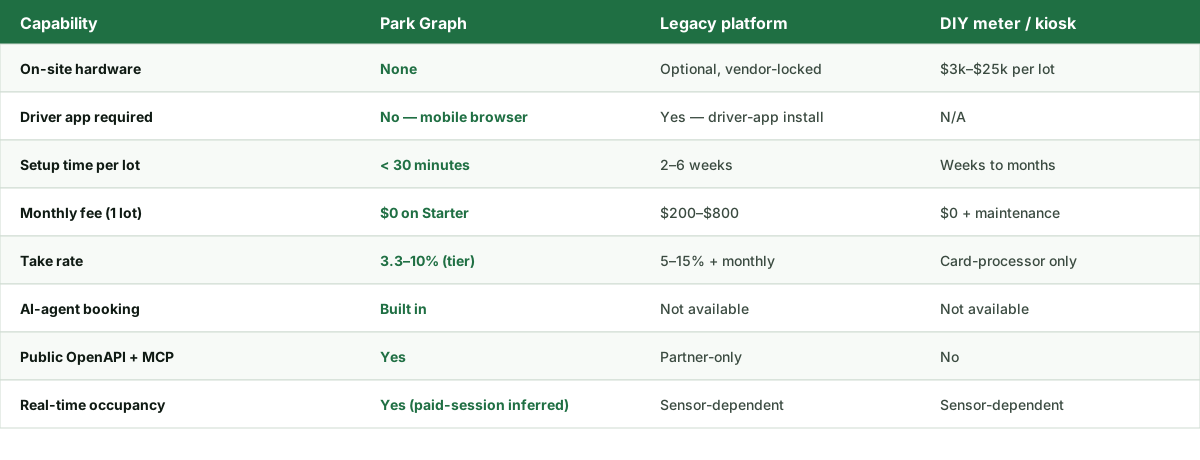
Best for SKIDATA
A fair comparison starts by acknowledging where the other vendor is the right call. SKIDATA is a real product with a real fit. These are the buyer profiles who should probably stick with SKIDATA (or pick it new), not replace it with Park Graph.
Airports and large transit hubs
SKIDATA's hardware-first model is a natural fit for high-throughput, fully-controlled-perimeter facilities where physical access control is required.
Multi-deck garages with strict ticketing requirements
Where the operator already has gates and the workflow is ticket-pull-and-pay-station, SKIDATA's product line maps directly.
Operators with capital budgets and multi-year horizons
PARCS hardware projects are capex-heavy and depreciate over years; if your finance organization is set up for that, the model fits.
Ski resorts and stadiums with proven SKIDATA install base
SKIDATA has a long install history in those verticals — staff already know the product, and replacement parts and service contracts are routine.
Best for Park Graph
And these are the buyer profiles where Park Graph is the better fit — the cases where the operating shape, the cost model, or the AI-agent surface tilt the comparison toward operator-side software.
Surface lots and small-to-mid garages
Park Graph deploys with a printable QR sign — a multi-month gate install is wildly out of proportion for a 50-spot surface lot.
Operators who do not want capex on parking hardware
Park Graph is a per-transaction software fee. There are no gates, no kiosks, no ALPR cameras to budget, install, and maintain.
Operators who need to launch this week
Park Graph is print, post, and accept payments — not a project plan.
Operators who want AI-agent reachability and a public API
Park Graph publishes a public REST API, an MCP server, and a ChatGPT Actions integration. SKIDATA's developer surface is partner-and-integrator gated.
Feature matrix
A row-by-row look at how the two products handle the things operators actually have to deliver — the driver flow, the operator dashboard, the API surface, the brand on the receipt. Where SKIDATA's row reads “not publicly documented” or “partner-only,” we checked their public site on the date noted in the Sources section.
| Feature | Park Graph | SKIDATA |
|---|---|---|
| Hardware required | None | Gates, dispensers, pay stations, often ALPR cameras |
| Capex profile | $0 hardware capex | Capex install per lot |
| Time to launch | Same-day | Months per project schedule |
| Driver flow | Scan QR → pay → done | Pull ticket → pay at station → exit, or ALPR + license-plate billing |
| Operator dashboard | Web dashboard + payouts | Per SKIDATA Sweb / partner BMS integrations |
| Public REST API | Yes, with webhooks | Partner-and-integrator gated per public docs |
| AI-agent / MCP | Public MCP + ChatGPT Actions | Not publicly documented as of 2026-05-04 |
| Pricing model | Per-transaction software fee | Capex + service contract |
| Service contract required | No | Typically yes for hardware operations |
| Best-fit vertical | Surface lots, garages, events, hotels, hospitals, universities | Airports, stadiums, transit hubs, ski resorts, large garages |
| Operator brand on receipt | Operator brand | Per integration and pay-station configuration |
| Replaces SKIDATA gates entirely? | No — Park Graph is not a physical access-control system | Yes — SKIDATA's product line is built around physical access control |
Pricing model — qualitative comparison
Park Graph and SKIDATA are not the same shape of product and not the same shape of cost. Park Graph is a per-transaction software fee with no hardware capex. SKIDATA, per its product literature and partner network, is sold as hardware-plus-installation-plus-service: gates, ticket dispensers, pay stations, often ALPR cameras, integrated with the operator's building management system and supported under a service contract. Project costs are deal-specific and SKIDATA does not publish them; the right way to compare is total cost of ownership over five years, including hardware refresh, parts, and service. For lots that do not require physical access control — most surface lots, most small-to-mid garages — the software-only path tends to win on TCO by a wide margin.
We deliberately do not quote a SKIDATA percentage, per-transaction fee, or contract minimum on this page. Public material from SKIDATA does not always publish those numbers as a single rate, and inventing a number to make a comparison chart look tidier would be the exact kind of fake claim this page is built to avoid. For your specific deal, ask your SKIDATA account manager — and for Park Graph, our pricing is published at /pricing with no hidden contract minimums.
Deployment, hardware, and time to launch
Park Graph deploys as a printed QR sign — there is no install date, no integrator visit, and no project schedule. SKIDATA's deployment is a hardware project: site survey, equipment order, mechanical and electrical install for the gates and pay stations, network and BMS integration, staff training, and acceptance testing. For airports, stadiums, and large garages where physical access control is non-negotiable, that project is the cost of doing business. For everything else, the gap in time-to-first-paid-session is dramatic.
The single biggest practical difference between Park Graph and SKIDATA on most lots is how long it takes to accept the first paid session. Print, post, and accept payments — same day — is a different shape of operating motion than a procurement, install, or marketplace listing review.
AI-agent readiness, public API, and MCP
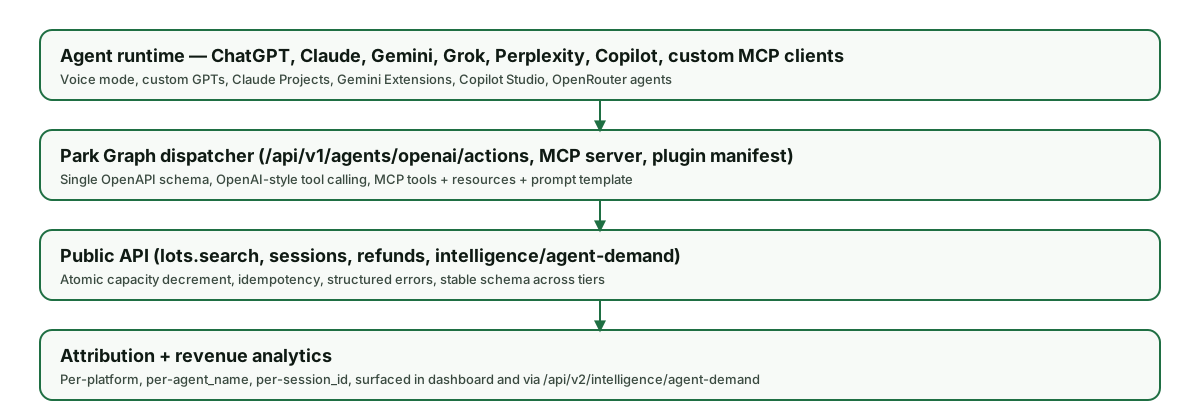
Park Graph publishes a Model Context Protocol server, a ChatGPT Actions manifest, and a public REST API with webhooks. SKIDATA's published interfaces are partner-and-integrator gated; we did not find a public MCP server, ChatGPT Action manifest, or self-serve developer API on skidata.com as of 2026-05-04. SKIDATA's strength is the physical access stack; AI-agent reachability is not where SKIDATA competes today.
AI-agent commerce moved from theory to a real distribution channel in 2025 and 2026. Drivers ask ChatGPT, Claude, Gemini, and Perplexity to find and pay for parking at the destination they are headed to, and assistants that speak Model Context Protocol can complete that transaction inside the chat. Park Graph publishes a public MCP server and ChatGPT Actions manifest so any lot in the network is reachable to those assistants. See our MCP server and ChatGPT Actions docs for the full surface.
QR-payment comparison
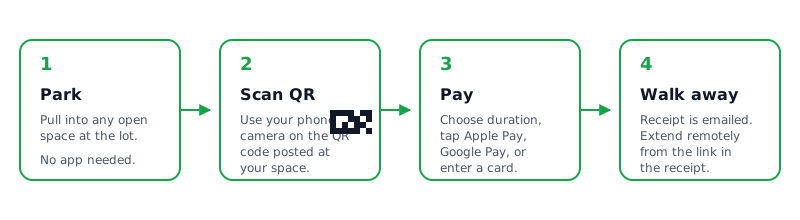
SKIDATA supports QR-pay add-ons in some configurations — for example, mobile pre-pay redeemed at a pay station — but SKIDATA's primary, default driver flow is ticket-pull at entry, pay at a pay station, exit through the gate. Park Graph is QR-first by default: there is no ticket and no pay station in the loop. For lots that do not need physical access control, the QR-first flow is faster for the driver and dramatically cheaper for the operator.
A working QR-pay flow is now table stakes for any operator who wants to capture walk-up demand. The right comparison question is not “does the vendor support QR” (most do at this point) — it is “is QR the default driver flow with no app install required, or is it an add-on to the primary flow?” That distinction shows up directly in driver conversion at the lot.
Migration path
Operators with an existing SKIDATA install do not typically rip out the gates to use Park Graph; the access-control hardware does work the QR sign cannot do (close on a stuck ticket, raise on payment, integrate with stadium ingress). Where Park Graph fits alongside SKIDATA is for adjacent surface lots, valet add-ons, event overflow, and AI-agent reachability for the existing facility. Operators planning a SKIDATA hardware refresh should price the option of replacing the surface-lot portion with a Park Graph QR sign before reordering equipment for it.
Most operators run both products side by side for thirty days before making a per-lot decision. The cost of running both is small (a printed sign and a free Starter plan on the Park Graph side); the cost of switching prematurely on a single hunch is much larger. We are happy to help design that thirty-day comparison — see our contact page.
About SKIDATA
SKIDATA was founded in Salzburg, Austria in 1977 and built a global business in parking access and revenue control systems — gates, ticket dispensers, pay stations, ALPR cameras, and the software that ties them together. The company was acquired by Honeywell in 2024 and is part of Honeywell's broader smart-city portfolio. SKIDATA's strength is the hardware: the equipment is rugged, the install base is global, and integrators are familiar with it. SKIDATA's competition is other PARCS vendors (Amano McGann, Designa, T2 Systems); software-only operators like Park Graph compete by removing the need for physical access control entirely on lots that do not require it.
SKIDATA was founded in 1977 and is headquartered in Salzburg, Austria. SKIDATA is owned by Honeywell (since 2024). The company's public site is skidata.com.
About Park Graph
Park Graph is AI-native parking management software. The product turns any parking lot into a QR-pay surface in under five minutes, ships an operator dashboard with sessions, revenue, occupancy, and payouts, and publishes a public REST API, an MCP server, and a ChatGPT Actions integration so AI assistants can find, quote, and pay for parking on behalf of drivers. Pricing is a per-transaction software fee with a three-tier ladder (Starter is free, Pro is monthly, Enterprise is monthly with a lower transaction fee and white-label). There is no hardware to buy, no integrator to schedule, and no contract minimum on Starter.
See the product overview, how Park Graph works, QR-code payments, AI-agent booking, developer docs, the MCP server, and pricing.
Sources
Every claim on this page about SKIDATA is verified against a public source on the date listed below. If you find a stale claim, reach out and we will refresh it.
- SKIDATA — homepage — verified May 4, 2026
- SKIDATA — products / PARCS portfolio — verified May 4, 2026
- SKIDATA — about / company history — verified May 4, 2026
- Honeywell — SKIDATA acquisition press release (2024) — verified May 4, 2026
Switching from SKIDATA? Try Park Graph in an afternoon.
Print a QR sign, post it at your lot, and accept payments today. Run side by side with SKIDATA for thirty days, then decide per lot.
FAQ — Park Graph vs SKIDATA
- Is Park Graph a SKIDATA replacement?
- Not for facilities that require physical access control. SKIDATA's product line is built around gates, dispensers, and pay stations; Park Graph does not raise a gate. Park Graph replaces the SKIDATA flow only on lots that do not actually require physical access control — typically surface lots, small-to-mid garages without strict ingress control, and adjacent overflow.
- How does Park Graph pricing compare to SKIDATA?
- Park Graph is a per-transaction software fee with no hardware capex. SKIDATA is sold as hardware plus installation plus service per partner agreement; SKIDATA does not publish a single project cost. The fair comparison is total cost of ownership over five years.
- Does SKIDATA have a public REST API?
- SKIDATA publishes integration interfaces (Sweb, partner APIs) for system integrators, not a public, self-serve REST API in the sense Park Graph publishes one. Confirm any specific API access with your SKIDATA partner.
- Does SKIDATA support AI-agent booking?
- We did not find a public MCP server, ChatGPT Action manifest, or self-serve agent SDK on skidata.com as of 2026-05-04. Park Graph publishes both an MCP server and a ChatGPT Actions integration.
- Can Park Graph and SKIDATA coexist at the same site?
- Yes, and it is a common pattern. SKIDATA runs the controlled-perimeter portion (the garage with gates); Park Graph runs the surface lots and overflow on the same site without adding more hardware.
- Will I need to remove SKIDATA hardware to install Park Graph?
- No. Park Graph is a printed sign and a web dashboard; nothing physical is replaced. If you choose to stop using a SKIDATA gate at a specific lot, that is a separate decision and can wait for the next hardware refresh.
- How long does Park Graph take to launch compared to SKIDATA?
- Park Graph is same-day for a surface lot. A SKIDATA hardware install at a comparable garage is typically months from site survey through acceptance testing.
- Does Park Graph integrate with building management systems?
- Park Graph publishes a public REST API and webhooks; integration into BMS or building access systems is typically straightforward at the operator's discretion. SKIDATA's BMS integration is a project line item.
- Where are the public sources behind these claims?
- Every factual claim about SKIDATA on this page is sourced to public material listed in the Sources section at the bottom of the page, with the verified date.