Comparison
Park Graph vs Spacer: Which Parking Platform Fits Your Operation?
Last updated: . Every competitor claim on this page is sourced to the public material listed in the Sources section at the bottom, with the date the claim was verified.
Owner facts: Park Graph vs Spacer
The six things lot owners ask first, checked against each company's own pages on . Spacer's pages for every cell are linked in Sources, and its fees are at spacer.com/how-spacer-works-for-hosts.
| Owner question | Park Graph | Spacer |
|---|---|---|
| Fees | Starter: $0 a month and 10% of each payment (minimum $0.75). Pro ($499/mo) and Enterprise ($2,499/mo) lower the fee to as little as 3.3%. Stripe's card processing fee applies on top. All published at /pricing. | Free to list. Spacer adds its fee for renters as a markup on the price you set; it does not publish the markup as one rate. |
| Payouts | To your bank account through Stripe. Your first payout is released 7 days after your first payment, once your ID check is done. After that, payouts arrive 2 business days after each payment. | First payment within 5 business days of the booking start date, then monthly within a few days of each booking's monthly anniversary, through Stripe. |
| Setup time | Same day. Sign up, add the lot and set your rates in a few minutes, then print the QR sign on any printer and post it. No hardware and no install visit. | Spacer says a listing takes under 5 minutes. Each booking starts when a renter requests it and you accept; then you arrange the renter's access. |
| Enforcement | You decide: your own staff or a tow operator you hire, under your local rules. The sign posts the notice, and plate lookup in your dashboard shows who paid. Park Graph has no enforcement crew; Wins Parking, its parent company, offers enforcement in select markets by separate agreement. | No enforcement service found on Spacer's host pages. Spacer screens renters and handles disputes. |
| App-less QR pay | Yes, it is the default. Drivers scan the sign and pay in the browser with Apple Pay, Google Pay or a card. No app and no account. | No drive-up QR payment found. Renters book monthly parking online before they arrive. |
| AI booking | Lots are findable by AI assistants through the public API and MCP server on every plan. On Pro and Enterprise, assistants such as Claude and ChatGPT can also book and pay for a space. | No Spacer MCP server, ChatGPT app or public API found as of 2026-10-29. |
Snapshot: Park Graph vs Spacer at a glance
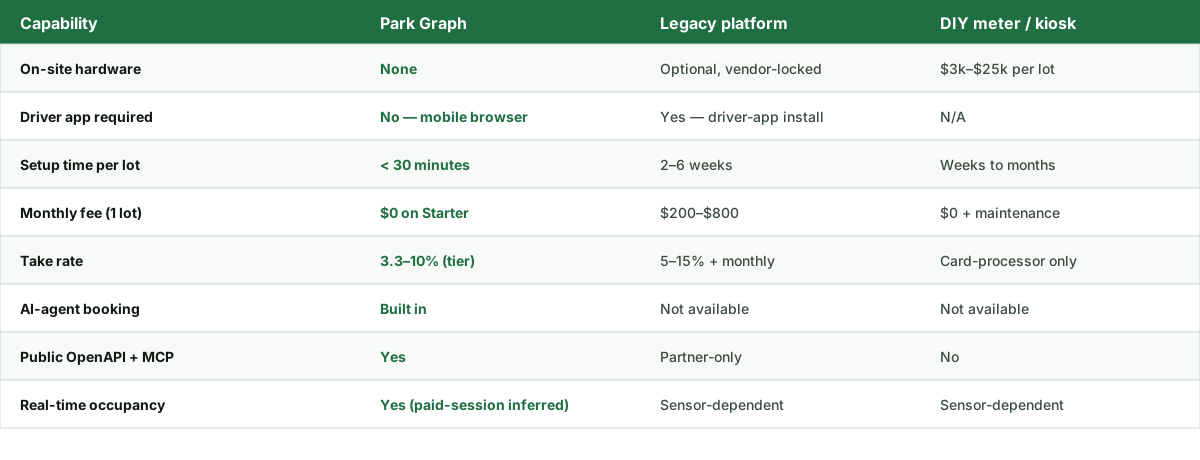
Eight dimensions, two columns, no fluff. The values come directly from each vendor's public material — see the Sources section at the bottom of this page for the URLs and verification dates behind every cell in the Spacer column.
| Dimension | Park Graph | Spacer |
|---|---|---|
| Deployment model | Self-serve software the owner runs at the lot | Marketplace listing; renters lease month to month |
| Hardware required | None — printable QR sign | None; the host hands over access (for example a remote) |
| Driver QR-pay flow | Scan, pay, park — no app, no account | No drive-up QR pay found; renters book in advance |
| AI-agent / MCP ready | Public MCP server + ChatGPT Actions | No MCP server or ChatGPT app found as of 2026-10-29 |
| Operator API depth | Full public REST API + webhooks | No public API found as of 2026-10-29 |
| Pricing model | Published per-payment fee; free Starter plan | Free to list; renter markup on the host's price |
| Strongest vertical | Hourly, daily, event and monthly paid parking | Monthly parking in garages, driveways and lots |
| Typical time to first paid session | Same day (print and post the QR sign) | When a renter books, you accept, and access is arranged |
Best for Spacer
A fair comparison starts by acknowledging where the other vendor is the right call. Spacer is a real product with a real fit. These are the buyer profiles who should probably stick with Spacer (or pick it new), not replace it with Park Graph.
Owners of a single garage or driveway
Spacer is built for leasing one spot or a few to a monthly renter, and its own example is a homeowner renting out an empty garage.
Hosts who want renters screened for them
Spacer says it screens renters, provides contracts, and advertises $2.5M insurance coverage and dispute support for hosts.
Hosts who want Spacer to market the spot
Spacer says it advertises listings through paid search, social media, email and PR, so renters come to you.
Spaces behind a gate or remote
A monthly renter you accept can be given a remote or key once. Spacer's process ends with the host arranging access.
Best for Park Graph
And these are the buyer profiles where Park Graph is the better fit — the cases where the operating shape, the cost model, or the AI-agent surface tilt the comparison toward operator-side software.
Lots with daily and hourly demand
Park Graph charges any driver by the hour, day or month at the sign, so a lot can earn from short visits and events, not only monthly renters.
Owners who want to set the price drivers pay
With Park Graph drivers pay the rate on your sign. Spacer adds its fee as a markup on the price you set.
Owners who want payouts after each payment
After the first release, Park Graph pays out 2 business days after each payment; Spacer pays monthly on each booking's anniversary.
Owners who want AI assistants to book their lot
On Pro and Enterprise, assistants such as Claude and ChatGPT can book and pay for a space at your lot through Park Graph's MCP server.
Feature matrix
A row-by-row look at how the two products handle the things operators actually have to deliver — the driver flow, the operator dashboard, the API surface, the brand on the receipt. Where Spacer's row reads “not publicly documented” or “partner-only,” we checked their public site on the date noted in the Sources section.
| Feature | Park Graph | Spacer |
|---|---|---|
| Fees | Published per-payment fee; Starter is $0 a month | Free to list; Spacer's fee is a markup on the host's price |
| Payouts | 2 business days after each payment, after the first release | Within 5 business days of the booking start, then monthly |
| Setup time | Same day | Listing in under 5 minutes; first payment after a renter books and you accept |
| Enforcement | Your staff or a tow operator you hire; plate lookup shows who paid | No enforcement service found; renters are screened |
| App-less QR pay | The default driver flow | No drive-up QR pay found |
| AI booking | Findable on every plan; bookable by assistants on Pro and Enterprise | No MCP server or ChatGPT app found |
| Rental length | Hourly, daily, multi-day and monthly passes | Monthly leases |
| Who sets the price | You; drivers pay the price they see | Host sets a price; Spacer adds its markup for renters |
| Driver flow | Scan the sign, pay, park | Search, book, wait for the host to accept, collect access |
| Host protections | Payments run through Stripe; you set the lot rules posted on your sign | Renter screening, contracts, advertised $2.5M insurance coverage |
| Public API | Full public REST API with webhooks | No public API found |
Pricing model — qualitative comparison
Spacer says listing is free and that it collects a fee from renters, shown as a markup on the price the host sets, to pay for its service, technology and advertising. It does not publish that markup as one number. Park Graph charges the owner a published per-payment fee, with a free Starter plan and lower fees on paid plans, plus Stripe's card processing fee; drivers pay the rate on your sign. For one garage leased to one renter, a marketplace with no host fee is simple. For a lot with steady daily traffic, a per-payment fee on every driver who parks usually brings in more.
We deliberately do not quote a Spacer percentage, per-transaction fee, or contract minimum on this page. Public material from Spacer does not always publish those numbers as a single rate, and inventing a number to make a comparison chart look tidier would be the exact kind of fake claim this page is built to avoid. For your specific deal, see Spacer's own published pricing at spacer.com/how-spacer-works-for-hosts or ask your Spacer account manager — and for Park Graph, our pricing is published at /pricing with no hidden contract minimums.
Deployment, hardware, and time to launch
Spacer listings go up online; Spacer says it takes under five minutes. A renter then books, the host accepts, and the host arranges access, which in Spacer's own example means handing over a garage remote. Park Graph deploys as a printed QR sign and a web dashboard: add the lot, set rates, print the sign, post it, and the next driver can pay. Neither needs hardware. Spacer suits a few known monthly renters; Park Graph suits a lot where anyone can pull in and pay.
The single biggest practical difference between Park Graph and Spacer on most lots is how long it takes to accept the first paid session. Print, post, and accept payments — same day — is a different shape of operating motion than a procurement, install, or marketplace listing review.
AI-agent readiness, public API, and MCP
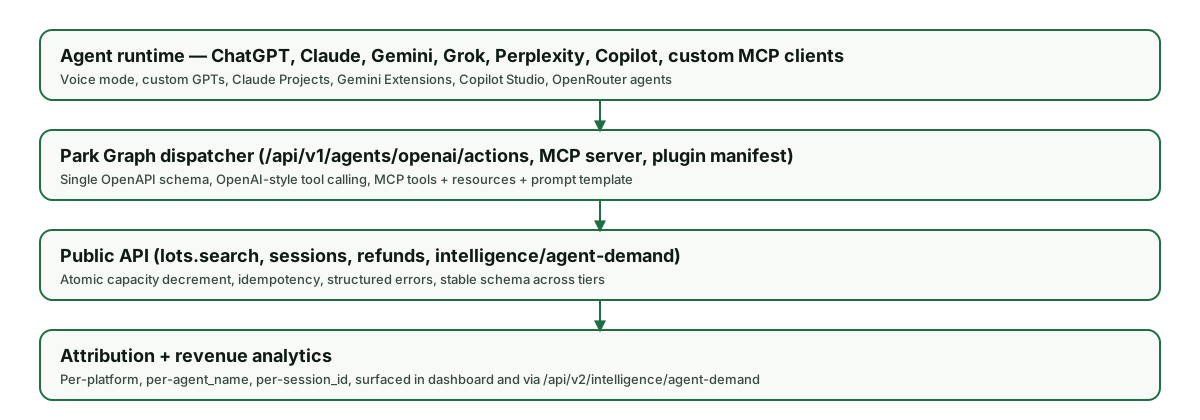
As of 2026-10-29, we found no Spacer MCP server, ChatGPT app or public developer API. Park Graph publishes a public REST API with webhooks, an MCP server and a ChatGPT integration. Listed Park Graph lots are findable by assistants on every plan, and on Pro and Enterprise an assistant can book and pay for a space for the driver.
AI-agent commerce moved from theory to a real distribution channel in 2025 and 2026. Drivers ask ChatGPT, Claude, Gemini, and Perplexity to find and pay for parking at the destination they are headed to, and assistants that speak Model Context Protocol can complete that transaction inside the chat. Park Graph publishes a public MCP server and ChatGPT Actions manifest so any lot in the network is reachable to those assistants. See our MCP server and ChatGPT Actions docs for the full surface.
QR-payment comparison
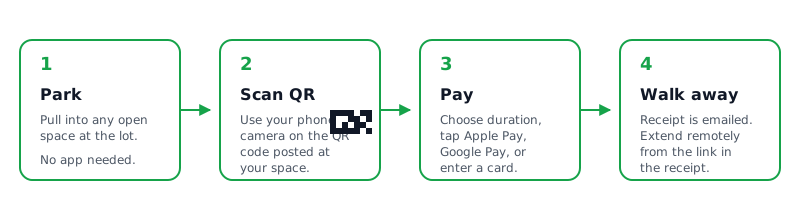
Spacer is a booking marketplace for monthly parking: renters find a spot online, book it, and start parking once the host accepts and arranges access. We found no drive-up QR payment on Spacer's pages. Park Graph's driver flow starts at the lot: scan the sign, pick a time, pay with Apple Pay, Google Pay or a card, and park. An owner can lease a few monthly spaces on Spacer and post a Park Graph sign for everyone else.
A working QR-pay flow is now table stakes for any operator who wants to capture walk-up demand. The right comparison question is not “does the vendor support QR” (most do at this point) — it is “is QR the default driver flow with no app install required, or is it an add-on to the primary flow?” That distinction shows up directly in driver conversion at the lot.
Migration path
You don't have to end any Spacer lease early. Step 1: decide which spaces stay with Spacer renters and which you open to daily drivers. Step 2: sign up for Park Graph, add the lot and set rates. Step 3: print the QR sign and post it at those spaces. Step 4: when a Spacer booking ends under its notice terms, choose whether to relist it on Spacer or sell a Park Graph monthly pass for that space.
Most operators run both products side by side for thirty days before making a per-lot decision. The cost of running both is small (a printed sign and a free Starter plan on the Park Graph side); the cost of switching prematurely on a single hunch is much larger. We are happy to help design that thirty-day comparison — see our contact page.
About Spacer
Spacer is a monthly parking marketplace run by Spacer Technologies, which started in Australia in October 2015 and launched in the USA in December 2018. Its founders are Mike Rosenbaum and Roland Tam. Hosts list garages, driveways, undercover spaces and lot spaces for free; renters book monthly parking online; Spacer collects its fee from renters and pays hosts monthly through Stripe. Spacer Technologies also runs Parkhound and WhereiPark in Australia.
Spacer was founded in 2015 and is headquartered in Australia. Spacer is owned by Spacer Technologies. The company's public site is www.spacer.com.
About Park Graph
Park Graph is AI-native parking management software. The product turns any parking lot into a QR-pay surface in under five minutes, ships an operator dashboard with sessions, revenue, occupancy, and payouts, and publishes a public REST API, an MCP server, and a ChatGPT Actions integration so AI assistants can find, quote, and pay for parking on behalf of drivers. Pricing is a per-transaction software fee with a three-tier ladder (Starter is free, Pro is monthly, Enterprise is monthly with a lower transaction fee and white-label). There is no hardware to buy, no integrator to schedule, and no contract minimum on Starter.
See the product overview, how Park Graph works, QR-code payments, AI-agent booking, developer docs, the MCP server, and pricing.
Related comparisons
Sources
Every claim on this page about Spacer is verified against a public source on the date listed below. If you find a stale claim, reach out and we will refresh it.
- Spacer — how it works for hosts (fees, payouts, FAQ) — verified October 29, 2026
- Spacer — how it works (booking and access) — verified October 29, 2026
- Spacer — about us (founders) — verified October 29, 2026
- Spacer Technologies — about us (history, US launch, brands) — verified October 29, 2026
Switching from Spacer? Try Park Graph in an afternoon.
Print a QR sign, post it at your lot, and accept payments today. Run side by side with Spacer for thirty days, then decide per lot.
FAQ — Park Graph vs Spacer
- Is Park Graph a Spacer alternative for lot owners?
- Yes, if you want drivers to pay by the hour, day or month at your lot. Spacer leases spots month to month through online bookings that you accept; Park Graph lets any driver scan your sign and pay.
- How does Spacer make money?
- Spacer says listing is free and that it collects a fee from renters, added as a markup on the price you set. It does not publish the markup as one rate; see Spacer's hosts page. Park Graph's fees are published at /pricing.
- When does Spacer pay hosts?
- Spacer says payments reach your bank within 5 business days of the booking start date, then monthly within a few days of each booking's monthly anniversary, through Stripe.
- Can I rent parking by the hour on Spacer?
- Spacer describes itself as a marketplace for monthly parking. For hourly or daily parking, Park Graph charges drivers at the sign, and you can still sell monthly passes.
- Does Spacer work with AI assistants?
- We found no Spacer MCP server, ChatGPT app or public API as of 2026-10-29. Park Graph lots are findable by assistants on every plan, and assistants can book on Pro and Enterprise.
- Who handles drivers who don't pay?
- With Park Graph you do, or a tow operator you hire, under your local rules; the sign posts the notice and plate lookup shows who paid. Spacer renters are screened and booked in advance, and we found no enforcement service on Spacer's host pages.
- Can I use Spacer and Park Graph at the same time?
- Yes, on separate spaces. Keep monthly Spacer renters on their spots and post a Park Graph sign at the spaces you open to daily drivers.
- Is Neighbor the same kind of service as Spacer?
- Broadly, yes: both are marketplaces where hosts rent space month to month to renters who book online. Our Park Graph vs Neighbor page compares Neighbor's fees and payouts line by line.
- Where are the sources behind these claims?
- Every claim about Spacer on this page is sourced to Spacer's own pages or its parent company's site, listed in the Sources section with the date we checked it.