Lot owner guide
How to Get Out of a Metropolis, LAZ or SP+ Parking Contract
Who you are dealing with
SP+ is now part of Metropolis, which says it closed the acquisition on May 16, 2024[1]. LAZ Parking offers owners three paths: lease the facility, sign a management agreement, or sell. Its management agreements can be cost-plus, fixed-fee or performance-based[2], and its leases can be flat, fixed or percentage rent[3].
Neither publishes its rates for owners, so this guide describes clauses that are common in parking agreements generally. Your own contract is the only authority on yours.
Lease, management agreement or sale: why it matters
Your exit depends on which kind of deal you signed. Under a lease, the operator usually runs the lot as its own business and pays you rent, so leaving means ending the lease on its terms. Under a management agreement, the revenue is usually yours and the operator earns a fee for running the lot, so leaving means ending the service and taking the collections back. A sale is different again: the lot is no longer yours to take back.
The title on the first page does not always match how the money moves. Check who collects, who pays expenses, and who sends whom a check each month; that tells you which kind of exit you are planning.
Six clauses to find before you give notice
Auto-renewal
Many agreements renew themselves for another term unless one side objects in time. Find the renewal date and work backward: the deadline to object is the date that matters, not the end of the term.
Ask: What is the last day I can object to renewal, and does the notice have to arrive by then or only be sent?
30, 60 or 90-day notice
Notice windows of 30, 60 or 90 days are typical. Check how notice must be sent (certified mail, courier, email), to whom, and whether the clock starts on sending or on receipt. A notice sent the wrong way can be treated as no notice.
Ask: Who is the notice contact, which delivery methods count, and has a later amendment changed the period?
Termination for convenience vs. cause
A convenience clause lets you leave for any reason on notice, sometimes with a fee. A cause clause needs a breach, such as missed payments or reporting, and usually a written cure period first. Know which one you are using before you write the letter.
Ask: Is there a fee for leaving for convenience, and what written steps does a for-cause exit need first?
Equipment and gates
Gates, pay stations, cameras and signs may belong to the operator. Check who owns each item, who removes it, who repairs the pavement, and whether you can buy anything you want to keep.
Ask: Which items will you remove, by what date, and who pays to repair the ground and wiring afterward?
Revenue-share holdbacks
Under a revenue share, the operator usually collects first and pays you later, sometimes after expenses or a reserve. Ask when the final payment is due and how disputes over the last statement are handled.
Ask: When is the final statement due, how much is held back today, and when will it be paid to me?
Customer and permit data
Monthly parkers, permits and validation accounts may sit in the operator's systems. Read what the data clause says you are entitled to, and ask for the list early, in a format you can use.
Ask: Which lists will you hand over, in what format, and will you stop billing my parkers on the effective date?
If your contract was signed with SP+
Because SP+ is now part of Metropolis, a contract signed with SP+ may still be in SP+'s name, or it may have been assigned. Read any assignment notice you received. Send your notice to the party and address the agreement names, and copy any assignee you were told about in writing. If you are not sure who holds the contract, ask in writing well before the notice window closes, so a slow answer does not cost you a renewal term.
A 30-day exit timeline
This plan assumes a 30-day notice period. With 60 or 90 days, send notice first and spread the rest across the window.
- Days 1–3Read the agreement. Find the term end date, the renewal clause, the notice window and every termination clause. Collect every amendment and side letter, because a later amendment can change the notice period. Get counsel to read it with you.
- Days 4–6List what the operator holds. Write down the equipment on site and who owns it, any reserves or holdbacks, monthly parkers, permit holders, validation accounts and any staff the operator employs at the lot.
- Day 7Send written notice. Send the notice to the address and by the method the agreement names. Keep proof of delivery, put the effective date in your calendar, and give your property manager a copy.
- Days 8–14Request the final accounting and data. Ask in writing for a final revenue statement, the release of any holdback, and an export of parker and permit lists the agreement lets you have.
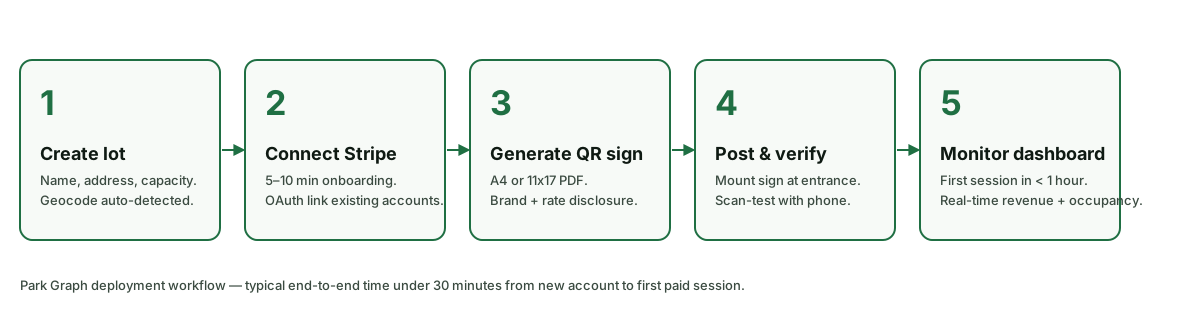
- Days 15–21Set up your own payments. Create a free Park Graph account, add the lot, set your rates, connect Stripe and print your QR signs. Tell monthly parkers how they will pay from the effective date.
- Days 22–29Plan the handover. Agree the removal date for operator equipment and signs, and check your state's towing and sign rules before posting your own.
- Day 30Go live. On the effective date, post your QR signs, confirm the operator has stopped collecting, and reconcile its final statement against your records.
Before your own signs go up, check your state's towing and booting laws.
Telling drivers and monthly parkers
Drivers notice a change of sign before they read an email, so plan both. A week before the effective date, post a short notice at each entrance saying when the new signs start and that payment moves to a QR code. Email or write to monthly parkers and permit holders with the start date, the new price if it changes, and how to pay.
On the day, cover or remove the old signs before you post the new ones, so no one pays the wrong party. Keep the old contact number in your notice for a few weeks; drivers will still call it.
Common mistakes
- Counting the notice period from the end of the term instead of from the renewal deadline.
- Emailing notice when the agreement requires certified mail or a courier.
- Sending notice to the operator's local manager instead of the notice address in the agreement.
- Leaving the operator's signs and pay stations up after the effective date.
- Asking for the parker list on the last day instead of at the start.
Termination notice letter template
Not legal advice; have counsel review.
Fill in the brackets from your agreement, delete the reason that does not apply, and send it as the agreement requires.
Not legal advice; have counsel review
[Your name or company]
[Address]
[Date]

Sent by [the delivery method the agreement requires]

[Operator's legal name]
Attn: [notice contact named in the agreement]
[Notice address named in the agreement]

Re: Notice of termination, [agreement name] dated [date], [property address]

Under Section [__] of the agreement, [owner name] gives notice that the agreement will end on [effective date], [__] days after this notice. [Choose one: This is a termination for convenience under Section [__]. / This is a termination for cause under Section [__] because [reason].]

Before the effective date, please:
1. Send a final accounting of all revenue collected through the effective date and pay all amounts held for us, including any reserve or holdback.
2. Deliver the list of monthly parkers, permit holders and validation accounts for the property in a common electronic format, as the agreement allows.
3. Confirm in writing which equipment and signs you will remove, and when.

Please confirm receipt of this notice in writing.

Sincerely,
[Name, title]
What you keep: flat pricing vs. a revenue share
Park Graph publishes its pricing: a flat monthly plan plus a per-payment fee, with no share of your revenue. Example: a lot grossing $20,000 a month from 2,000 payments of $10.
| Plan | Price | Fee per payment | You keep |
|---|---|---|---|
| Starter | Free | 10% (min $0.75) | $18,000 (90%) |
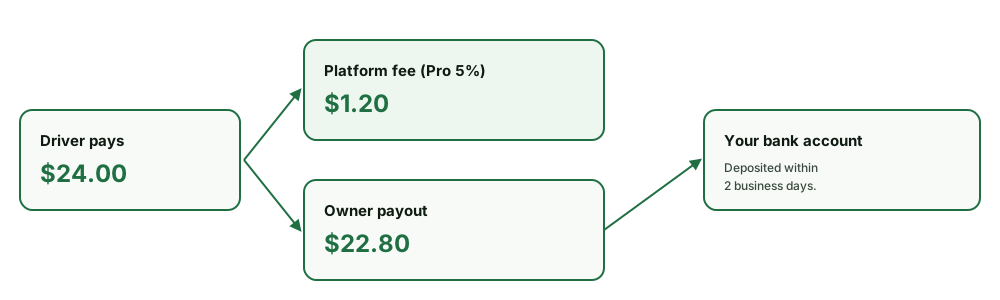
| Pro | $499/mo | 5% (min $0.25) | $18,501 (92.5%) |
| Enterprise | $2,499/mo | 3.3% (min $0.10) | $16,841 (84.2%) |
At this volume Pro leaves you the most. To match it, a revenue share would have to pay you 92.5% of gross before its own expenses. On every plan, standard Stripe processing fees apply on top.
Pro and Enterprise cost the same at about $117,647 a month in gross at this ticket size; above that, Enterprise's lower fee leaves you more. Under a revenue share, what you keep is a percentage the contract sets, and the operator's expenses may come out before your share is paid. Compare the two on the same month's gross.
Run your own numbers in the parking lot revenue calculator, or compare an operator directly on the Metropolis alternative and LAZ Parking alternative pages.
Your first month on your own
Watch payments daily for the first two weeks. If a busy hour shows few payments, check that the sign is visible from where drivers park, and adjust your rate if the lot fills or sits empty. Decide early how you will handle cars that do not pay: check the plate in your dashboard, then use your own staff or a local tow partner under your state's towing rules.
Sources
Ready to run the lot yourself?
Start free on Starter: print a QR sign, set your rates, and keep the revenue a contract used to split.
Frequently asked questions
- Can I end a parking management contract early?
- Only if the agreement gives you a way out. Look for a termination-for-convenience clause, which lets either side end it on notice, and a for-cause clause, which usually needs a breach and a chance to fix it. Without either, you may have to wait for the term to end. Have counsel confirm before you send notice.
- Is SP+ part of Metropolis now?
- Yes. Metropolis says it closed its acquisition of SP+ on May 16, 2024. If your agreement was signed with SP+, send notice to the party and address the agreement names, or to any assignee you were told about in writing.
- Who keeps the gates and pay machines?
- The agreement decides. Equipment the operator installed and paid for often stays its property, so plan for removal and patching. A Park Graph lot needs no gates or machines, only a printed QR sign.
- Can I take my monthly parkers with me?
- Ask for the list in writing and check the data clause first; some agreements limit what the operator must hand over. Then tell each parker how to pay you directly from the effective date.
- Will I owe a termination fee?
- Some agreements charge a fee for leaving early or ask you to repay equipment or improvement costs the operator has not yet recovered. Read the termination and equipment clauses together, and ask for the amount in writing before you send notice.
- Can the operator keep collecting after the end date?
- It should not, but pay stations, apps and signs can keep taking money if no one switches them off. Ask the operator to confirm the shutdown date in writing, and check that its signs are covered or removed when yours go up.
- Can I set up Park Graph before the contract ends?
- Yes, but don't collect on the same spaces early. Until the effective date the agreement still governs collections, so create your account, add the lot, set rates and print signs in advance, then post the signs on the day.
- Do I need a lawyer to send the notice?
- You can send it yourself, but a lawyer can confirm the right clause, the right party and the right date. Mistakes in any of the three can delay the exit by a full renewal term, so a short review is usually worth it.
- How fast can I collect parking payments myself?
- Setup takes an afternoon: create an account, add the lot, set a rate, print the sign and connect Stripe. Your first payout is released 7 days after your first payment, once your ID check is done. After that, payouts arrive 2 business days after each payment.