FOR IMMEDIATE RELEASE
As Fake QR Parking Stickers Spread Across U.S. Cities, Park Graph Launches Patent-Pending Protection for Lot Owners
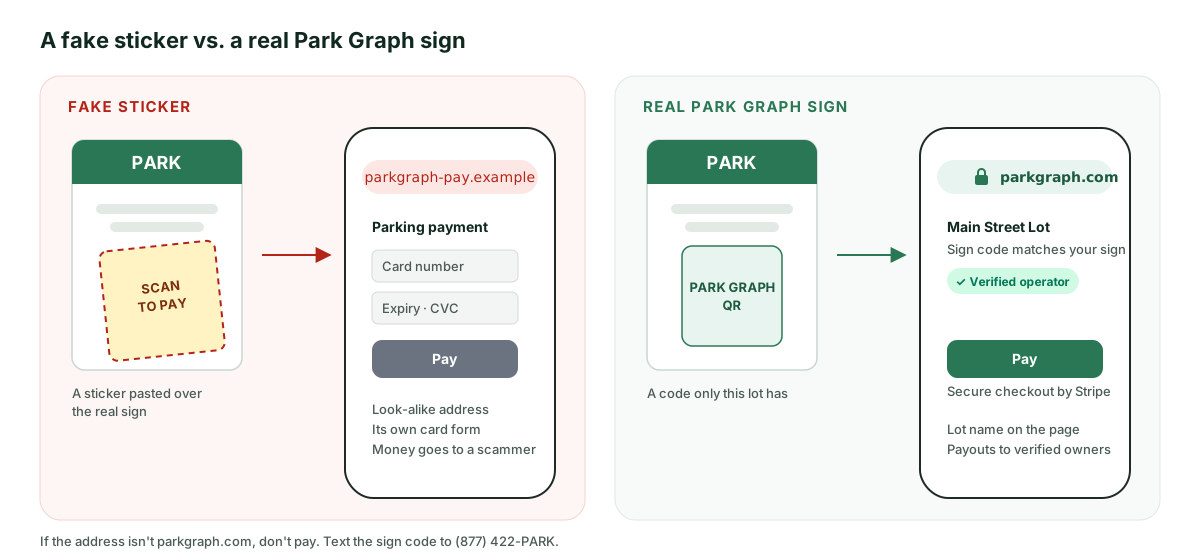
Every Park Graph sign carries a code only that lot has; a copied or fake sticker doesn't match, and drivers only ever pay on parkgraph.com
EDWARDS, Colo. — November 2026 — Park Graph, the QR code parking payment platform for lots of every size, today announced protections against counterfeit QR stickers, backed by five U.S. patent applications filed in October 2026.
The scam is simple: a criminal places a fake QR sticker over a real parking code, and drivers pay the criminal instead of the lot. Cities and police departments in New York, Orlando, Fort Lauderdale, Raleigh, Ann Arbor and Asheville have warned drivers about fake QR codes on parking meters since mid-2025.
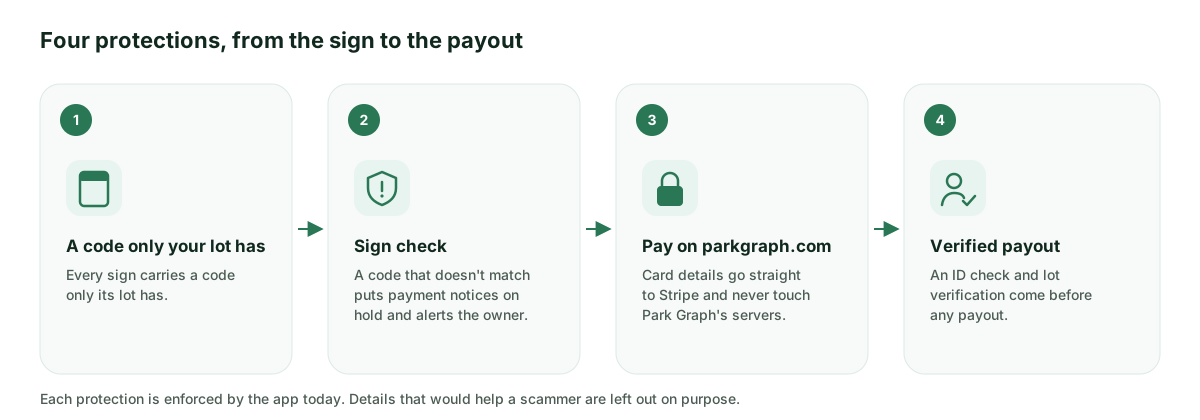
Park Graph's security protections work at four points:
- Every sign is one of a kind. Each lot's QR carries a code that only Park Graph issues, so a copied or outside sticker doesn't carry it.
- Fake codes get flagged. Before any payment notice goes out, the lot's sign must match its code. If it doesn't, notices stop and the owner is alerted until the original sign is confirmed.
- Drivers pay only on parkgraph.com. Card details go straight to Stripe and never touch Park Graph's servers.
- Payouts go only to verified owners. Owners pass a Stripe ID check, and each lot is verified before its first payout.
"Fake QR codes are the reason a lot of owners still won't take mobile payments," said Ross D. Blankenship, founder of Park Graph. "I've filed patents on exactly this problem. Every Park Graph sign is built so your drivers pay you, and only you."
The five pending patent applications cover counterfeit payment-code detection for parking and EV charging, payment notices verified against posted sign codes, AI-assistant parking reservation holds, lot onboarding from a photo message, and multi-lot reservations for vehicle fleets.
Park Graph replaces gates, meters and kiosks with one printed sign. Drivers scan and pay by QR code in about 30 seconds with Apple Pay, Google Pay or a card, with no app download. Owners set their own rates and can go live the same day. The Starter plan is $0 a month plus a per-payment fee, and Pro and Enterprise plans lower that fee for busier lots. Drivers can also find and book Park Graph lots inside AI assistants through its parking API and MCP server.
About Park Graph: Park Graph is QR code parking payment software for parking lots, truck parking, event venues and private property across the United States. It is operated by Wins Parking, LLC, a parking design, build and management company operating since 2016. Turn a parking lot into income at parkgraph.com.
Media contact: Ross D. Blankenship · support@parkgraph.com · (877) 422-7275