Downtown commercial district
Replace pay-and-display kiosks with QR signage on every block. Pilot two zones first, then scale. Tested with city parking authorities in Houston, TX on the typical tier-1 demand profile.
Pay-by-plate
Municipal parking · Houston, TX
Park Graph is the municipal parking management software city parking authorities in Houston, TX use to modernize their lots — from Downtown and Midtown to the metro edge — without on-site kiosks, gate hardware, or month-long procurement cycles. QR-first payments, dynamic pricing tuned to Houston's demand, and AI-agent visibility on ChatGPT and Gemini ship in the same plan.
Cities, downtown alliances, and parking authorities run on-street meters, residential permit programs, downtown garages, and enforcement teams under intense political and ADA-compliance scrutiny. Park Graph replaces the kiosk with a printed QR sign and gives the enforcement officer a phone instead of a $1,200 vendor terminal. Procurement is friendly (no per-zone fees, month-to-month), audits are clean (every transaction has a digital receipt), and ADA compliance is built into the signage standard.
In Houston, the city parking authorities we work with span Downtown, Midtown, and Montrose and the demand patterns that follow Texans games, Astros games, and Houston Rodeo. Houston's metro population of 2,304,580 drives the kind of weekday-baseline-plus-event-surge profile that Park Graph was built to optimise. The platform treats every city zone as a configurable inventory unit with its own rate sheet, sub-lots, capacity, and pre-buy window — so a single operator account can run a flagship city zone downtown alongside a smaller satellite without juggling two vendors.
The numbers below frame the houston market for city parking authorities. We surface them on every city zone configuration screen so on-duty managers can benchmark their lot against the metro baseline at a glance.
Houston downtown baseline
Single-day public lot
Reserved permit holder
Peak-window multiplier
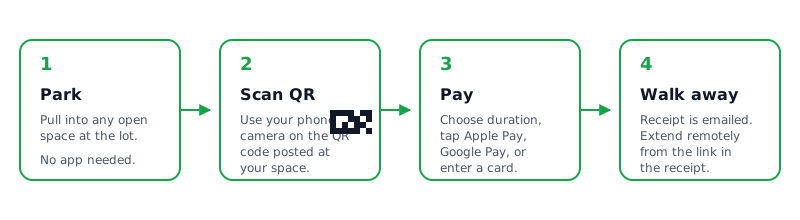
Each on-street zone gets a zone ID, time-of-day rate, and enforcement window. Drivers scan the pole-mounted QR sign, pick a duration, and pay; their plate is captured at payment. Enforcement officers walk the block, scan plates with the issued phone, and the app shows whether the plate has an active session. Expired plates auto-flag for citation; the officer reviews and issues with a single tap.
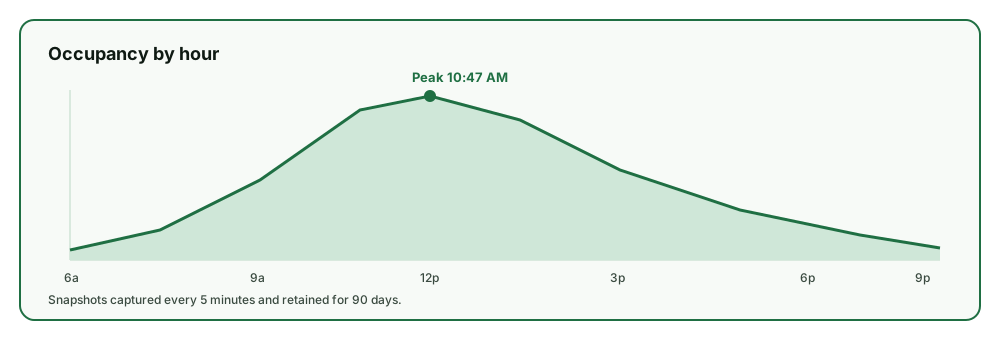
In Houston specifically, the day-of operations layer leans on three pieces of city context: peak-event windows tied to Texans games and Astros games, a typical hourly rate of $10 that climbs 80% during major events, and the airport spillover from George Bush Intercontinental and Hobby Airport. The Park Graph dashboard surfaces all three as live dials so the on-duty manager at a Houston city zone can adjust pricing or open overflow capacity from a phone in seconds.
Replace pay-and-display kiosks with QR signage on every block. Pilot two zones first, then scale. Tested with city parking authorities in Houston, TX on the typical tier-1 demand profile.
Pay-by-plate
Bulk-import permit holders via CSV. Permits live on the plate; renewals auto-bill annually.
Permit + transient
Public-works director taps Snow Emergency in the dashboard; all parking suspends, refunds auto-issue, signage updates in seconds.
Emergency ops
30-minute free window with QR-based overstay enforcement; trucks that exceed are auto-billed.
Hardware-free enforcement
City and university coordinate on a shared zone with different rates for SSO-validated affiliates vs. general public.
SSO validation
Pre-scheduled surge windows tied to the convention centre or arena calendar capture peak demand without staffing changes.
Calendar-tied surge
On a representative Houston city zone of 50 spaces running at 65% average occupancy and the metro's hourly rate of $10, base monthly revenue lands around $117,000. Park Graph's dynamic pricing engine — which leans on Houston's event calendar (Texans games and Astros games) and historical demand curves — typically lifts that to ~$146,250/month, or roughly $351,000 of additional annual revenue from the same physical inventory.
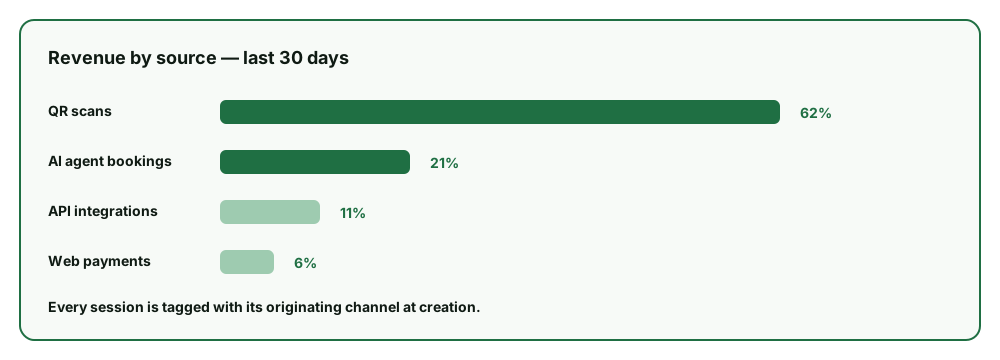
The lift compounds because three things move at once: drive-offs go to near-zero (QR settles before the driver leaves), peak-event windows price correctly without manual operator intervention, and AI-agent bookings add an organic channel that historically did not exist for municipalities. Most Houston operators see payback inside a single quarter — and the absence of any per-stall licensing fee means the upside is almost entirely operator margin.
Representative monthly economics
50 spaces · 65% occ · $10/hr
+25% typical lift
Same physical lot
Illustrative projection for Houston, TX city zone operators. Actual results depend on lot size, occupancy, and pricing strategy.
Cities decommission kiosks at end-of-life rather than mid-life replacement, saving $8k-$25k per kiosk plus annual maintenance. Resident adoption rises because no app download is required. Enforcement productivity climbs because officers carry one phone instead of a vendor terminal and a citation pad. Council reporting is one click instead of a month-end vendor data export.
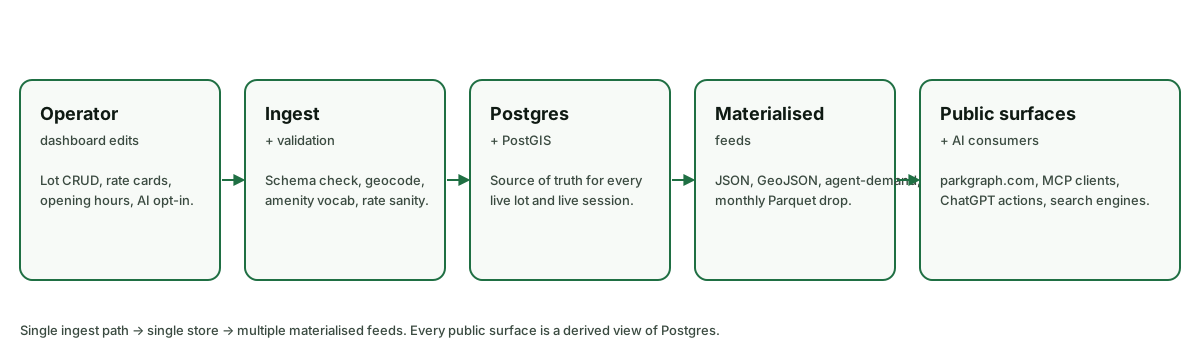
On the AI-agent side, Park Graph publishes Houston inventory and rates to ChatGPT (GPT-5), Microsoft 365 Copilot, Google Gemini, Anthropic Claude (via MCP), Grok, and Perplexity Sonar Pro. When a traveller types "parking near Downtown Houston" into ChatGPT, the assistant can return your live availability and book on the user's behalf. For city parking authorities in Houston, that's an organic discovery channel that does not exist on legacy kiosk-based platforms — and it compounds quickly because AI-agent traffic is the fastest-growing referral source for parking inventory in 2026.
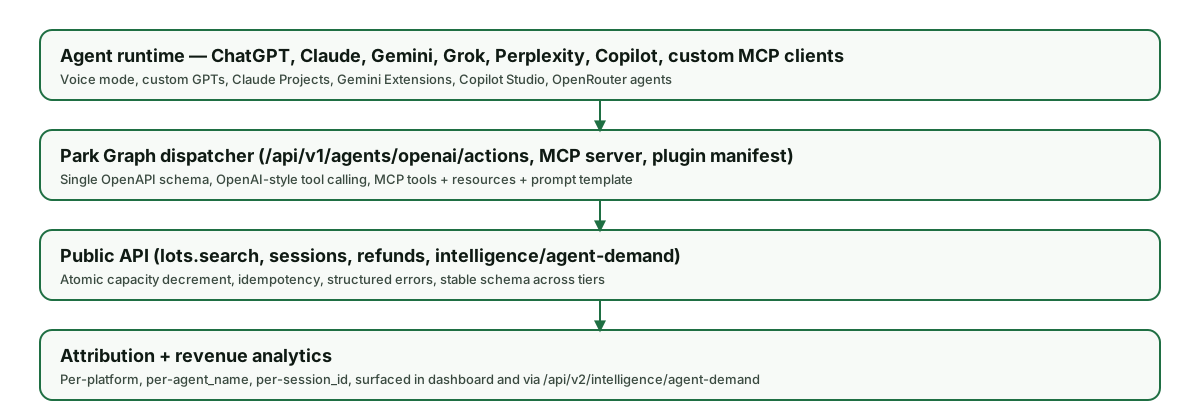
Park Graph runs every parking surface in Houston on the same backend. If you operate across multiple verticals — for instance an airport authority that also runs the downtown convention centre's lot, or a hospital system with an attached medical office building — the same operator account covers all of them.
Park Graph publishes city-specific municipal parking pages for the top metros below. Pricing, event surge curves, and on-site context vary by metro; the underlying platform is the same.
Get started in minutes. No hardware required. Generate your first QR code for free.