Mall / outlet centre
Anchor-tenant POS validation; non-shoppers pay the QR rate. Evening/weekend monetisation for nearby venues. Tested with retail center operators in Washington, DC on the typical tier-1 demand profile.
POS validation
Retail center parking · Washington, DC
Park Graph is the retail center parking management software retail center operators in Washington, DC use to modernize their lots — from Georgetown and Dupont Circle to the metro edge — without on-site kiosks, gate hardware, or month-long procurement cycles. QR-first payments, dynamic pricing tuned to Washington's demand, and AI-agent visibility on ChatGPT and Gemini ship in the same plan.
Shopping malls, outlet centres, lifestyle centres, big-box anchors, and grocery-anchored centres all share the same retail parking puzzle: free for shoppers, monetisable for non-shoppers, and somehow you have to tell the difference. Park Graph runs receipt validation through the retailer's POS, charges non-shoppers via QR, and unlocks evening/weekend monetisation on lots that historically gave away every space.
In Washington, the retail center operators we work with span Georgetown, Dupont Circle, and Capitol Hill and the demand patterns that follow Nationals games, Commanders games, and Cherry Blossom Festival. Washington's metro population of 689,545 drives the kind of weekday-baseline-plus-event-surge profile that Park Graph was built to optimise. The platform treats every retail lot as a configurable inventory unit with its own rate sheet, sub-lots, capacity, and pre-buy window — so a single operator account can run a flagship retail lot downtown alongside a smaller satellite without juggling two vendors.
The numbers below frame the washington market for retail center operators. We surface them on every retail lot configuration screen so on-duty managers can benchmark their lot against the metro baseline at a glance.
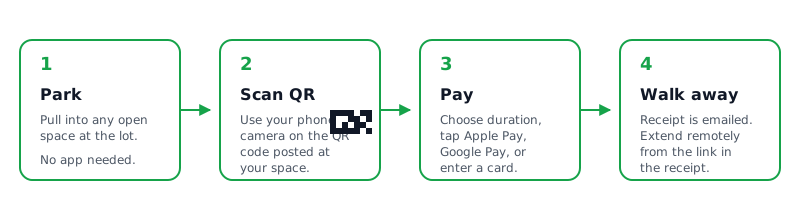
Shoppers park free as long as they make a qualifying purchase; the validation comes from the retailer's POS automatically. Non-shoppers pay the QR rate. Evening and weekend windows can monetise the lot for nearby restaurant, theatre, or arena traffic. The dashboard shows the validation rate by anchor tenant and the non-shopper conversion rate by hour.
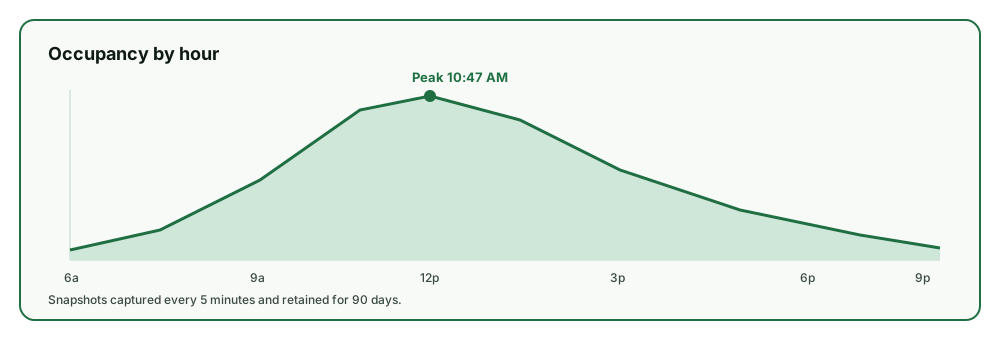
In Washington specifically, the day-of operations layer leans on three pieces of city context: peak-event windows tied to Nationals games and Commanders games, a typical hourly rate of $20 that climbs 120% during major events, and the airport spillover from Reagan National and Dulles International. The Park Graph dashboard surfaces all three as live dials so the on-duty manager at a Washington retail lot can adjust pricing or open overflow capacity from a phone in seconds.
Anchor-tenant POS validation; non-shoppers pay the QR rate. Evening/weekend monetisation for nearby venues. Tested with retail center operators in Washington, DC on the typical tier-1 demand profile.
POS validation
Restaurant + retail mix with validation by tenant. Tier rates by daypart.
Tenant + daypart
Free for grocery shoppers (validated at checkout); time-limited free for everyone else; pay-after-window for overstay.
Grace + overstay
Self-validated at the register; non-shoppers pay. Particularly useful for anchors near downtown or transit.
Self-validated
Validation discount tier for the cinema; full-price for non-cinema visitors at the same hour.
Cinema discount
Surge windows for Black Friday and December weekends; validation thresholds adjust automatically.
Holiday surge
On a representative Washington retail lot of 50 spaces running at 65% average occupancy and the metro's hourly rate of $20, base monthly revenue lands around $234,000. Park Graph's dynamic pricing engine — which leans on Washington's event calendar (Nationals games and Commanders games) and historical demand curves — typically lifts that to ~$292,500/month, or roughly $702,000 of additional annual revenue from the same physical inventory.
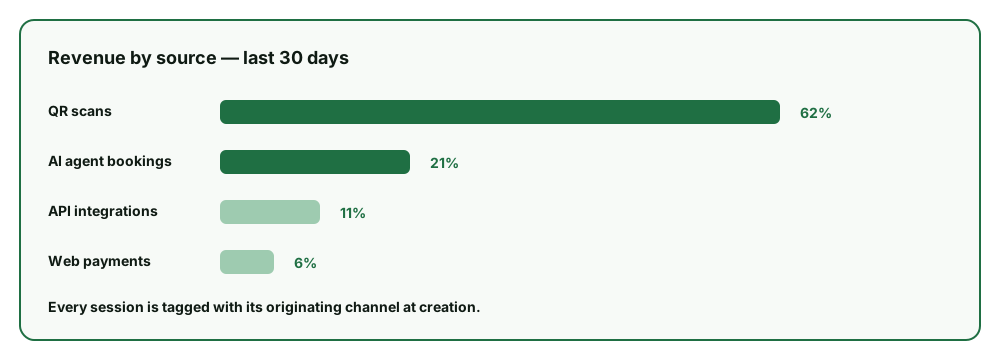
The lift compounds because three things move at once: drive-offs go to near-zero (QR settles before the driver leaves), peak-event windows price correctly without manual operator intervention, and AI-agent bookings add an organic channel that historically did not exist for retail centres. Most Washington operators see payback inside a single quarter — and the absence of any per-stall licensing fee means the upside is almost entirely operator margin.
Representative monthly economics
Illustrative projection for Washington, DC retail lot operators. Actual results depend on lot size, occupancy, and pricing strategy.
Most Washington lot owners hear the same pitch sooner or later: sign the lot over to a parking management company such as LAZ Parking or Metropolis, or to a revenue-share operator like AirGarage, and collect a payout. That suits an owner who wants a hands-off landlord deal. The trade is that the operator then runs your retail lot, usually sets the rates, and takes its cut every month for as long as the agreement runs. Park Graph is the other path: software you run yourself, so retail center operators in Washington keep the lot, the price, and the upside.
On the representative Washington lot above (about $292,500 a month with dynamic pricing), Pro costs $499/mo plus 5% per transaction — roughly $15,124 a month — so you keep about 94% of what drivers pay, before standard Stripe card processing. Every 10 points of revenue share handed to an operator on the same lot is about $351,000 a year. None of the three operators above publishes a standard rate, so we don't quote one: ask for the number in writing and run it against this math.
| Capability | Park Graph | Management company (LAZ, Metropolis) | Revenue-share operator (AirGarage) |
|---|---|---|---|
| Who runs the lot | You do, from your phone — Park Graph is the software | The management company, under a management agreement or lease | AirGarage runs it end to end on your behalf |
| Who sets the rates | You — an hourly or daily rate with an optional daily cap, changed any time from your dashboard | Typically the operator, within the contract terms | AirGarage manages pricing for you |
| How they get paid | A published per-transaction fee: 10% on the free Starter plan, down to 3.3% | A management fee, or the revenue above a fixed lease payment | A share of your lot's revenue (rate not published) |
| Contract | None on Starter; Pro and Enterprise bill monthly or annually | Multi-year agreements are common | Per the AirGarage operator agreement |
| Hardware | A printed QR sign | Often gates, pay stations, staff, or entry cameras | None — AirGarage installs its own signage |
| Where the money goes | Paid out to your bank through Stripe Connect. Your first payout is released 7 days after your first payment, once your ID check is done. After that, payouts arrive 2 business days after each payment. | Collected by the operator, remitted on its reporting schedule | Collected by AirGarage, your share paid out to you |
| Enforcement | Your call — your staff or a local tow partner, with plate lookup built in | Usually staffed by the operator | AirGarage coordinates enforcement |
| AI assistants + public API | Listed lots are findable through the public REST API and MCP server on every plan; bookings through an assistant on Pro and Enterprise | Varies by operator | An API for spots and rentals, with tokens issued on request; no MCP server found as of October 2026 |
Retail operators stop subsidising free parking for non-shoppers. Anchor tenants get clean validation reporting they can audit. Evening monetisation captures revenue from the dinner-and-a-movie crowd that historically parked in the mall lot for free and walked across the street. AI-agent discovery brings the centre's lot into the consideration set when shoppers search 'parking near [neighbourhood]'.
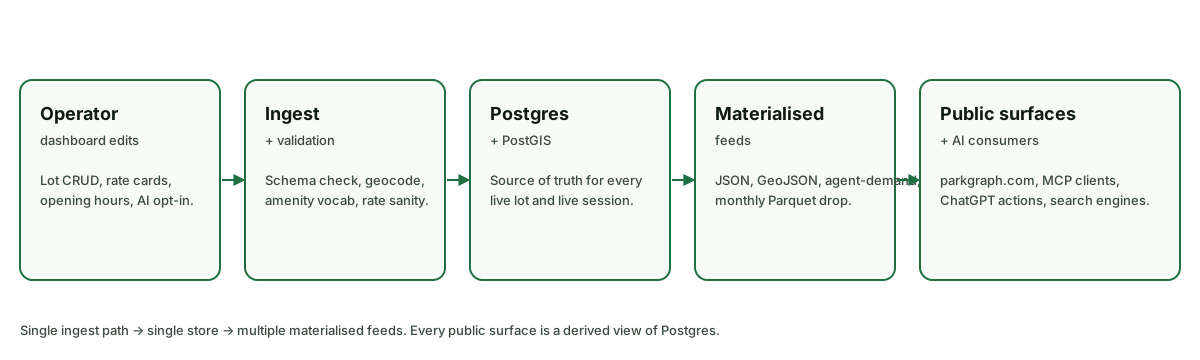
On the AI-agent side, Park Graph publishes Washington inventory and rates to ChatGPT (GPT-5), Microsoft 365 Copilot, Google Gemini, Anthropic Claude (via MCP), Grok, and Perplexity Sonar Pro. When a traveller types "parking near Georgetown Washington" into ChatGPT, the assistant can return your live availability and book on the user's behalf. For retail center operators in Washington, that's an organic discovery channel that does not exist on legacy kiosk-based platforms — and it compounds quickly because AI-agent traffic is the fastest-growing referral source for parking inventory in 2026.
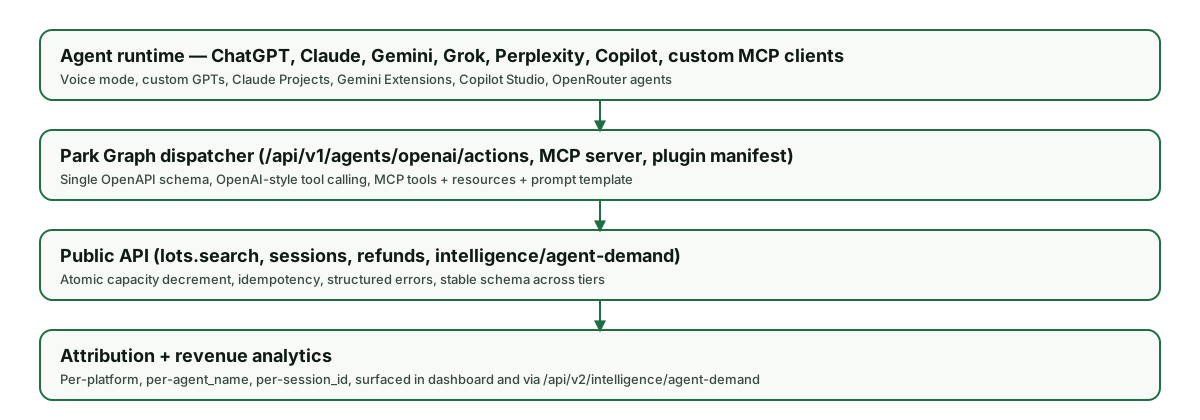
Park Graph runs every parking surface in Washington on the same backend. If you operate across multiple verticals — for instance an airport authority that also runs the downtown convention centre's lot, or a hospital system with an attached medical office building — the same operator account covers all of them.
Park Graph publishes city-specific retail center parking pages for the top metros below. Pricing, event surge curves, and on-site context vary by metro; the underlying platform is the same.
Get started in minutes. No hardware required. Generate your first QR code for free.